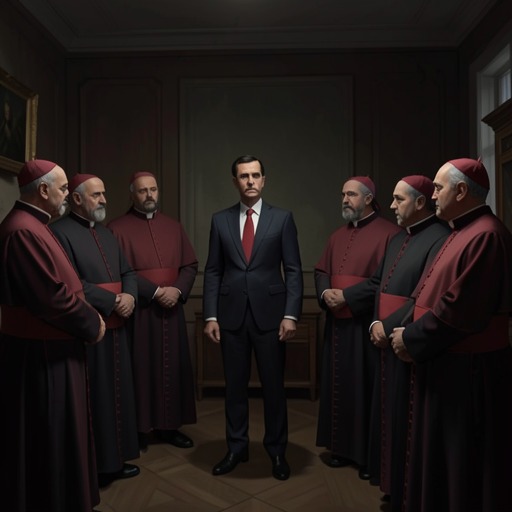
Vittorio Scavizzi
ConclaveVittorio Scavizzi is the ninety-four-year-old Vicar General Emeritus of Rome and the cardinal chosen to deliver the second meditation immediately before the first ballot of the conclave. Though too old to vote, he uses this final address to challenge Jacopo Baldassare Lomeli’s call for doubt and tolerance, arguing instead for unity, doctrinal firmness, and a Church that moves the world rather than follows it. His intervention turns a prescribed moment of reflection into a pointed political statement, and the silence that follows leaves the electors to begin voting under its shadow.
Identity and Selection
Scavizzi is described as the Vatican’s oldest resident and, at ninety-four, belongs to the group of cardinals ineligible to cast a ballot. The College chooses him soon after the late Pope’s funeral to give the second meditation, a private address prescribed by the Apostolic Constitution immediately before voting begins. Its stated purpose is to remind the electors of their responsibility to act with the right intention for the good of the Universal Church. The custom of assigning the meditation to a cardinal over eighty also gives the old guard a place in the proceedings, even though its representative cannot vote.
Jacopo Baldassare Lomeli cannot recall how the choice of Scavizzi was made. He suspects the proposal may originally have come from Tutino, whose own political position had shifted: the Prefect of the Congregation for Bishops was under investigation over an apartment extension and was planning to transfer his support to Goffredo Tedesco. The possibility that this appointment had factional origins gives Scavizzi’s ceremonial role a political edge before he speaks. Lomeli watches him approach the microphone with a sudden premonition of trouble.
The Second Meditation
Scavizzi is helped toward the microphone by Archbishop Mandorff. His body lists to one side, and he grips his notes in an arthritic hand, but his narrow eyes are bright with resolve. He pulls the microphone toward him, and the amplified thumps echo around the Sistine Chapel. After a short pause, he begins speaking in a laboured rasp, asking the cardinal brothers to attend to the Lord’s words at this moment of responsibility.
His argument turns directly on Lomeli’s homily that morning. Scavizzi recalls Lomeli’s use of St Paul’s Letter to the Ephesians in support of doubt, and presents that appeal as a troubling mistake: the modern world, he insists, does not need more doubt. He instead emphasizes Paul’s call for unity in faith and knowledge of Christ, so that believers will not be swept about by changing doctrine. The address thus answers Lomeli not indirectly but in front of the assembled electors, making theological disagreement part of the conclave’s opening scene.
Scavizzi develops the contrast through the image of the Church as a ship. The electors, he says, must choose a captain who will ignore the doubters and hold the rudder fast. He warns against the dictatorship of relativism and against accommodating the Church to passing movements and modernist fashions. The alternative he proposes is not a Church that moves with the world, but one that moves the world. He closes by praying that the Holy Spirit direct the deliberations toward a pastor who will end what he calls recent drift and lead the Church back to knowledge of Christ, love, and joy.
Departure and Political Effect
When he finishes, Scavizzi releases the microphone; the amplification produces another sharp sound in the chapel. He bows toward the altar and, leaning heavily on Mandorff, limps down the aisle. The electors watch in complete silence. He looks at no one, including Tedesco, who is seated in the front row across from Lomeli. The address’s effect is registered less in an immediate reply than in the room’s stillness and in the conspicuousness of Scavizzi’s departure.
As Scavizzi and Mandorff pass behind the screen, their footsteps remain audible in the vestibule, followed by the opening and closing of the Sistine Chapel doors and the turn of a key in the lock. The conclave’s physical confinement resumes, but the speech has already framed the choice before the electors: firmness and unity against doubt and accommodation. Lomeli then understands why the Patriarch of Venice had seemed so cheerful. Tedesco had known what was coming; Lomeli considers it possible that he had even written the address. The narrative leaves that authorship as a suspicion, not a confirmed fact, but Scavizzi’s meditation plainly serves as a powerful intervention in the contest.
Significance in the Conclave
The second meditation is formally a reminder of responsibility before voting, yet Scavizzi gives it the force of a rebuttal and a campaign argument. His age and inability to vote do not make him politically irrelevant: the College’s tradition gives him a platform at the exact point when the electors are about to choose, and he uses it to define the stakes in sharply contrasting terms. By opposing Lomeli’s rhetoric of doubt with a call for doctrinal unity, Scavizzi brings the conclave’s ideological division into the open before the first ballot.
The scene also binds procedure to factional maneuvering. A prescribed address, delivered by an elder who cannot participate in the vote, becomes a means of influencing those who can. Tedesco’s apparent foreknowledge—and the possibility, left unresolved, that he helped compose the speech—makes the episode an early sign that the formal rituals of election are entangled with political strategy. Scavizzi exits without looking at the candidate most closely associated with the address’s apparent political effect; the electors remain inside, locked in, with his challenge still shaping the decision ahead.