Joshua Adeyemi
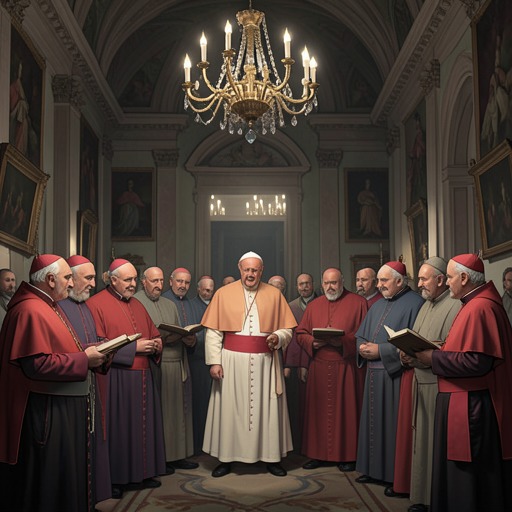
ConclaveJoshua Adeyemi is the Nigerian Cardinal Major Penitentiary and a leading candidate to succeed the late Pope. He enters the conclave with a formidable base among African electors and the symbolic possibility of becoming the first Black pope; for a time, his support makes that possibility tangible. His candidacy collapses, however, when Sister Shanumi confronts him over their past and the child born from it. The contrast between his carefully maintained public dignity and the personal history he denies makes his arc a study in how power, reputation, and responsibility collide.
Identity and Background
Adeyemi is one of the four senior cardinals present when the late Pope’s body is discovered, serving as Cardinal Major Penitentiary, or confessor-in-chief. His office places him among the Church’s highest-ranking figures, and his conduct in the initial crisis shows a practiced concern for public presentation: he returns his glasses to his face with deliberate composure and insists that the late Pope’s full schedule be included in the official account. In his view, the record should show how hard the Pope had worked, leaving no reason for people to suspect that he had been ill.
His politics make him a compelling but difficult candidate. He is associated with attacks on global capitalism and homosexuality, positions likely to win support in Africa while limiting his appeal in America and Europe. The narrative presents his candidacy as carrying a possibility that fascinates the media: the election of the first Black pope. That symbolic weight complements, but does not replace, the practical challenge of building support beyond his home region.
Building a Candidacy
As cardinals arrive in Rome, Adeyemi moves among the African electors with the assurance of a natural leader. He gathers a group of them after meeting them near the Palace of the Holy Office, points out the surrounding buildings as they cross the piazza, and brings them to the Dean for their formal welcome. Even older and more experienced African cardinals defer to him. The Dean expects the African electors to vote as a solid bloc for Adeyemi, but recognizes that African unity alone would not be enough: Europe’s fifty-six electors remain dominant, and Adeyemi’s social positions risk alienating voters outside Africa and the developing world.
The competition is not simply a contest of doctrine or reputation. When the first ballot fails to settle the choice, the cardinals’ private conversations turn toward the arithmetic of reaching seventy-nine votes. Adeyemi is invited to test his views with conservative archbishops from Eastern Europe, an indication that his campaign is seeking support beyond its presumed regional base. At the same time, his prominence depends on an image that must hold across audiences: the forceful African churchman whose potential election represents a historic change, and the candidate whose positions may divide the wider electorate.
His support grows sharply in the third ballot. As the votes are read, Adeyemi’s name recurs so frequently that the Dean says a prayer for him. The tally gives Adeyemi fifty-seven votes, ahead of Goffredo Tedesco on thirty-two and Joseph Tremblay on twelve. The numbers mark him as the clear front-runner at that point, but not as elected; the ballot instead makes the personal and political stakes of his candidacy more exposed.
The Confrontation with Sister Shanumi
After an incident involving Sister Shanumi, Adeyemi refuses to discuss her in private with the Dean. In his room, he adjusts his zucchetto, flicks dust from his mozzetta, and straightens his pectoral cross before insisting that he is the target of a plot intended to ruin his reputation. He says he has not seen her for thirty years and did not recognize her when she appeared outside his room. He treats the manner of her arrival at the Casa Santa Marta as the central question; the Dean replies that their relationship matters more.
The account Sister Shanumi gives the Dean changes the meaning of the confrontation. She says that when the relationship began she was a child and only a postulant, while Adeyemi was the community’s priest. The Church arranged for the child’s adoption. After the birth, Shanumi wanted acknowledgment of what had happened, but Adeyemi was transferred to a parish in Lagos and her letters were returned unopened. When she saw him again at the Casa Santa Marta, he told her they must forget the past. His refusal to look at her in the dining room, followed by the news that he might soon be elected Pope, preceded her public distress.
A small photograph embodies the years of silence. Shanumi has kept an image of the boy, about six or seven years old, folded to the size of a postage stamp; repeated folding has left deep creases across its surface. Her account recasts what Adeyemi describes as a staged political attack as a return of unresolved personal harm. It also puts the burden of guilt in a different place: Shanumi tries to confess an inventory of sins, while the Dean questions what she has to confess and where responsibility lies.
Adeyemi initially retains the bearing of a wounded but imposing figure. Then, as the Dean watches him, that composure gives way: he sits on the edge of his bed and clasps his hands over his head. The collapse is not an election result in itself, but his explanation no longer controls the story. The disclosed history has undercut the public image on which his candidacy rests.
Conclave Politics and Public Image
Adeyemi’s trajectory unfolds among rival campaigns that use different forms of influence. Tedesco argues for restoring Latin as a common language, framing modern reform as a change that may produce the opposite of its intended improvement. Tremblay presents himself as an informal, accessible candidate while using daily meetings, press appearances, and his office as Prefect of the Congregation for the Evangelisation of Peoples to maintain visibility and build goodwill among electors from poorer countries. Adeyemi’s route to support is more openly tied to his stature among African cardinals and to his conservative social positions.
The meal after the first ballot makes the electoral machinery visible. Though the papal constitution forbids electoral agreements, the cardinals begin to count who can reach seventy-nine votes. Tedesco works among South American electors, Tremblay listens to South-East Asian cardinals, and Adeyemi is invited to speak with conservative Eastern Europeans. His candidacy has reached beyond Africa, but the negotiations also reveal how much depends on relationships and coalition-building rather than on symbolic promise alone.
The late Pope’s efforts to demand financial transparency form another part of the political atmosphere in which Adeyemi’s candidacy develops. Aldo Bellini describes the Pope’s insistence on proper accounts, disclosure, outside tenders, and receipts, followed by investigations and damaging leaks. He says that Tedesco and his allies attacked the Pope over statements on gay people, divorced couples, and women’s advancement, leaving the pontiff increasingly isolated within the Holy See. These wider institutional disputes do not establish Adeyemi’s role in the financial controversies, but they show the embattled Church in which his bid for the papacy takes place.
Collapse and Final Accusation
Once Sister Shanumi’s story is known, Adeyemi’s rise has a different ending. The third-ballot tally had placed him well ahead, and he had seemed capable of carrying a historic candidacy into the final stages. The disclosure forces the electorate to see beyond the regional strength and public stature that had made him a front-runner. His failure is not portrayed as a simple reversal of votes: it is also a confrontation with a past that he had sought to contain through silence and denial.
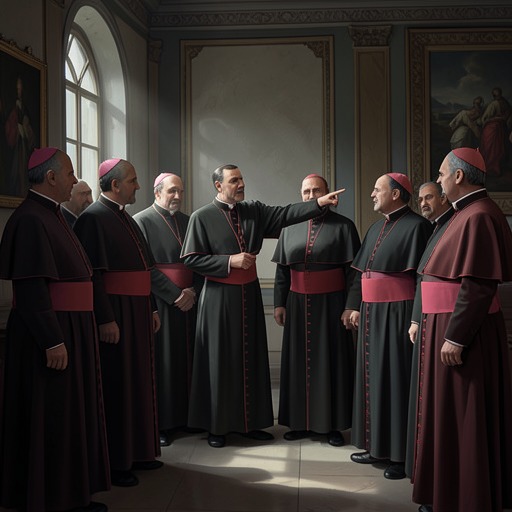
Adeyemi’s last defining gesture turns his attention from his own exposed history to Tremblay. In the dining room, Sister Agnes publicly confirms that Tremblay had requested Sister Shanumi’s transfer to Rome. Tremblay responds that he made the request because the late Pope asked him to, and swears that he did not know who she was. After several seconds of silence, Adeyemi rises and points at Tremblay, calling him a Judas. The accusation gives Adeyemi a final public act of judgment, but the evidence establishes the gesture and its immediate context, not what further political or personal consequences it will bring.
Narrative Role
Adeyemi’s story connects the mechanics of the conclave to the question of who bears responsibility when institutional authority and private history meet. His regional following, historic symbolic importance, and rapid rise in the ballot make the fall of his candidacy consequential; Sister Shanumi’s account then shifts the reader’s attention from electoral arithmetic to the human cost hidden behind a candidate’s public image. His composed gestures in private, the worn photograph in her testimony, and his final denunciation of Tremblay trace a movement from managed appearance to public rupture. The movement does not resolve the wider conclave or settle the accusation against Tremblay; it leaves Adeyemi as both a collapsed contender and a witness to the political use of Shanumi’s arrival.