Vincent Benítez
ConclaveVincent Benítez is a Filipino missionary priest whose work in Manila and the Democratic Republic of the Congo precedes his appointment as Archbishop of Baghdad and secret elevation to the College of Cardinals. His unexpected arrival at the conclave exposes both a legal question about who may participate and a moral one about what makes a candidate worthy: Benítez carries little institutional visibility, but the people who have heard of his work regard him with deep respect. His support for Jacopo Baldassare Lomeli ultimately becomes an explicit appeal for the electors to unite behind the dean.
Identity and Background
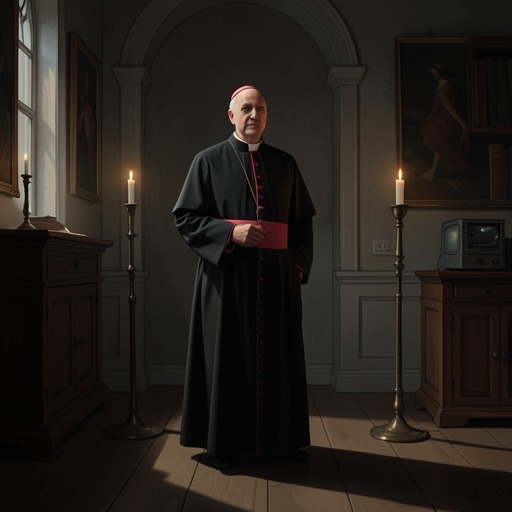
Benítez is introduced as the Filipino Archbishop of Baghdad, appointed the previous year by the late Pope. His elevation to cardinal had been kept secret under the practice of in pectore appointment, so even Lomeli, Dean of the College of Cardinals, had not been informed. The late Pope had revised the relevant canon law shortly before his death; the appointment’s secrecy was therefore not, by itself, proof that Benítez lacked the standing of a cardinal. A letter of appointment addressed to the archdiocese of Baghdad and its seal supported his claim, while the election rules allowed a cardinal-elector arriving before a new pope had been elected to join the process already under way.
The Vatican Press Office’s biographical note identifies Benítez as sixty-seven, born in Manila, educated at San Carlos Seminary, and ordained in 1978 by Cardinal Jaime Sin. He first served at Santo Niño de Tondo and Our Lady of the Abandoned Parish in Santa Ana. His ministry took him from parish work into places and communities poorly served by ordinary Church structures, a trajectory that helps explain why his reputation preceded his personal acquaintance with many of the cardinals.
Missionary Work and Papal Appointment
In Manila, Benítez established eight shelters for homeless girls through the Project of the Blessed Santa Margherita de Cortona. His work in the city’s poorest districts and his efforts to build rescue missions for victims of street gangs became part of the reputation that followed him. At dinner during the conclave, Cardinal Mendoza described him as a legend in the Manila diocese; Cardinal Ramos joined in welcoming him, though neither had previously met him.
After the assassination of Christopher Munzihirwa, the former Archbishop of Bukavu, Benítez requested a transfer to the Democratic Republic of the Congo in 1996. There he undertook missionary work and established a Catholic hospital in Bukavu for female victims of sexual violence during the First and Second Congo Wars. His African ministry also included clinics and shelters for women and girls affected by the continent’s civil wars. African cardinals welcomed him with comparable reverence, even though his work had been carried out in remote places and often outside the Church’s traditional institutional structure.
The late Pope met Benítez during an African tour in 2017 and was impressed enough to create him monsignor. When the Baghdad archdiocese became vacant, he rejected three nominations proposed by the Congregation for Bishops and insisted on appointing Benítez. In 2018 Benítez became Archbishop of Baghdad; the following year, the late Pope secretly admitted him to the College of Cardinals. The archdiocese was small, with barely more than two thousand members, and Benítez’s rapid rise from missionary priest to archbishop had no ordinary intermediate stage. The sequence points to deliberate papal patronage of a man whose service, rather than a long career in the Curia, had made him notable.
In January of the year of the conclave, Benítez offered to resign on medical grounds after sustaining minor injuries in a car-bomb attack, then withdrew the offer following a private meeting with the late Pope in the Vatican. The available file on him was otherwise remarkably scant. His sudden appearance in Rome thus joins an unusually well-attested record of service to a limited documentary trail and an appointment whose terms had been deliberately concealed.
Arrival at the Conclave
Benítez’s arrival requires Lomeli and the other officials to decide whether an unfamiliar visitor may take part in the election. Lomeli initially questions why the late Pope would have made such a sensitive appointment without consulting the Secretary of State. But the appointment letter, the seal, and the governing canon law establish a basis for recognizing him. The rules give practical force to a decision that secrecy had kept hidden: Benítez can join the election before it has concluded.
When Lomeli first meets him, Benítez is described as slender and exhausted, with a quiet, precise manner. At dinner, Lomeli leads him to his fellow countrymen, Cardinal Mendoza and Cardinal Ramos. The welcome soon extends beyond them. Cardinal Muamba introduces Benítez to the African cardinals, who rise in turn to greet him. Their regard rests not on personal familiarity but on the accounts of his ministry: a missionary’s work in Manila, Africa, and Baghdad has earned recognition across communities he has served without climbing the usual ladder of Church appointments.
Benítez’s arrival also changes the election’s calculations. The conclave is already shaped by factions around Cardinal Bellini, Cardinal Tremblay, and Cardinal Adeyemi. Yet Benítez does not fit neatly into that established contest. His authority comes from the late Pope’s exceptional intervention and from a reputation for service in dangerous and impoverished settings, not from a visible campaign for office. Lomeli watches the cardinals’ response and recognizes why the late Pope may have wanted such a figure brought into the College.
Support for Lomeli
Benítez’s first direct electoral gesture toward Lomeli is unexpected: he tells the dean that he voted for him. Lomeli is surprised, and the exchange establishes that Benítez is not merely a newly admitted observer or an ally of one of the better-known factions. He has made an independent judgment about whom he considers fit to lead the Church.
Later, Lomeli challenges him over the possibility that he might support Cardinal Tremblay. Benítez gives Lomeli a long, appraising look and asks whether the dean wants him to vote for a man Lomeli himself regards as ambitious. Lomeli assumes that Benítez’s close relationship with the late Pope means he would oppose Cardinal Tedesco, but Benítez’s answer is not simply an endorsement of one faction against another. He insists that he cannot vote for someone unless that person is, in his judgment, the most worthy candidate, and says that for him the choice is Lomeli, not Tremblay. When Lomeli again rejects his vote, Benítez maintains that he will give it and invites the dean to go to dinner with him as a friend.
That persistence gives Benítez’s support a particular weight. He is not described as pursuing the papacy for himself; instead, he presses Lomeli to accept a responsibility the dean has repeatedly resisted. His support makes personal discernment, rather than strategic convenience, the stated basis of his vote. It also sharpens the tension between Lomeli’s reluctance and the election’s need for a candidate able to unite the electors.
The Final Appeal and Election
After a later ballot, Benítez addresses the cardinals who have voted for him. He says that roughly two dozen electors have supported him, but argues that they should not prolong the election until the rules allow a pope to be chosen by a simple majority. With an evident leader emerging from the previous ballot, he asks his supporters to transfer their votes to Lomeli and urges the College to elect the dean when it returns to the Sistine Chapel. The appeal turns Benítez’s earlier private support into a public intervention in the outcome of the conclave.
Cardinal Tedesco objects that the electors risk treating the process as a political convention and insists that they must vote for the man they judge best fitted to be pope, not simply the candidate most readily presented to the crowd. The disagreement places Benítez’s appeal at the intersection of electoral strategy and spiritual discernment: he proposes a transfer of votes, but grounds it in his conviction about Lomeli’s fitness and the need to bring the prolonged election to an end.
After his election as Pope Innocent XIV, Lomeli declines to receive the traditional pledges of obedience while seated on the papal throne. Instead, he greets the cardinal-electors individually while standing before the altar, embracing them and offering particular words of comfort to those who had once hoped to become pope themselves. The gesture includes Benítez’s fellow contenders and establishes a policy of forgiveness rather than reprisals. The account does not specify Benítez’s individual exchange with the new pope, but his earlier support belongs to the election that ends with Lomeli chosen and the cardinals reconciled under his leadership.
Narrative Significance
Benítez’s career contrasts institutional advancement with ministry at the margins. His appointments are exceptional and depend on the late Pope’s intervention, yet the respect he commands is rooted in work among homeless girls, communities affected by conflict, and people living in places where the Church’s ordinary structures offer little guidance. His concealed elevation first appears as a procedural irregularity; as his history emerges, secrecy also becomes the means by which an unconventional missionary enters the electorate.
Within the election, Benítez acts as a moral and political counterweight to the established candidates. He arrives with no evident campaign of his own, casts his vote for Lomeli, refuses to treat electoral maneuvering as a substitute for judging a candidate’s worth, and finally calls on his supporters to back the dean. His role is not to settle the conclave alone, but to help convert the respect he has earned across regions into a concrete act of unity at a moment when the election risks continuing into further ballots.