Goffredo Tedesco
ConclaveGoffredo Tedesco is a cardinal whose traditionalist convictions make him one of the most consequential candidates in the contest to succeed the late Pope. A skilled churchman behind a deliberately rustic public image, he combines a formidable following with a forceful critique of reform. His role turns the election into a contest over not only who will lead the Church, but how its traditions and institutions should change—and whether unity can survive that disagreement.
Identity and Background
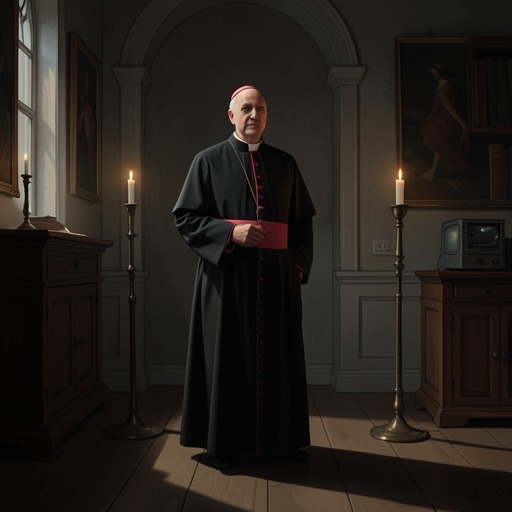
Tedesco is the Patriarch of Venice and a protégé of Ratzinger’s at the Congregation for the Doctrine of the Faith, where he served as the so-called Panzer Cardinal’s enforcer. His background is southern Italian: he comes from a peasant family in Basilicata and was the youngest of twelve children. His unpolished appearance suggests an ordinary laborer, but the impression is misleading. He holds two theology degrees and speaks five languages fluently; the apparent rusticity contrasts with both his learning and his command of Church politics.
He has stayed away from Rome since the Pope’s funeral, citing a severe cold. Few believe that explanation, and his absence adds to his mystique rather than diminishing his political presence. Tedesco needs little additional publicity: his influence among traditionalists already makes him a central figure in the succession.
A Candidate in the Succession
When the Pope dies, Tedesco is among the three cardinals already known to have organized support in the electoral college. His position as a leading traditionalist gives him a following distinct from the constituencies around Aldo Bellini, the liberal intellectual, and Joseph Tremblay, whose administrative office and missionary portfolio link him to a different range of electors. Tedesco’s candidacy is therefore not incidental to the contest: even before voting begins, his supporters make him a consequential alternative to the reform-minded candidates.
The conflict is personal as well as institutional. Bellini blames Tedesco for helping drive the late Pope’s critics to the point where some feared a schism, and says that Tedesco had, in effect, killed the Pope. That is Bellini’s accusation, not an established account of the Pope’s death. Jacopo Baldassare Lomeli nonetheless recognizes why Tedesco remains influential: he has a devoted traditionalist following and is bound to be a prominent candidate. Lomeli insists that Tedesco be informed of the death as a courtesy, despite Bellini’s anger, because leaving him to hear the news from a reporter could further inflame the situation.
Tradition, Reform, and the Case Against Change
At dinner, Tedesco sets out his opposition to reform through the example of Latin. He argues that abandoning the language was meant to make communication easier but has instead made communication among cardinals harder: in the dining room, they cluster according to their native languages, whereas Latin had once offered a common means of conversation at a conclave. His argument broadens from this example into a warning that change can produce the opposite of its intended improvement. He favors Latin even while acknowledging that his own command of it is poor, presenting its use as a symbolic point about what the Church has lost.
Tedesco’s disagreement with the late Pope is part of a wider struggle over the direction of the Church. The late Pope’s refusal of full papal regalia and decision to live at Casa Santa Marta became, in Bellini’s account, the opening moves in a pontificate marked by conflict. He demanded financial transparency, proper records, disclosure of accounts, outside tenders for building work, and receipts; he also brought in accountants and management consultants to review files. Bellini describes the ensuing leaks, the exposure of financial embarrassments, and Tedesco’s circle attacking the Pope over statements on gay people, divorced couples, and the promotion of women. Tedesco thus stands on the opposing side of a reforming papacy whose growing popularity outside the Vatican coincided, in Bellini’s telling, with increasing isolation within it.
That opposition does not mean Tedesco is portrayed as a simple caricature of reaction. He presents himself as a defender of continuity and warns that not all ideas deserve equal weight. In his view, accommodation to every new movement risks leaving the Church without a stable course. The force of his position lies in the way it joins a specific institutional argument—about language and liturgy—to a larger fear that reform may undo rather than renew.
The Conclave and Its Rhetoric
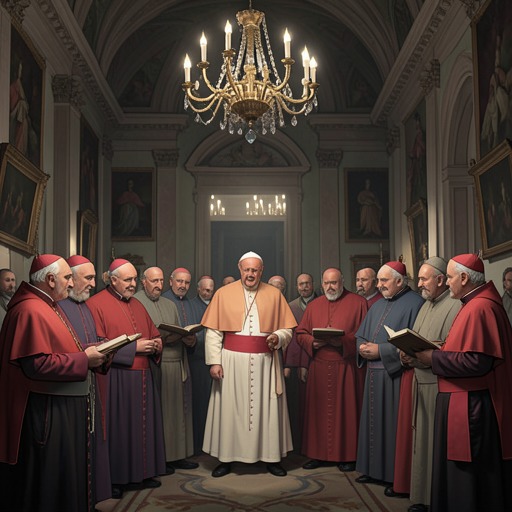
The election brings Tedesco’s traditionalism into direct view. In the Sistine Chapel, Vittorio Scavizzi delivers a denunciation of relativism and calls for a Pope who will end the recent drift. Tedesco sits in the front row, and Lomeli suspects that Tedesco knew what was coming and may even have written the address. The episode shows how his influence can operate beyond a speech of his own: the intervention aligns with his outlook and reaches the assembled electors at the moment the conclave closes around them.
As the cardinals maneuver for support, Tedesco moves among the tables, canvassing rather than waiting for voters to approach him. The contrast with Joshua Adeyemi is pronounced: Adeyemi stands aside while supporters bring electors to him, whereas Tedesco participates actively in the contest. The narrative also shows Lomeli becoming more alert to Adeyemi’s momentum, making Tedesco’s activity part of a wider struggle in which candidates project different kinds of authority—personal, organizational, and ideological.
Yet Tedesco is wary of turning that struggle into mere political management. When Bellini asks his own supporters to transfer their votes to Lomeli, Tedesco objects that the cardinals risk reacting to events as though they were at a political convention. He insists that the Holy Spirit cannot be summoned like a servant and reminds the electors that their oath is to choose the person they believe best fitted to be Pope, not simply the candidate easiest to present to the crowd. His intervention complicates his role as a partisan candidate: he has pursued support, but he also objects when the election appears to substitute expediency for discernment.
Reconciliation and Ending
After Lomeli is elected Pope Innocent XIV, the new pontiff refuses to receive the traditional pledges of obedience while seated on the papal throne. Instead, he stands before the altar and greets the cardinal-electors individually, embracing them warmly. He gives particular attention to Tedesco, as well as Bellini, Adeyemi, and Tremblay—the men who had at one time imagined themselves in his place—and pledges his support to each. The gesture makes the new Pope’s intention plain: there will be no recriminations or dismissals, and the Church will face the coming danger in a spirit of unity.
Tedesco acknowledges the gesture grudgingly, but his response marks a consequential change in the atmosphere around him. He does not withdraw his traditionalist convictions; rather, the new Pope offers him a place within a Church that has chosen a different leader. The election’s close therefore does not resolve the conflict between tradition and reform by erasing it. It answers the conflict, for the moment, with an act of personal reconciliation—and with Tedesco still present among those expected to share the Church’s future.