Joseph Tremblay
ConclaveJoseph Tremblay, the Camerlengo and a cardinal with a substantial constituency, enters the succession as a candidate whose appeal rests on both institutional position and a deliberately accessible public persona. He manages the Church during the vacancy, courts support among cardinals, and presents himself as a plausible bridge across regional and political divisions. But a report concealed among the late Pope’s papers turns his candidacy into a test of accountability: Lomeli confronts him with allegations of simony and a dismissal from office. The eventual election of Pope Innocent XIV does not end in public punishment. Instead, the new pontiff embraces Tremblay and pledges his support, making reconciliation part of the Church’s response to crisis.
Office, Background, and Candidacy
At the late Pope’s deathbed, Tremblay is identified as Camerlengo of the Holy See and one of the four senior cardinals present, alongside Aldo Bellini, Joshua Adeyemi, and Jacopo Baldassare Lomeli. The office places him at the centre of the immediate response: he tells Archbishop Janusz Woźniak that his first responsibility is to secure the Church’s integrity and says that he delayed notifying Lomeli so that the facts could first be established. He has a printed timeline ready, setting out the Pope’s final evening, the failed emergency treatment, and the time of death. His insistence on a consistent official account is presented as a precaution against rumours, though it also places him in control of information during a sensitive transition.
The cardinals’ initial political alignments make Tremblay a credible contender. He has links to the developing world through his position as Prefect of the Congregation for the Evangelisation of Peoples, while, as Lomeli observes, he can appear American without actually being one. His profile does not fit neatly into a single ideological camp: Lomeli characterizes him as a doctrinal liberal and social conservative, or perhaps the reverse. In contrast to Bellini, the remembered intellectual hope of the liberals, and Adeyemi, whose possible election would carry the symbolic force of becoming the first black Pope, Tremblay’s appeal combines his office, international connections, and personal presentation.
Managing the Vacancy and Building Support
Tremblay keeps himself visible throughout the vacancy. He convenes daily meetings of the cardinals in the Synod Hall and gives press conferences afterwards. Articles citing Vatican sources begin to credit his skilful management, while his role in the Congregation for the Evangelisation of Peoples gives him a more material connection to cardinals from poorer countries: they approach his office for funds for missionary work and for their living expenses in Rome before the Conclave. Lomeli recognizes how readily this combination of publicity and practical assistance can impress electors, even as he doubts whether the apparent signs of destiny mean anything.
His informality is part of the same public image. Lomeli sees him arrive alone from the direction of the Apostolic Palace with his choir dress in a dry-cleaner’s wrapper and a Nike sports bag over his shoulder. The scene supports the impression of a modern, unpretentious candidate, but it is set against the immaculate silver hair beneath Tremblay’s red zucchetto. The contrast makes his accessibility look carefully maintained rather than careless. At the same time, Tremblay’s political presence is not limited to press appearances: during an evening gathering, Lomeli observes him quickly pursuing the Patriarch of Lisbon after the latter leaves to smoke, while Bellini and Goffredo Tedesco move among the cardinals. Tremblay, too, is actively canvassing support.
He can also command a conversation by withholding attention. When Lomeli tries to approach him after dinner, Tremblay continues listening to the Archbishop of Colombo and responds with repeated assurances until the Archbishop himself points out that the dean wishes to speak. Tremblay then greets Lomeli warmly and calls the evening lovely. The exchange shows the tension between genial public manners and a calculated management of access: Lomeli senses that Tremblay knows he is waiting and hopes he will leave, but persists until he gets an opening.
The Late Pope’s Inquiry and the Confrontation
The account of the Pope’s death gives Tremblay an early procedural advantage. Woźniak tells Lomeli that, after the doctor summoned the Camerlengo, Tremblay arrived and took charge, as the rules required. About an hour later, Tremblay asked Woźniak what the Pope had said at supper. Woźniak, frightened and shocked, disclosed only that the Pope had seemed agitated; he later saw Tremblay whispering with the Pope’s private secretary, Hector Morales, and suspected Tremblay was persuading him to remain silent about the meeting. This is Woźniak’s account and suspicion, not an independently established finding, but it gives Lomeli reason to question whether the official handling of the Pope’s final hours left relevant information undisclosed.
The question of the Pope’s response to Tremblay becomes personal when Lomeli raises rumours that the Holy Father demanded his resignation from all his offices. Tremblay dismisses the story as nonsense and guesses that Woźniak is the source. Later, after Lomeli learns more about a report and the Pope’s final meeting with Tremblay, he tells him that he knows the Pope raised the matter, dismissed him from his posts, and that he now understands why. Tremblay’s composure falters: in the chapel’s half-light he sits abruptly and stares at the crucifix without answering. Lomeli speaks to him as a friend, acknowledging his wish to serve God while arguing that he mistakes his abilities for fitness to become Pope.
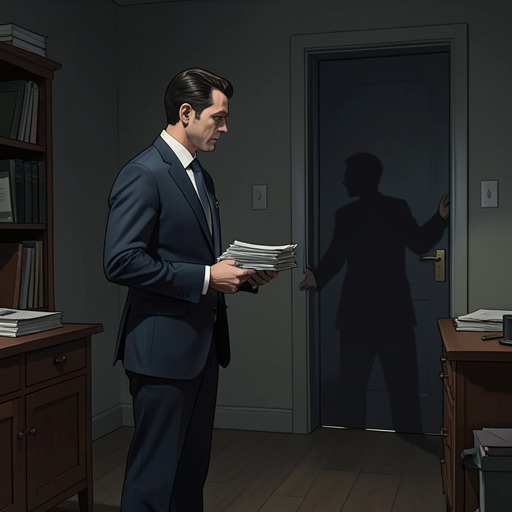
The documents Lomeli finds in the late Pope’s room give the conflict a financial dimension. Hidden in a wooden case inside a bedpost are statements, transfers, addresses, and the Pope’s handwritten annotations. An attached report estimates the APSA property portfolio at 347,532 square metres, with a potential value above €2.7 billion but a stated book value of €389.6 million; it says that a paid occupancy rate of only 56 percent appears to indicate that much income is not being properly declared. The pages also list the apartments of senior church figures, including Tremblay’s 510-square-metre residence. These figures do not by themselves establish Tremblay’s personal guilt, but the report Lomeli later shows Bellini specifically concerns the activities of Tremblay as prefect of the Congregation for the Evangelisation of Peoples.
Lomeli describes the report as an overwhelming prima facie case of simony and alleges that Tremblay bought votes on the first ballot, mostly from cardinals in Africa and South America, paying them in cash during the previous twelve months. The evidence as presented in this confrontation is an accusation, and the narrative does not establish a trial or formal adjudication. Bellini initially resists engaging with the pages, while Lomeli stresses the seriousness of the charge: the contest is no longer simply a dispute between candidates but a question of whether church office and electoral support have been corrupted by money.
Election, Exposure, and Reconciliation
Tremblay’s candidacy remains consequential even as the allegations gather force. The narrative depicts him as a contender with supporters inside the College of Cardinals, a prominent public profile, and practical influence over cardinals seeking funds. Lomeli’s private confrontation and the report’s circulation challenge that standing, but the evidence does not describe a final public judgment against him before the election. The conflict therefore remains entangled with the larger question of how the Church should proceed when its election, leadership, and internal finances are under suspicion.
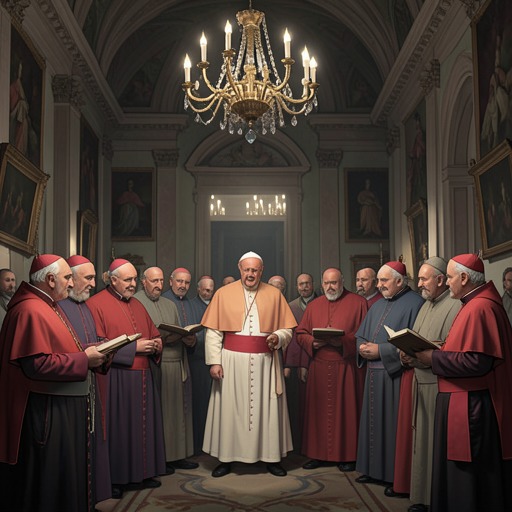
After Pope Innocent XIV is elected, Tremblay is among the former contenders the new pontiff embraces individually while standing before the altar. The Pope receives the cardinal-electors’ pledges there rather than seated on the papal throne, and gives Tremblay, as well as Bellini, Tedesco, and Adeyemi, words of comfort and admiration and a promise of support. The gesture makes clear that no one will be dismissed and that the Church will face the days ahead in a spirit of unity. Tremblay’s arc thus ends not with an account of punishment or vindication, but with the new Pope’s deliberate refusal of recrimination: the allegations have made his candidacy morally fraught, yet his place in the community is retained under a policy of forgiveness and institutional unity.
Character and Narrative Significance
Tremblay’s character is drawn through a recurring gap between office and appearance. As Camerlengo he invokes responsibility for the Church’s integrity and prepares a precise chronology; as a candidate he cultivates an approachable style, keeps himself before the press, and maintains access to resources sought by electors. Lomeli’s observations repeatedly complicate the image of the informal, capable administrator: the man with a sports bag is also a disciplined operator, and the friendly greeting can follow a calculated delay in conversation. The novel does not reduce his public appeal to fraud, but it places that appeal beside evidence and allegations that make the exercise of his authority open to scrutiny.
The conflict also links personal ambition to institutional oversight. The late Pope’s financial reforms had demanded transparent accounts, receipts, outside tenders, and professional scrutiny of the Curia’s files; the report against Tremblay emerges from the broader effort to discover whether church income and property are properly accounted for. In that setting, the alleged purchase of votes is not merely a private moral failing: it would turn the machinery of election and missionary administration into instruments of private advantage. Yet the ending resists a simple triumph of accusation over accused. Pope Innocent XIV’s embrace of Tremblay leaves accountability unresolved in the evidence while making reconciliation a visible first act of the new pontificate.