American Medical Association
DopesickThe American Medical Association is presented as a professional voice questioning whether pain should continue to be treated as the “fifth vital sign.” Its call for removal, reported in 2016, marks a reassessment of a framework that had made pain measurement central to clinical practice while the consequences of expanded opioid prescribing were becoming harder to ignore.
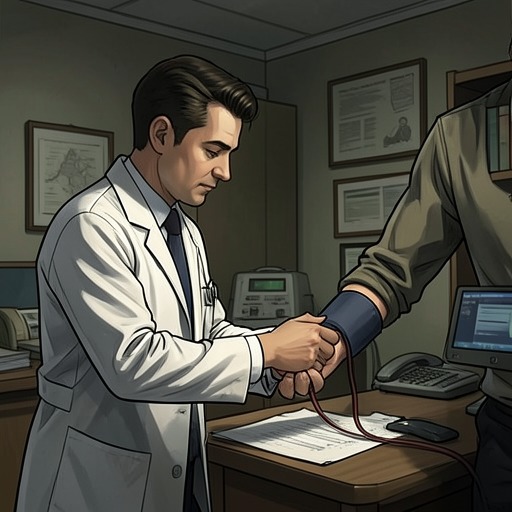
The Fifth Vital Sign
When OxyContin was introduced in 1996, medical practice was already moving toward treating pain as equal in importance to blood pressure, heart rate, respiratory rate, and temperature. Hospitals and accreditation bodies adopted new standards for assessing and treating it; in 1999, the Joint Commission approved mandatory pain-care standards. The American Medical Association’s later call to remove pain’s status as the fifth vital sign therefore concerned an established medical framework, not simply a slogan.
That framework also developed amid pressure to treat pain more assertively. Patients rated their health-care experiences in formal surveys, and hospitals and clinicians competed for high scores that could affect reimbursement. The book describes how these incentives encouraged more liberal pain treatment, while Purdue Pharma presented opioid prescribing as responsible care and promoted OxyContin for conditions extending well beyond cancer pain. Its sales effort also sought to associate the company with the new hospital standards through branded materials and pain-assessment resources.
Measurement and Prescribing
Pain scales offered a way to standardize assessment, but the book emphasizes the limits of what they measured. Pain is subjective: very different experiences could receive the same numerical rating depending on a patient’s tolerance. The apparent precision of a scale did not establish that treatment had improved outcomes. The book instead links reliance on pain scores with increased opioid prescribing and abuse, while noting that the meaning of adequate relief remained unsettled.
The account also records clinicians’ retrospective doubts. John Burton, then head of emergency medicine for Carilion Clinic, recalled that physicians had been instructed to make pain a much higher priority and said this increased opioid prescribing without a sufficient understanding of the consequences. He also recalled believing that a two-week supply of opioid pills could not lead to dependence, a belief he later recognized as wrong. These reflections show why questioning the fifth-vital-sign framework carried stakes beyond terminology: assessment rules could influence prescribing habits, even when their effects on patient outcomes were uncertain.
The Association’s Intervention
A 2016 report cited by the book describes the American Medical Association as urging that pain be removed as the fifth vital sign. The evidence establishes the association’s position, but does not detail the proposal’s wording, the process by which it was adopted, or the full reasoning behind it. Its significance in the narrative is the timing: the call appears as medical practice was confronting the risks of treating pain scores as a straightforward guide to medication.
The surrounding discussion also points to continuing questions about opioid use in routine care. A separate cited review concerns the frequent prescription of opioid painkillers after surgery and the fact that patients commonly leave some of those medications unused. The book does not attribute that research to the American Medical Association; rather, it places the association’s call within a broader reconsideration of pain assessment, prescribing, and the assumptions linking a measured pain score to a need for opioids.
Significance in the Book
The American Medical Association’s appearance provides a marker of institutional reconsideration. The earlier standards helped make pain more visible and actionable in hospitals, responding to concern that patients had been undertreated. Yet quantifying pain and elevating its priority did not, by themselves, determine what treatment was appropriate or demonstrate better outcomes. The association’s 2016 call brings that tension into view: a system designed to correct neglected pain also needed to examine how its measures and incentives could contribute to excessive opioid use.