Remote Area Medical
DopesickRemote Area Medical (RAM) is a large, free medical outreach event for uninsured people in rural southwest Virginia, where a three-day gathering each summer brings medical, dental, and eye care to the Wise County Fairgrounds. Teresa Gardner Tyson and the Health Wagon help plan and host it. The event offers immediate services to people with few reliable alternatives, but its crowded, makeshift clinics also reveal the depth of the region’s unmet needs and the strain placed on volunteers who try to meet them.
The annual outreach
Once each summer, RAM occupies the Wise County Fairgrounds for a three-day weekend. More than three thousand people may camp there for days in heat reaching 100 degrees, waiting for care in a clinic assembled from bedsheets and clothespins. Patients sit in the fairground bleachers while volunteers distribute water and direct them to temporary medical, dental, and eye-care services. The scale makes the gathering more than a small mobile clinic: it is a concentrated response to needs that ordinary health-care access has left unmet across a wide rural region.
The people arriving for care span ages and circumstances. They include children with undiagnosed diabetes and adults who use walkers and need treatment for infected teeth. Some patients’ dental problems follow years of methamphetamine use; others lack dental coverage. In the book’s account, the fairgrounds become a place where gaps in insurance and routine care are not abstractions but visible queues for basic services. The event’s three-day duration and improvised facilities underscore both the determination behind the outreach and the limits of what a temporary clinic can provide.
Care amid overlapping needs
RAM’s services intersect with the region’s opioid crisis without being limited to addiction treatment. Craig Adams, a construction worker recovering from opioid addiction, brought his wife, Crystal, to the event so they could both have dental work. They had relied on temporary dental-repair products for so long that they had lost count. Adams had previously served eight years in the Virginia prison system after breaking into Randy’s Gateway Pharmacy in Richlands in an attempt to steal OxyContin. By the time he attended RAM, he was taking Suboxone and had not used illicit drugs for more than three years. His experience links a routine health need—dental care—to a history of addiction, incarceration, and recovery, without reducing the purpose of the event to any one of those conditions.
The event also provided specific responses to infectious disease and overdose risk. At RAM, hepatitis C testing was offered free for the first time. A pharmacy professor estimated that three-quarters of people who inject drugs in the region had contracted hepatitis C without knowing it. RAM also distributed take-home naloxone kits and trained almost four hundred people to use them. These services made the outreach relevant not only to people seeking immediate examination or dental care, but also to efforts to identify infection and respond to potentially fatal overdoses.
Planning and practical limits
The scale of the weekend depends on extensive preparation. Teresa Gardner Tyson was interviewed before and after the July 2017 event, as well as during the preceding months, while her organization helped coordinate and host it. In the weeks before the gathering, she handled media requests from as far away as Holland and made urgent calls to secure supplies. On one occasion, an organization the event normally relied on could not provide enough bottled water because its pallets had already been reserved for natural-disaster relief. The episode shows how basic logistics, alongside clinical services, could become a point of vulnerability for a crowd numbering in the thousands.
The physical conditions at the fairgrounds sharpen the contrast between the event’s reach and the region’s ordinary resources. Patients wait in bleachers; treatment rooms are pieced together from cloth and simple fasteners; volunteers distribute water as they guide people through temporary clinics. Rural overdose death rates were reported as 50 percent higher than urban rates, and a volunteer physician observing RAM argued that the patients’ overall health could be worse than the conditions associated with disaster relief elsewhere. The book presents that comparison as a measure of the accumulated health burden, not as a claim that one weekend of outreach could resolve it.
A temporary event and ongoing care
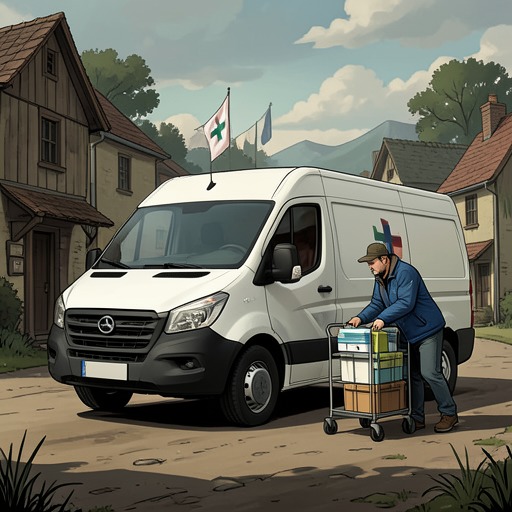
RAM works alongside, but is distinct from, the Health Wagon, the regional service that remains after the visiting outreach has ended. The Health Wagon was founded in 1980 by Sister Bernie Kenny, a Catholic nun and medical missionary who first provided care from the back of her red Volkswagen Beetle. By 2017, Tyson’s grant-funded staff of twenty continued tending to uninsured residents, including through a mobile unit that visited local communities. The contrast is important: RAM brings a large concentration of volunteer services to the area once a year, while the Health Wagon addresses needs between those annual visits with a much smaller continuing operation.
A fifty-four-year-old substitute teacher encountered by Tyson illustrates the difference between a free outreach event and dependable coverage. She had gone decades without insurance and relied on RAM events and occasional visits from the Health Wagon’s mobile unit. Her husband, disabled by a series of strokes, had Medicare, but she had no comparable coverage. She delayed seeing her family doctor until she was almost dying; the doctor offered a discounted cash visit for sixty-three dollars. Her reliance on occasional free care took place in Virginia, where lawmakers had not approved the Affordable Care Act’s Medicaid expansion. RAM could provide an important point of access, but it could not replace regular insurance or a stable local system of care.
The event’s significance lies in this combination of direct help and visible insufficiency. It brings examinations, dental services, testing, and overdose-prevention resources to people who might otherwise go without them, and it gives volunteers a way to respond to immediate needs. At the same time, patients’ long waits, improvised treatment spaces, and dependence on annual outreach make clear that charitable mobilization does not amount to continuous care. RAM stands as a substantial intervention in rural health, and as evidence of how much remains beyond the reach of a temporary clinic.