Hope Initiative
DopesickThe Hope Initiative was a Roanoke program that sought to turn police contact with people using opioids into a route toward treatment rather than another step into the criminal justice system. Conceived as a public-private partnership and staffed in part by trained volunteer mentors called angels, it tried to help people navigate a fragmented care system. Its promise and its limitations emerged together: families and volunteers could offer persistence, practical help, and human connection, but they could not by themselves create treatment beds, remove financial barriers, or settle disputes about what recovery should look like.
Origins and purpose
The program grew out of the concern of Chris Perkins, a Roanoke police chief nearing retirement, about the city’s rising heroin problem. After twenty-four years on the force, he was still monitoring crime reports around the clock and hoped to make the initiative his final major project. He looked to Gloucester, Massachusetts, where police chief Joseph Campanello had offered people a way to turn in drugs and seek treatment instead of facing arrest. By early 2017, the Gloucester model, the Police Assisted Addiction and Recovery Initiative, had spread to two hundred police agencies in twenty-eight states. Roanoke’s version became known as the Hope Initiative.
Perkins’s proposal attempted to change the point of contact between law enforcement and people with addiction. Rather than treating arrest as the default response, the program offered treatment on the condition that participants stay clean. The intended incentive was a chance to address addiction as a disease and, if participants remained sober, to leave them alone. Perkins also recognized a practical problem with relying on jail: many people returned to the streets with more drug contacts than they had before incarceration. His plan depended, however, on cooperation among health-care providers, criminal justice agencies, and community organizations that did not share a single approach or operate as one system.
Volunteers, families, and a local network
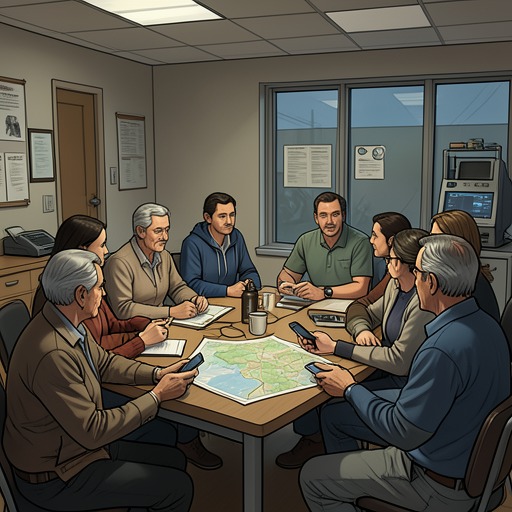
The Hope Initiative’s angels were meant to do more than hand out a list of phone numbers. Trained volunteers would help people find treatment, provide mentoring through a difficult and relapse-prone process, and connect them with local housing, mental-health, and employment resources. The model resembled an on-call recovery sponsor, with additional help navigating social services. The program was to operate at the Bradley Free Clinic, a long-running clinic for working people in Old Southwest, an area where heroin use was increasing.
The first volunteers brought personal knowledge of how addiction affected families. Janine Underwood, the clinic’s executive director, attended the first meeting not simply as the head of a nonprofit clinic but as the mother of Bobby Baylis, who had died after taking fentanyl-laced heroin. For years she had watched him move between rehabilitation and jail after becoming dependent on OxyContin prescribed following surgery for an injury. During a three-year prison sentence, he had participated in treatment and trained for work in heating and air-conditioning. After release, he returned to Roanoke, lived in his mother’s basement, and appeared to be doing well at his new job. Three months later, a visit with old friends ended in his fatal use of fentanyl-laced heroin. Janine became the first volunteer to commit to the Hope Initiative.
Jamie Waldrop, whose son Christopher was also affected by addiction, became the second. Her family and Janine’s had already been connected through the overlapping social and treatment networks of young people in Hidden Valley. The program’s volunteer group also included Terrence Engles, a former professional baseball player who had become a treatment consultant after his own progression from prescribed OxyContin to addiction and overdose. His role involved encouraging young adults to enter treatment, whether through a national provider for those with insurance or through the much more limited regional and charitable options. The volunteers’ backgrounds differed, but the work drew them into the same task: helping people find a place in a system whose services were difficult to locate and often unavailable when urgently needed.
Referral system and practical barriers
By early 2017, volunteers had spent months assembling a five-page spreadsheet identifying thirty-six rehabilitation and aftercare providers across the southeastern United States. The list was intended to match prospective patients with programs according to their finances and the availability of beds. People could visit the Bradley Free Clinic on the second Monday of each month and, if they had no outstanding warrants, be paired with trained volunteers to work through their care needs. Social-service workers were available to help eligible participants apply for Medicaid. Some volunteers also helped arrange outpatient medication-assisted treatment, although the angels themselves were divided about its value.
The spreadsheet made the available options visible, but it could not guarantee access. Treatment depended on a facility having an open bed, on the patient being able to afford care, and on institutional rules that shaped who could enter or remain in a program. In one attempted transfer, a Hope volunteer and a patient’s father arranged an out-of-state treatment placement, but the transition still depended on keeping the patient in detox for an extra day and arranging a family meeting elsewhere because the detox facility would not allow it on its premises. The episode illustrated how quickly a possible opening for treatment could narrow as a person moved between services.
The same difficulty appeared in the effort to create a smoother route from emergency care into treatment. Emergency physician Karen Kuehl and Hope Initiative coordinator Cheri Hartman explored a system modeled on Ontario, where overdose patients could be referred from emergency rooms directly to outpatient medication-assisted treatment and counseling. They encountered shortages of medication providers and detoxification and treatment beds, along with bureaucratic, financial, and legal obstacles. A grant intended to improve the handoff was unsuccessful. In the meantime, hospital social workers referred some patients revived after overdose to the Hope Initiative, leaving volunteers to help where a coordinated medical pathway did not yet exist.
Trust, treatment disagreements, and the limits of scale
The program also had to establish itself among people who might fear that seeking help would bring further punishment. At the clinic, police declined to intervene when participants used drugs in the parking lot, recognizing that enforcement there could deter people from coming for assistance. Janine Underwood, still grieving Bobby, was not initially a supporter of harm reduction or medication-assisted treatment, but she tried to remain open-minded. Volunteers received frequent calls and messages on their personal phones, including contact from grieving parents and from a young man who was suicidal. Janine’s work expanded beyond the role she had expected; after that man died before a planned visit, she said she felt that she had become a crisis center and was in over her head.
The first-month figures showed both contact and attrition. Twenty-two people came to the Hope Initiative. Volunteers saw signs of progress among some who repeatedly asked for help and stayed in touch, but none had entered residential treatment by the end of that month, and only a handful had obtained outpatient medication-assisted treatment. Janine became so exhausted that colleagues had to call emergency services after she passed out at work with stress-related vertigo. The gap between an initial encounter and sustained care was not a failure of effort alone: the program confronted limited capacity, complicated access, and the effects of addiction on a person’s ability to plan and follow through.
Disagreement about medication further complicated the pathway. Some angels believed it was wrong to treat addiction with another drug, despite evidence supporting medication-assisted care. The divide reflected a wider tension in the region: people could be connected to a volunteer and still face judgment or rejection in recovery settings because they used buprenorphine. The Hope Initiative could help arrange medication treatment, but it could not make every provider or mutual-support community accept it.
By the end of its first year, 132 people with addiction had come to the Hope Initiative; fewer than ten had entered residential treatment and remained sober. That outcome measured the distance between a referral and a durable treatment connection. It also clarifies the initiative’s significance in the book: the angels’ work made visible the labor required to cross gaps between police, hospitals, detox facilities, treatment providers, and families. The program offered a local bridge and a way to respond without making arrest the only available answer, but the bridge ended where the surrounding system’s capacity and rules took over.