Health Wagon
DopesickThe Health Wagon is a mobile health service for underserved communities in Virginia’s coalfields, where losing insurance, living far from a clinic, and having little money for care can turn ordinary medical needs into barriers. Founded in 1980, the organization’s work is presented through nurse practitioner Teresa Gardner Tyson and a grant-funded staff of twenty. Their mobile unit carried care along rural roads, but it could not repair the larger gaps in the safety net around it: the organization repeatedly met needs that public coverage and local services had not met.
Origins and Mobile Mission
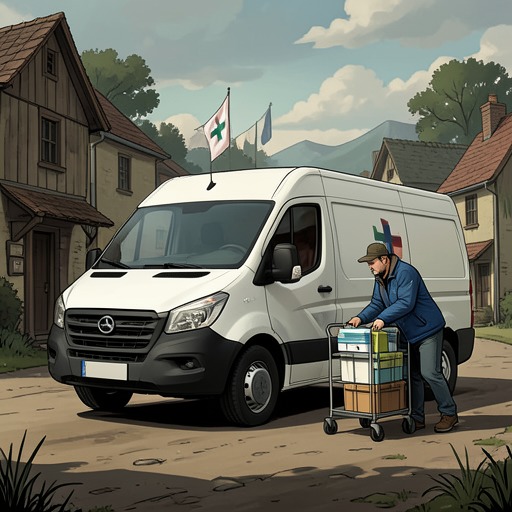
The Health Wagon began with Sister Bernie Kenny, a Catholic nun and medical missionary who had served as a midwife in Africa before volunteering in Appalachia. She first provided care from the back of a red Volkswagen Beetle. The organization’s name preserves that practical, itinerant model: medical care went out to people rather than requiring people to reach a permanent clinic. By the period described in the book, Sister Bernie had retired, but the mobile approach remained central to the work.
Tyson and the organization’s twenty grant-funded staff carried that mission across Southwest Virginia. Tyson traveled in a 2001 Winnebago, steering it along the region’s winding roads while managing calls from nurses, patients, and the media. The unit’s mobility allowed her to provide care in communities where residents might have few affordable alternatives. At different stops, the vehicle could be set up near a grocery store or a town square, bringing a medical service into the places where people lived and worked.
Care Amid Economic and Insurance Barriers
The Health Wagon’s patients were not simply underserved in the abstract; the book shows how its work intersected with declining wages, school closures, disability, and lack of insurance. At a stop in St. Paul, Tyson treated a substitute teacher whose daily pay had fallen from seventy dollars to fifty-six. The teacher had gone decades without insurance and relied on occasional visits to Tyson’s mobile unit and free care at Remote Area Medical events. Her husband, a former Walmart worker disabled by strokes, had Medicare. She delayed seeing her family doctor, who offered a discounted cash visit for sixty-three dollars, until she felt her condition was serious enough.
These circumstances were part of a wider contraction in the region’s safety net. Virginia had not expanded Medicaid under the Affordable Care Act, leaving people like the teacher to patch together intermittent care rather than depend on continuous coverage. The book describes Tyson and her staff as left to tend to the health needs of uninsured residents while political arguments over health coverage continued. The Health Wagon could bring a clinician to a community, but a mobile stop did not replace stable insurance, regular primary care, or the broader services patients needed.
The organization’s work also unfolded against the opioid crisis and its related health burdens. Tyson grieved for patients dying from untreated hepatitis C associated with injection drug use, as repeated failures to expand Medicaid constrained access to care. The account places the Health Wagon within a region where health needs were severe and resources stretched, rather than suggesting that a mobile clinic alone could resolve them. Its contribution was immediate and local: reaching people whom the existing system often failed to reach.
Field Work, Risk, and Adaptation
The mobile service depended on Tyson’s direct presence in communities, but that access could involve uncertainty and risk. In the former coal camp of Clinchco, neighbors rushed to the RV seeking help for a person in a home. Staff went inside to respond, only to learn that the patient they were initially preparing to assist was not the person the neighbors meant; the patient in a rear room had already died. Others in the trailer then shouted at the Health Wagon staff to leave. Tyson said she stood by their attempt to help, while recognizing that conditions in some communities were changing and that staff could not go in without assessing the situation.
The incident led to a concrete revision of safety procedures. Tyson had previously parked the RV in residential neighborhoods in smaller communities; after the close call in Clinchco, she moved the service to the police-station parking lot there. In Lebanon, the unit could be positioned outside a Food City, and in St. Paul near the town square. These choices show how the organization’s mobile method required not only transportation and clinical work but also ongoing judgment about where care could be delivered safely.
Place in the Regional Response
The Health Wagon was one part of a wider, uneven response to the crisis. The book describes Tyson’s repeated visits after the departure of out-of-state volunteers and public attention surrounding a Remote Area Medical event, emphasizing the day-to-day work that remained when visiting doctors and politicians had left. In that setting, the organization’s grant-funded staff continued to see uninsured residents across the coalfields. Its significance lies partly in this continuity: it remained present between highly visible events and reached patients whose needs did not end when outside attention moved on.
The narrative also places the Health Wagon beside other responses without conflating their roles. Local public-health officials were separately organizing town halls, syringe-safety education, and testing efforts, while advocates sought broader treatment access and insurance coverage. Those activities reflect the same strained regional landscape, but the Health Wagon’s documented role is its mobile medical service and Tyson’s work with its staff. Together, the accounts show a response assembled from organizations and individuals working within serious limits, with the Health Wagon serving as a practical point of care for people otherwise likely to go without it.