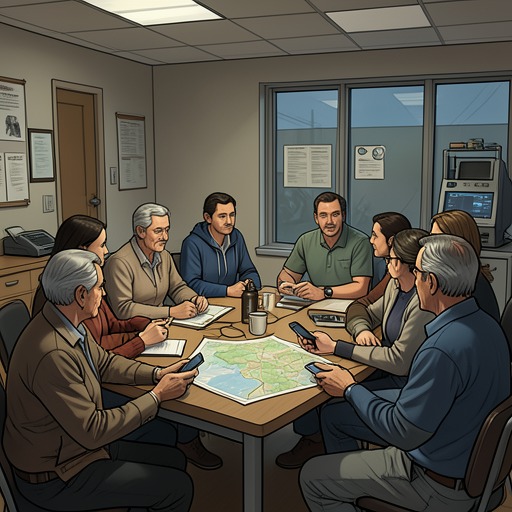
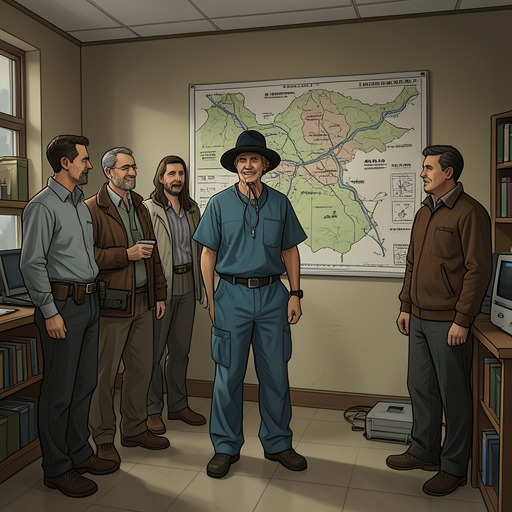
East Tennessee State University working group
DopesickThe East Tennessee State University working group was a regional alliance of mental-health and substance-abuse administrators that turned collaboration into a practical response to the opioid crisis. Led by Robert Pack, it helped develop Overmountain Recovery, a clinic in Gray, Tennessee, designed to bring treatment closer to communities and combine medication with counseling and other forms of support.
Identity and Purpose
Pack’s coalition, whose members called themselves the working group, was presented as a way to overcome governmental rigidity and bureaucratic indifference that obstructed responses to addiction. Its approach rested on cooperation among institutions rather than reliance on a single agency: Pack had the backing of East Tennessee State University, the region’s nonprofit hospital corporation, and the state mental-health agency.
The working group’s work also grew from personal loss. Pack had begun researching addiction after a close friend died by opioid-related suicide in 2006. By the time the group advanced the clinic project, it had secured $2.5 million in grants, supported eight funded projects, and developed twenty-five research proposals. It had also opened a Center for Prescription Drug Abuse focused on research, building an institutional base alongside its direct service work.
From Coalition to Clinic
The working group’s most visible local project was Overmountain Recovery, planned for a rural town between Johnson City, Tennessee, and Kingsport, Tennessee. The clinic’s name invoked the Overmountain Men, local farmers and frontiersmen associated with the Battle of Kings Mountain; its recovery model was likewise intended to extend beyond medication alone. Plans included group and individual counseling, yoga and other alternative therapies, and job-training support.
The clinic was to offer Suboxone eventually, but was designed primarily around Methadone used at Overmountain Recovery. The medication was less expensive and harder to divert because patients would drink the liquid dose daily in front of a nurse. This mattered in a region where the nearest existing methadone facility was about sixty miles away, over a mountain. The proposed clinic therefore addressed not only what treatment could include, but the distance that had made a particular treatment difficult to reach.
Negotiation and Opposition
Overmountain Recovery was planned for Gray, Tennessee, a middle-class community of farmers and suburban residents, with Daniel Boone High School nearby. The proposal met strong resistance from Citizens to Maintain Gray, whose members worried that patients taking methadone would be unsafe drivers. Some residents acknowledged privately to Pack and co-leader Steve Loyd that addiction had affected their own families, even as they opposed locating the clinic in their community.
Rather than bypassing opponents, the working group heard their concerns and brought in outside police chiefs and methadone providers to present examples and studies from other communities. The coalition used that evidence to address safety objections before local and state decision-makers. The process took more than a year and involved repeated public opposition: in a town of 1,222 residents, more than 300 people spoke against the project, and some cast Pack and Loyd as drug dealers. The group nevertheless secured near-unanimous approval from the city zoning board and approval from the state. Overmountain Recovery opened in September 2017.
Significance
The working group’s record connected large-scale research activity to a specific service gap: a distant treatment option became a local clinic offering medication alongside counseling and practical supports. Its method depended on assembling institutions, presenting evidence in public, and continuing through a prolonged approval process rather than treating local resistance as a problem that could simply be ignored.
The clinic’s development also demonstrated the difference between announcing an effective treatment and making it accessible. Overmountain Recovery’s planned daily medication, counseling, alternative therapies, and job-training support reflected a broader care model, while its location addressed a sixty-mile geographic barrier. In the book’s account, the working group’s importance lies in this movement from coalition-building to implementation: research and partnership became a contested but concrete addition to the region’s treatment infrastructure.