Wise County, Virginia
DopesickWise County, Virginia, appears as a focal point of rural health-care need and community response in Central Appalachia. At its fairgrounds, a major free medical event brings care to people who might otherwise go without it; across the surrounding region, health workers and advocates confront overdose, infectious disease, limited treatment access, and the consequences of economic and political neglect.## Setting and regional context Far southwest Virginia’s rural communities are presented not simply as a backdrop to the Opioid epidemic but as places where its effects intersect with inadequate health coverage and limited local resources. The book connects those pressures to broader changes in rural America: declining work, rising disability, and the expansion of opioid supply. Its account of Martinsville and Henry County, where unemployment rose above 20 percent and food-stamp claims more than tripled, offers a separate example of the economic distress affecting rural counties; those figures are not specific to Wise County.
The state’s policy choices form part of this setting. Virginia’s legislature repeatedly rejected Medicaid expansion after the Affordable Care Act, forgoing federal funds and coverage for hundreds of thousands of low-income residents. Across the state, that decision constrained access to treatment, counseling, and addiction medication. The book places the consequences alongside the daily work of rural providers, for whom distance, cost, and a thin safety net could determine whether care was reachable at all.## Remote Area Medical at the fairgrounds One three-day weekend each summer, Teresa Gardner Tyson hosts the nation’s largest free medical outreach event at the Wise County Fairgrounds. Remote Area Medical serves people with needs ranging from children’s undiagnosed diabetes to adults requiring dental care. Some patients’ dental problems followed years of meth use; others had gone without care because they lacked coverage. More than three thousand people may camp out for days in intense summer heat. Volunteers set up makeshift examination rooms with bedsheets and clothespins, use the fairground bleachers as waiting areas, and distribute water while directing patients to medical, dental, and eye-care services.
The clinic’s scale makes both its value and its limitations visible. Craig Adams, a construction worker and recovering opioid addict, came with his wife to have their teeth treated. He had served eight years in Virginia’s prison system after breaking into a pharmacy in Richlands to steal OxyContin, and had lost his mother and grandmother to overdose. By the time of the event, he had been free of illicit drugs for more than three years and was taking Suboxone. He had postponed seeking care because he expected social-service workers to shame him; instead, he found the clinic’s staff kind. His experience shows how access to practical care can meet people at a point where stigma has already kept them away.
The event also depends on substantial volunteer effort. In the weeks before the 2017 clinic, Tyson coordinated with distant media outlets and made urgent calls to secure bottled water after a nonprofit’s supply had been reserved for disaster relief. She observed that if the needs visible at the fairgrounds did not qualify as a disaster, it was difficult to know what did. The annual gathering offers a burst of care, but the region’s needs continue after out-of-state volunteers leave.## Local public-health response Regional health-department director Sue Cantrell used town-hall meetings in the coalfield counties during the summer of 2017 to warn residents and officials about the risks of drug use and infectious disease. Virginia had recently passed legislation enabling syringe-exchange programs, but every legislator from the coalfields had voted against it, citing law-enforcement concerns. Cantrell sought to arrange for a West Virginia police chief to explain the experience across the state line, where a syringe-exchange program had been associated with lower overdose deaths and greater access to treatment and disease-prevention services. In the meantime, her staff taught people how to clean syringes and distributed cleaning supplies; Cantrell sometimes offered food to encourage patients to get tested and return for their results.
Remote Area Medical added free hepatitis C testing for the first time. A pharmacy professor estimated that three-quarters of people injecting drugs in the region had contracted the disease without knowing it. The clinic also distributed take-home naloxone kits and trained nearly four hundred people to use them. Cantrell described simply getting patients to appointments as a major challenge: two people attending the medication-assisted treatment clinic she ran in Lee County either hitchhiked or walked, sometimes more than five miles. The distance turned a nominally available service into a difficult journey.
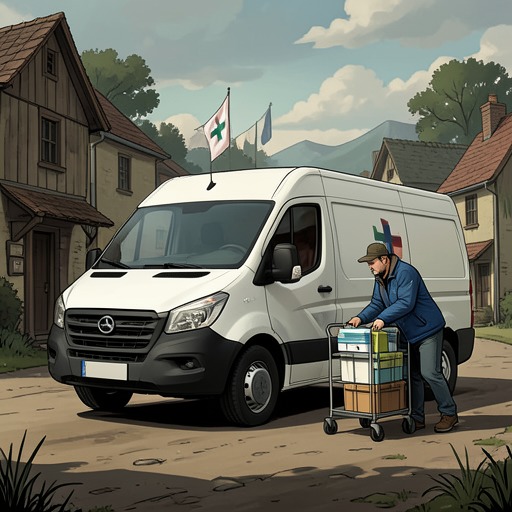
Cantrell proposed repurposing some subsidized housing as clean-living facilities, with support groups and other services. She argued that addiction should be supported as a chronic disease, while also calling for education linked to living-wage jobs so that people would have viable options to remain in the region or leave it. The proposal widened the question beyond treatment alone: recovery required not only medical care but also places, relationships, and activities capable of sustaining a life beyond drug use.## The limits of emergency care The Health Wagon, the mobile-care organization Tyson helped lead, illustrates how rural services try to bridge gaps left by conventional systems. Founded in 1980 by Catholic nun and medical missionary Sister Bernie Kenny, it began with care delivered from the back of a red Volkswagen Beetle. Decades later, Tyson’s grant-funded staff of twenty served uninsured people after the large annual clinic had ended. At one stop, Tyson treated a substitute teacher whose daily pay had fallen from $70 to $56. The woman had been uninsured for decades and relied on free care at outreach events and occasional visits from the mobile unit; she delayed seeing her family doctor until she was nearly dying, because even the discounted cash rate was $63 per visit.
That kind of stopgap care sits alongside a larger argument about the conditions that sustain the crisis. Nancy D. Campbell, a historian of the Narcotics Farm, emphasized that avoiding drugs requires meaningful alternatives: work, recreation, and relationships around which people can build their lives. In the book’s account, Wise County’s outreach and harm-reduction efforts are indispensable, but they cannot by themselves replace stable access to health care or rebuild the social and economic supports on which lasting recovery depends.