Central Appalachia
DopesickCentral Appalachia is the birthplace of the modern opioid epidemic in the book’s account: a place where the loss of work and health-care access intensified the damage of widespread opioid availability, while families and local caregivers tried to keep people alive. The region is not merely a backdrop to the crisis. Its coal camps, rural counties, and stretched community services make visible how economic distress and institutional decisions shape both exposure to addiction and the chance of recovery.
Setting and Visible Need
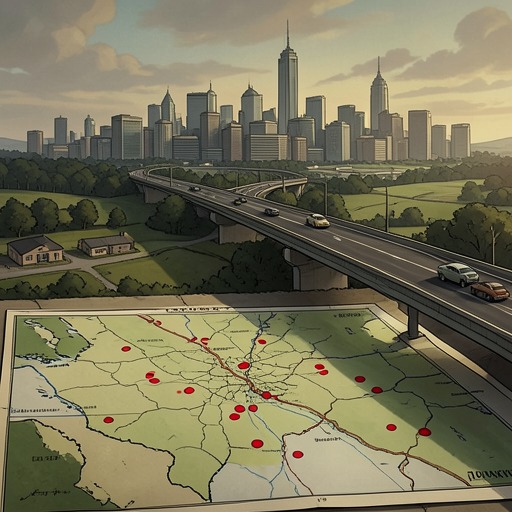
The narrative’s view of Central Appalachia is grounded in southwest Virginia, including Lee County and the coal camps near St. Charles and Wise County. On a drive through the area, Art Van Zee pointed out that the poverty and poor health visible there were not isolated to those towns; similar conditions could exist beyond the cities where many Americans lived, even if they were easier to overlook. In this account, rural hardship was increasingly difficult both to conceal and to recover from.
The region’s needs become tangible at the annual free medical outreach hosted at the Wise County Fairgrounds. Teresa Gardner Tyson helps plan and host the three-day event, where people seek care for conditions ranging from undiagnosed diabetes to serious dental problems. Some patients face barriers to dental coverage; others have health problems associated with years of meth use. In 2017, the preparations themselves revealed how precarious the undertaking was: Tyson worked with distant media and made urgent calls when organizers could not secure bottled water for the crowds. The event draws attention to a health burden that, in rural America, accompanies overdose rates reported as 50 percent higher than in urban areas.
Economic Decline and the Epidemic
The account connects opioid harm to the collapse of work, rising disability, and the expansion of painkiller supply. In Martinsville and surrounding Henry County, unemployment climbed above 20 percent, food-stamp claims more than tripled, and disability rates rose 60.4 percent. Those figures belong to a wider rural pattern associated with globalization, automation, and the decline of coal. The book places such structural pressures alongside aggressive pharmaceutical promotion and successive approvals of opioid drugs, rather than explaining the epidemic as a matter of individual conduct alone.
That relationship is described as a convergence: economic collapse prepared the ground, while opioids intensified the resulting crisis. Declining workforce participation was not confined to rural communities, though the account notes that its effects were less severe in places with fewer opioid prescriptions and more college graduates. Central Appalachia therefore appears both as a particular landscape of deindustrialization and as an early, stark example of pressures spreading more widely.
Unequal Institutions and Barriers to Care
The region’s history also exposes a racial divide in how opioid use was understood and addressed. In Roanoke, heroin had long been associated with inner-city Black users and dealers, and the small group involved was often described as isolated and largely invisible. Later evidence cited in the book indicates that doctors prescribed painkillers to people of color at substantially lower rates than to white patients, partly because of assumptions about misuse. By 2014, overdose deaths among young white people had risen sharply compared with 2002, while the rate for people of color was relatively unchanged. The contrast complicates any simple account of who was protected, who was exposed, and how.
Criminal enforcement and health care did not treat the crisis as interchangeable problems. The book contrasts the common call that arrests alone could not solve opioid addiction with the continued imprisonment of people such as Ronnie Jones for heroin distribution. It notes that people of color made up a disproportionate share of federal and state drug offenders, even though they were statistically less likely to use or deal drugs. The comparison makes the region’s epidemic part of a broader argument about unequal prescribing, policing, and punishment.
Care was constrained by gaps in insurance and treatment. Virginia repeatedly rejected Medicaid expansion after the Affordable Care Act, foregoing federal funds and coverage for hundreds of thousands of low-income residents. In states that expanded Medicaid, the program helped pay for treatment, counseling, and addiction medications; in Virginia, families and advocates faced the consequences of a narrower safety net. Stigma added another barrier: Tess Henry had attended twelve-step meetings but felt judged for taking buprenorphine, and members asked to sponsor her declined. The formal openness of Narcotics Anonymous to medication-assisted treatment did not prevent that local rejection.
Families, Community Response, and Warning
The gaps between health care and criminal justice are also experienced inside families. At a Families Anonymous meeting near Hidden Valley, two mothers of opioid-addicted young men met; their encounter connected families confronting addiction and brought into view the work relatives and volunteers did to keep loved ones alive. In 2012, there were not yet online parent groups linking people across the state to share treatment advice or practical support. Shame often kept families silent, even as they tried to navigate rehabilitation, prison, recovery, and relapse.
Local advocacy could meet a similarly muted response. Janine Underwood told school-board and county officials about the heroin problem in her community and sought support for prevention work. The school board declined to support the program, and the county provided its customary $2,000. The episode shows how affluence and the belief that a good school zone would protect a family could coexist with an escalating local crisis—and how raising the alarm did not guarantee a meaningful institutional response.
Against that silence, Central Appalachia is cast as a warning to other communities. A prevention leader in Lebanon described the region as having encountered the epidemic early enough to recognize what might follow elsewhere. National overdose data reinforced the warning: Don Burke’s study found that overdose deaths had doubled every eight years since 1979, and estimated that, without dramatic intervention, as many Americans could die in the coming five years as had died in the preceding fifteen. The metaphor of canaries in the coalfields gives local experience predictive weight: what happened here was not safely confined here.
Care as a Regional Practice
The book’s closing account returns to Central Appalachia not only as a landscape of need but also as a place of sustained, improvised care. Worn-out emergency medical technicians, preachers, probation officers, and nurse-practitioners appear alongside people serving meals in church basements and driving mobile clinics along difficult rural roads. Remote Area Medical’s free outreach is one expression of that work; the people organizing it respond to needs that ordinary access to health care has left unmet.
The ending does not suggest that volunteer effort can replace public investment or comprehensive treatment. Instead, the contrast between the scale of need and the labor of local caregivers gives the setting its final significance. Central Appalachia reveals the costs of economic decline and institutional failure, but it also shows a community repeatedly creating ways to respond when formal systems fall short.