Hidden Valley, Virginia
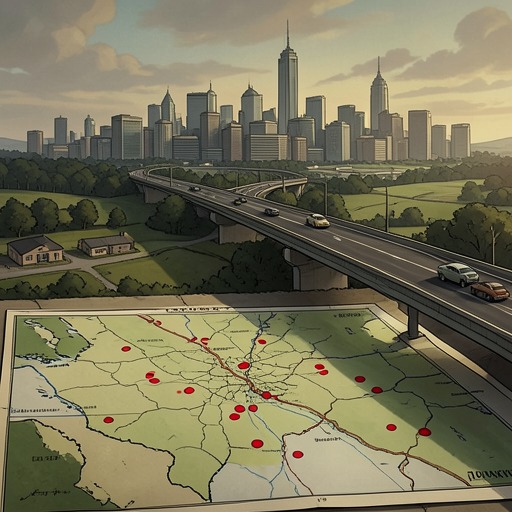
DopesickHidden Valley, Virginia, is portrayed as a prosperous suburban community in Roanoke County that became a major local center of opioid addiction. The place matters not simply as a point on the map, but as a challenge to the assumption that heroin was an inner-city problem: pills and heroin moved through school-age friendships, families struggled to speak publicly, and the apparent security of an affluent school zone did not protect its young people.
An unexpected center of the epidemic
For years, heroin in Roanoke had largely been treated as a matter for police and court reporters and associated with the inner city. That picture obscured a changing drug market. In 2006, Clifton “Lite” Lee brought heroin to Roanoke and connected with users across racial lines. When police caught two suburban teenagers selling the drug to friends and keeping some for themselves, their cellphones pointed to roughly fifty other young people they had supplied. Most attended Hidden Valley High School, in one of Roanoke County’s wealthiest neighborhoods, among insurance agents, doctors, and lawyers.
The scale and organization behind these local sales made the suburban setting especially consequential. Lee’s network was not merely a group of teenagers experimenting together: the teenagers served as middlemen, bringing heroin into their own friendships and using the proceeds and drugs to sustain their own use. The evidence exposed a path from a regional supply chain into a school-centered social network, where buyers could also become sellers and the network could expand beyond the people who first encountered the drug.
That history complicates the idea that the later suburban outbreak began with a single arrival or moment. The book’s account places Hidden Valley among the early opioid-using communities whose young people encountered pills and then heroin through peers. The suburban epidemic was less visible than a dramatic public disturbance, but its ordinary routes—friendships, phones, and access to drugs through acquaintances—made it possible to spread inside a community that had not understood itself as vulnerable.
School, family, and the geography of shame
The Hidden Valley school zone represented both privilege and misplaced confidence. Janine Underwood later explained that she had pulled strings to get her children into the zone because she considered it a better place to raise them. Yet police data showed that heroin was a more serious problem in Hidden Valley and nearby Cave Spring than in other, less affluent parts of the county. The belief that the neighborhood’s advantages would shield its families instead made it harder to recognize the crisis and respond to it openly.
In the early years, shame kept many families from going on the record. In 2012 there were not yet local Facebook groups through which parents in different parts of the state could exchange treatment advice, coping strategies, or practical support. The book describes families confronting addiction in isolation even as their children’s experiences connected them to a wider regional pattern. A meeting of Families Anonymous at a Lutheran church on the outskirts of Hidden Valley brought together two mothers of opioid-addicted young men: Jamie Waldrop and Drenna Banks. Their sons had been friends and had used drugs together; the meeting became a point of connection for parents whose family lives had been shaped by addiction.
The setting also complicates the idea that affluent families were untouched by the epidemic. Jamie Waldrop did not understand the extent of her sons’ addiction until she found them unconscious in separate incidents at home—one slumped in a chair after combining Xanax and painkillers, the other on a bathroom floor among heroin needles and blood. Such episodes brought the crisis into domestic spaces, far from the image of an isolated inner-city drug scene.
Community response and its limits
As director of the Hope Initiative, Janine Underwood tried to turn private grief into public prevention. She told the local school board and county officials about her son’s story and sought support for the county risk-prevention council, which was operating on a few small federal grants. Her account of speaking to officials and then sitting down without a question from the room captures the distance between the visible harm in local families and the public response to it. The school board declined to support the program; the county provided its usual $2,000.
Meanwhile, calls to the Hope Initiative about heroin users from Hidden Valley and Cave Spring came almost daily. The organization offered a route toward help, but its presence did not erase the stigma that kept families quiet or the institutional gaps between health care and criminal justice. The book sets the neighborhood’s everyday affluence against this lack of sustained public backing: local families could occupy a highly regarded school zone while their children struggled with addiction and their parents searched for help largely on their own.
A school community measured in losses
The book’s later returns to Hidden Valley make the duration of the crisis visible. Among the early users associated with the school were Scott Roth and John Robert “Bobby” Baylis. Years later, a young woman who had babysat for Bobby’s sister came to the Hope Initiative determined to get sober. When Janine Underwood and volunteer Nancy Hans went to her home to arrange a transfer to detox, she was nodding out. During a brief clear moment, she brought out her Hidden Valley High yearbook and pointed to a homecoming-dance photograph: three of the five young people pictured, she said, were now active heroin users.
That yearbook turns the school’s past into a record of both belonging and attrition. The image preserves a familiar adolescent scene, while the young woman’s account names how many of that small group were still using. Hidden Valley’s significance in the narrative lies in this collision: it was a place of schools, family homes, and social ties, but those same ties helped carry drugs and addiction through the community. Its apparent safety did not prevent the epidemic; the accumulated losses made the crisis harder to dismiss as someone else’s problem.