Baltimore
DopesickBaltimore is portrayed as a major East Coast heroin hub whose established market drew buyers from smaller communities and helped turn personal drug use into a repeatable cycle of buying and resale. For people such as Dennis Painter and Jesse Bolstridge, it was not merely a distant source of drugs: it was a destination where the market could be found with unsettling ease, and where the effort to finance one purchase could generate the next.
A longstanding trafficking corridor
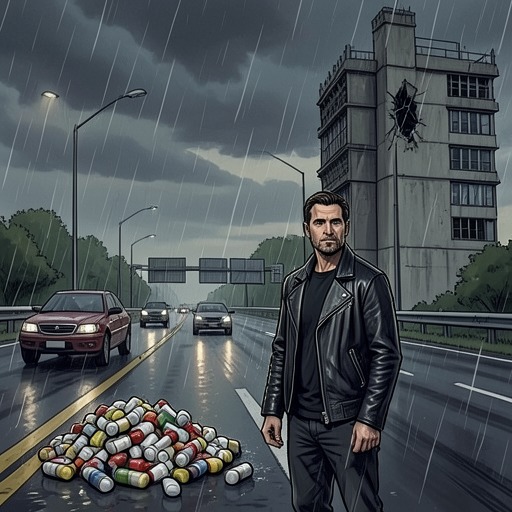
For roughly four decades, Baltimore had served as a staging area for dealers moving drugs along the East Coast. Its port provided an entry point for international smuggling, while Interstate 95 linked it to cities from Miami to Bangor, Maine. The names attached to that route changed with the drug trade: first Reefer Express, then Cocaine Lane, and eventually the Heroin Highway, also known as the Highway to Hell. The shifting labels mark a persistent function rather than a single episode: Baltimore occupied a strategic place in a corridor that connected supply, sales, and communities well beyond the city.
That infrastructure helped make Baltimore different from the smaller towns around it. The book contrasts young people who needed established contacts for daylong trips north to New Jersey and New York City with buyers who could travel to Baltimore without such connections. Its market was sufficiently visible and accessible that a visitor could arrive without already belonging to a local network. That relative openness did not make the trade harmless or simple; it made the city an especially consequential destination for people whose use had already become organized around obtaining the next supply.
The commuter-dealer economy
After OxyContin was reformulated in 2010, a small cluster of users tracked by Brent Lutz began making the roughly two-hour drive to Baltimore, often nearly every day. Most were young white men. They bought enough heroin to use and extra to sell to friends, turning a trip for drugs into a way to finance both the current purchase and the fuel for the next one. Police called them commuter-dealers, a group that had become an important part of Baltimore’s trade. Heroin sales in the city were estimated at $1.5 million a day.
The arrangement depended on a narrow margin between use and resale. A buyer’s surplus was not simply spare supply: it could be converted into cash for another trip, while recruiting friends into the same chain. The account places this mechanism alongside a broader pattern of users selling portions of what they bought to afford the next purchase. As the cycle multiplied, customers could become sellers and recruit further customers; the transaction carried the potential to extend dependence through a social network even when no single dealer controlled the whole chain.
The book also distinguishes Baltimore’s commuter trade from a separate, larger-volume route serving Virginia. By spring 2013, an investigator was tracing a source whose heroin came from New York City to Virginia’s I-81 corridor in loads that dwarfed the amounts commuter-dealers typically brought back from Baltimore. This contrast matters: Baltimore was a major hub and a powerful destination in its own right, but not the only route feeding the region. The drug market was distributed across overlapping channels rather than reducible to one supplier or one journey.
Finding the market
Dennis Painter, a native of Shenandoah County, made his first trip to Baltimore to buy heroin in 2012. He had been told to look for blinking blue lights intended to help police surveil high-crime neighborhoods. For out-of-state buyers, the same lights could function as beacons. The detail captures how a tool of observation could acquire an unintended second use: an effort to monitor the market also made the area legible to people arriving to take part in it.
Dennis usually made the drive with his best friend, Jesse Bolstridge. Sometimes they stopped at the city health department’s syringe-exchange van to collect clean needles. The exchange was one part of Baltimore’s place in the story that did not serve the drug market itself; it offered a practical harm-reduction service to people already exposed to its risks. On another trip, when Jesse was away at rehabilitation, Dennis travelled with acquaintances of acquaintances, was robbed, and was abandoned by the car pool. His girlfriend had to drive to retrieve him late that night, with their toddler twins asleep in the back seat. The episode shows the vulnerability built into the journey as well as its routine: a trip repeated to secure drugs could leave a buyer dependent on unreliable companions and expose others in his family to its consequences.
Scale, risk, and the city’s place in the epidemic
Baltimore’s importance as a market sat beside an extraordinary public-health burden. The book describes the city as having the country’s highest per-capita rate of heroin use and reports that residents were six times more likely to die from an opioid overdose than the national average. One contemporary comparison put the city at 0.2 percent of the national population but 1.2 percent of drug overdoses. The figures make clear that Baltimore was not simply a destination for visitors from elsewhere; its residents bore an especially concentrated share of the crisis.
The city therefore occupies two positions at once: a transfer point in a long-distance trade and a community living with severe local consequences. The commuter-dealer journeys joined those positions. They brought users into a large market, enabled purchases to be divided and resold, and carried the effects of the city’s heroin economy back to towns along the route. Baltimore’s narrative significance lies in this connection between geographic scale and intimate repetition: a port, a highway, a set of blinking lights, and the same trip made again to pay for what came before.