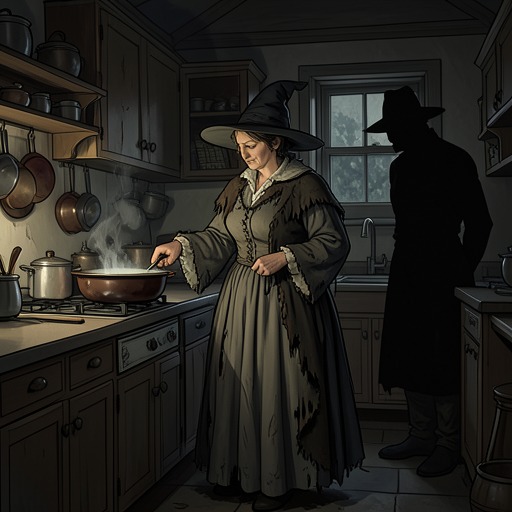
Faust drinks the witch’s rejuvenating potion
FaustFaust drinks the witch’s rejuvenating potion in the Witch’s Kitchen after rejecting both a life of ordinary physical labor and the prospect of relying on an old witch’s concoction. Mephistopheles arranges the drink, assures the Witch it will suit his friend, and presses Faust to swallow it despite the flame that rises from the cup. The episode turns Faust’s wish to recover youth into a supernatural intervention and prepares him for the pursuit of desire that follows.
Causes and Background
Before the potion is prepared, Faust recoils from the disorderly scene in the Witch’s Kitchen: a great cauldron burns on a low hearth, vapor rises from it, and apes attend the fire among the room’s fantastical witch’s implements. He doubts that such chaotic magic can restore him, and asks whether he must seek help from an old hag or accept a brew that would remove thirty years from his existence. His complaint is not simply that the proposed means look repellent; he asks whether Nature or a noble mind has any more potent remedy. The question makes the episode a choice between the limits of natural means and the promise of magical transformation.
Mephistopheles replies that there is a simpler method, but it belongs to another, eccentric account of how to become young. He describes a life of digging and hoeing, keeping one’s desires within a narrow sphere, and sustaining the body with unmixed food. That regimen, he says, could preserve youth for eighty years. Faust refuses it: taking up the spade and accepting such a restricted existence do not suit him. His rejection explains why the supernatural remedy becomes attractive in practice. He seeks renewal, but not through the disciplined, bounded life Mephistopheles proposes as its alternative.
Preparation and Drinking
The Witch warns that a person who drinks without proper preparation will die within an hour. Mephistopheles answers that Faust is his friend and that the drink will agree with him; he asks her for the kitchen’s best preparation and directs her to draw a circle and perform the adjuration. The assurance removes the stated danger from the scene without explaining the potion’s ingredients or giving a fuller account of how it works.
The Witch performs the ritual with elaborate gestures, arranging mysterious objects inside the circle. The glasses begin to ring and the cauldron to sound; she brings out a great book and has the apes serve as a reading-desk and hold torches. Mephistopheles eventually interrupts the adjuration, asks for the drink, and maintains that it will not injure Faust, describing him as a man of manifold degrees who has known many draughts. The preparation thus joins ritual display to Mephistopheles’s confident practical direction, while Faust himself complains that the Witch’s words are nonsense and that he can scarcely bear to hear them.
When the Witch pours the drink into a cup, a light flame appears as Faust raises it to his lips. Mephistopheles tells him to drink quickly, connecting the drink with renewed desire and urging him not to fear the fire. The Witch breaks the circle, and Faust steps out. His passage from hesitation to action is brief: Mephistopheles has arranged the remedy and now pushes him through its final threshold.
Effects and Narrative Role
The immediate stated effect is a redirection toward desire. Mephistopheles says they must leave at once and keep Faust in rapid occupation so that the potion’s power will spread through his frame; only afterward, he promises, will he teach him to value indolence. He predicts that Faust will soon feel Cupid stirring with keen pleasure. The scene therefore presents rejuvenation not as a self-contained cure but as preparation for a new course of experience, in which restored youth is tied to erotic pursuit.
That promise is borne out in the next exchange: Faust asks for a quick look into the mirror and responds to the woman’s form he sees there. The potion’s narrative consequence is thus visible in the shift from his initial rejection of the Witch’s setting to an immediate interest in the image of a woman. The text establishes this sequence and Mephistopheles’s interpretation of it; it does not provide a medical explanation of the drink or a precise account of its lasting physical effects.
Renewal and the Limits of the Bargain
The episode makes Faust’s renewal depend on a choice between different ways of living rather than presenting youth as an isolated gift. Mephistopheles’s proposed natural regimen would make sustained labor and self-restraint its conditions; Faust refuses because he will not accept its narrowness. The magical drink offers a contrasting route, but its promised benefit is framed by Mephistopheles as the beginning of desire and movement, not as a return to a settled life.
In the larger dramatic context supplied by the work’s introduction, the potion scene belongs to a poem whose form is meant to carry meaning rather than merely decorate it. The translator’s introduction argues that poetic form contributes essentially to a work’s fullness of meaning and that the original metres should be reproduced as closely as possible, while allowing meaning to take precedence when it conflicts with music. Here, the compact movement from Faust’s distrust, through Mephistopheles’s assurances and the Witch’s ritual, to the flaming cup and the mirror gives the transformation a staged, consequential form: the drink is both an object in the scene and the hinge between Faust’s dissatisfaction with ordinary existence and his renewed pursuit of desire.