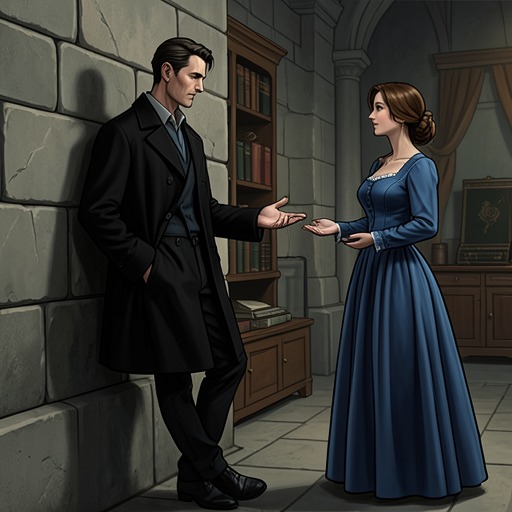
Faust and Margaret’s garden courtship
FaustFaust and Margaret’s garden courtship turns a tentative private test into an openly reciprocated declaration of love. Its decisive movement is from Margaret’s uncertain reading of a plucked flower to her direct avowal, while Faust’s words and gestures make the scene’s intimacy unmistakable. The garden brings the pair together in a deliberately divided company: Margaret is on Faust’s arm, while Martha and Mephistopheles walk nearby.
Setting and Dramatic Arrangement
The scene is set in the garden, where Margaret and Faust walk together as Martha and Mephistopheles pace up and down. This arrangement places the lovers in a shared social space rather than isolating them completely: the two couples occupy the same setting, but Margaret and Faust’s exchange develops at its center. Their walk provides the occasion for the conversation and gestures through which their feelings become legible.
Faust recalls having entered through the garden gate and asks whether Margaret recognized him. The gate gives his recollection a specific point of arrival, while his question makes recognition part of the courtship: he wants to know whether she noticed him before the present exchange. Margaret’s answer is conveyed less through a sustained explanation than through her behavior and the small ritual that follows.
The Flower and Margaret’s Test
Margaret plucks a star-flower and pulls off its leaves one after another. The gesture becomes a way of testing the question that she does not initially put to Faust directly: whether he loves her. Half aloud, she repeats the alternatives, “He loves me--loves me not.” As she continues removing the leaves, the repeated phrases make uncertainty a visible, incremental action rather than a settled judgment.
When she plucks the last leaf, the answer resolves in her favor. Margaret cries out, “He loves me!” and is delighted. The flower supplies no independent proof of Faust’s feelings; instead, the scene makes the final leaf a small theatrical cue that allows Margaret’s hope to become speech. Her private test changes the emotional direction of the exchange: what had been unspoken uncertainty now invites a response.
Faust’s Response and Mutual Avowal
Faust answers by treating the flower’s result as a declaration addressed to Margaret. He calls her an angelic soul and tells her that the blossom’s word is divine speech: it says that he loves her. He repeats the declaration, shifting from the flower’s game to his own explicit assurance. The repetition matters because it confirms that the outcome she has celebrated is not merely a wish projected onto the petals; Faust himself says that he loves her.
He grasps both her hands as he speaks. Margaret then says that she is trembling, registering the force of the exchange in her immediate response. Later, Faust enters with a playful claim that he has caught her and kisses her. Margaret clasps him and returns the kiss, then states plainly that she loves him from her heart. The scene thus moves through distinct stages: a question tested indirectly, an answer spoken by Faust, physical contact initiated by him and returned by her, and finally Margaret’s verbal confirmation of reciprocal love.
Interruption and Significance
The scene’s final moment of mutual affirmation is followed by a knock from Mephistopheles. The interruption arrives just after Margaret has declared her love and after the kiss has been returned, cutting across the lovers’ intimate exchange without undoing what they have said. The garden courtship therefore ends not in a resolution of the story’s larger conflicts but in a clear confirmation of the relationship’s immediate emotional reality.
The flower gives the scene its compact structure: Margaret removes its leaves one by one, uncertainty narrows to a final answer, and Faust converts that answer into an avowal of his own. The ending completes the movement from her hopeful test to a mutual declaration, while Mephistopheles’ knock marks the boundary between this private moment and the action continuing around the couple.