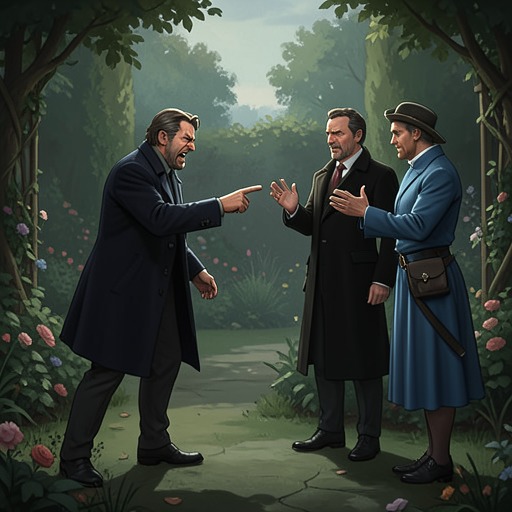
Valentine is killed in a fight with Faust
FaustValentine is killed in a street fight with Faust outside Margaret’s door, in a scene that converts a brother’s pride in his sister into accusation and a fatal confrontation. With Mephistopheles guiding Faust’s movements, the fight ends in Valentine’s death; before dying, he tells Margaret that her departure from honor wounded him and imagines himself going to God as a brave soldier.
Setting and Conflict
The scene takes place at night in the street before Margaret’s door. Valentine is identified as Margaret’s brother and a soldier, and his anger emerges from a contrast between his former confidence in her reputation and the shame he now associates with it. At drinking gatherings, he had heard other men praise their own sweethearts and answered with pride in Margaret, whom he regarded as unmatched. His companions agreed with him, and their swagger fell silent before his defense of her.
That earlier public confidence has become unbearable to him. Valentine describes his present vexation as so intense that he could tear his hair or dash out his brains; he imagines other men turning up their noses at him and stinging him with taunts. Even when he says that he could thresh them all together, he cannot call them liars. His words make the fight more than a private quarrel: he believes that Margaret’s changed standing has made the men’s former praise, and his own pride in repeating it, impossible to sustain.
The Encounter and Fight
Valentine notices two figures approaching and identifies them as potential targets. His challenge is immediate: if one of them is the man he suspects, that man will not leave the spot alive. The stage then identifies the pair as Faust and Mephistopheles, placing the confrontation directly between Valentine’s threat and the scene’s fatal outcome.
During the fight, Mephistopheles takes an active role in helping Faust. He urges the doctor not to retreat, promises to lead and parry, and tells him to thrust home. Valentine perceives that an uncanny opponent must be fighting him and says that his hand is already lame. The exchange shows the unequal terms of the encounter: Faust is not left to meet Valentine’s attack unaided, while Mephistopheles shapes the action and prompts its decisive blow.
Valentine cries out to God, and Mephistopheles declares him subdued. He immediately urges Faust to leave, warning that a murderous cry is rising and that, although the matter might be settled with the police, a penal court would examine it. The pair flee. Their exit makes the consequences of the killing explicit even as it leaves the scene behind: the fight has become a matter that could draw legal scrutiny, and Faust departs rather than remain to answer for it.
Death and Final Words
After Faust and Mephistopheles leave, Margaret cries out in misery. Valentine, dying, tells the women not to howl and calls the people around him to listen. His effort to command the gathering continues the forceful public manner that marked his earlier speeches, but now it is used to deliver a final judgment on his sister.
He tells Margaret to refrain from tears: her departure from honor, he says, stabbed him to the heart. He contrasts that injury with his own impending death, imagining that through the sleep of the grave he will go to God as a brave soldier. He then dies. His last words bind together family injury, military identity, and religious hope, but they do not reconcile him with Margaret; the scene ends with her brother dead and his condemnation still standing.
Consequences and Dramatic Significance
The killing changes Valentine’s relationship to Margaret from protective pride to reproach. Earlier, he had defended her reputation before his companions and used their agreement to confirm his confidence. Now that same reputation provides the measure by which he condemns her. The reversal is particularly stark because Valentine does not withdraw his old praise as false; he says instead that he can no longer dismiss the men who might taunt him as liars.
The encounter also exposes the practical consequences of Faust’s association with Mephistopheles. Mephistopheles guides Faust through the fight, calls for the finishing thrust, and manages the escape by anticipating the police and the penal court. Valentine’s death therefore joins a family tragedy to the larger conflict surrounding Faust’s pursuit of Margaret: the private consequences of that pursuit become a public street killing, followed by flight and the prospect of legal investigation.
Form and Presentation
The scene’s verse gives Valentine’s change in feeling a sharply staged progression. His recollection of the drinking table is arranged through the repeated social pattern of men boasting and companions answering; his earlier calm contrasts with the agitation of the present, where he imagines taunts and admits that he cannot call his detractors liars. The shift from remembered group approval to solitary anger prepares the sudden challenge to the two approaching figures.
The close then moves from combat to command and judgment. Mephistopheles’s short instructions press the fight toward its outcome, while Valentine’s final speech gathers the scene’s concern with honor, kinship, and death into a direct address to Margaret and the surrounding women. In this translation, the action is carried in verse that seeks to preserve the original’s rhythmic character; its translator describes the work as pursuing the original metres while preferring meaning when meaning and music cannot both be retained. Here the alternating movement from recollection to threat, intervention, and dying address gives the fatal encounter a formal sequence as well as a plot consequence.