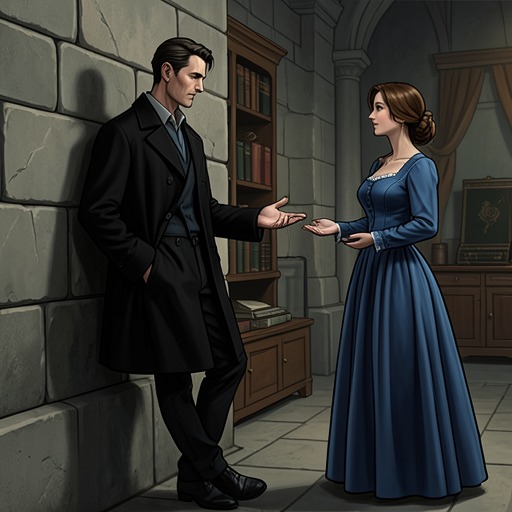
Mephistopheles’s false report about Martha’s husband
FaustMephistopheles’s false report about Martha’s husband is a staged deception that makes Martha’s grief the instrument of a plan to bring Faust and Margaret together. Mephistopheles fabricates the husband’s death and remorse, offers a location and elaborate account to make the story credible, and then turns Martha’s demand for legal confirmation into an occasion for Faust to bear false witness. The scene makes the gap between truth and persuasive speech part of the action: Mephistopheles’s invented testimony succeeds because Martha wants it to be true, while Faust’s resistance collapses when Mephistopheles connects the lie to his desire for Margaret.
The Report and Its Audience
Mephistopheles enters Martha and Margaret’s company with a formal apology for intruding, then steps back reverently on seeing Margaret. His manner sets the scene’s two objectives beside one another: he is courting Martha’s confidence with an announcement of death, while his presence also serves Faust’s pursuit of Margaret. When Martha asks his business, Mephistopheles says that her husband is dead and sends a greeting. Martha responds with shock and grief, immediately treating the claim as a loss rather than questioning its source.
The report is made more credible through particulars. In response to Martha’s request to hear how her husband’s life ended, Mephistopheles places him in Padua, buried beside Saint Antony in consecrated ground. He then claims to have been present at the death. The supposed final scene is deliberately undignified: the husband lies on half-rotten straw, but, Mephistopheles assures Martha, dies a Christian. He attributes to him a confession of regret for leaving his wife and trade, and a wish to be forgiven. Martha accepts the account with tears and says that she had forgiven him long ago.
A Story Built to Withstand Questions
Martha does not receive the report passively. She asks whether her husband had forgotten his love and faith amid his roaming, and whether he remembered her work and worry. Mephistopheles answers by supplying a second narrative of the husband’s past. He says that after leaving Malta, the man prayed for his wife and children, then joined in taking a Turkish merchantman carrying treasure to the Soldan. His share was, in Mephistopheles’s telling, a fitting payment for bravery.
When Martha asks whether the money was buried and where it can be found, Mephistopheles says that its fate is unknown. He adds that a young woman cared for her husband when he wandered without friends in Naples, and that the two felt love and faith until his life ended. Martha condemns him for having stolen from his children and for continuing his shameful way of life. The tale thus gives her competing grounds for grief and anger: the fabricated last-minute remorse does not erase the reported abandonment, lost wealth, or another attachment.
The accumulation of details does not establish what happened to the husband; it shows how Mephistopheles constructs a report that can absorb Martha’s questions. Padua and consecrated burial answer where he lies; the deathbed confession answers whether he regretted leaving; the Malta voyage and treasure explain the missing money; Naples supplies an account of his final companionship. Each new assertion extends the deception while making Martha’s demand for verification more consequential.
From Private Grief to Public Proof
As the company prepares to part, Martha asks for a legal witness who can certify where, how, and when her husband died. She says she dislikes irregular arrangements and wants the death reported in the weekly paper. Her request changes the scheme from a story told in private into an intended public attestation. Mephistopheles immediately agrees that two witnesses will establish the truth and promises to bring a friend of high standing who can add his deposition.
That promised friend is Faust. In the following street scene, Faust asks whether the arrangement is under way and nearly complete. Mephistopheles explains that they need only make a valid deposition that Martha’s husband lies dead in consecrated ground at Padua. Faust asks whether they must first travel there. Mephistopheles dismisses the journey as unnecessary: they can depose to the claim whether they know it or not. The false report has now become a proposed legal act, with Faust’s testimony meant to give invented information the standing of fact.
Faust’s Objection and Mephistopheles’s Leverage
Faust objects that, if this is the best Mephistopheles can devise, he will destroy the plan. Mephistopheles answers by turning the accusation back on him. Faust, he says, has already given confident definitions of God, the world, humanity, and the forces that shape human life without possessing certain knowledge of them; why, then, should he balk at claiming knowledge of the husband’s death and burial? The argument does not prove the report true. It exposes the selective character of Faust’s scruple by comparing the proposed false testimony with his broader claims to knowledge.
Mephistopheles then names the motive that can overcome Faust’s protest: the plan helps him flatter and ensnare poor Margaret, and swear devotion to her. Faust calls Mephistopheles a sophist and liar, but affirms that his devotion to Margaret comes from the heart. When Mephistopheles challenges him to name the intense power he seeks but cannot define, Faust describes an ardor so exalted that he would call it endless and eternal, and asks whether doing so makes the declaration devilish falsehood. Mephistopheles replies that his point still stands. The exchange leaves Faust’s emotion intact while showing how readily it can be used to justify a dishonest means.
Dramatic Function
The episode is more than an invented death notice: it converts Mephistopheles’s verbal control into an action with consequences for both Martha and Faust. Martha’s effort to secure a lawful, publicly stated account supplies the occasion for the false deposition; Mephistopheles supplies the fabricated facts; Faust is recruited as the witness whose participation would make the deception appear trustworthy. The scene’s movement from intimate grief to planned certification gives the lie an expanding reach without confirming any part of its content.
The scheme also sharpens the contrast between Faust’s resistance and his desire. He recognizes the plan as fraudulent and threatens to break it, yet Mephistopheles redirects the discussion to Faust’s pursuit of Margaret and to the certainty of his own grand declarations. Faust defends the sincerity of his feeling, not the truth of the husband’s supposed death. The episode therefore leaves the central contradiction unresolved: devotion may be genuine, but in this scene it is made to serve a deception, and Mephistopheles knows exactly how to make that connection useful.