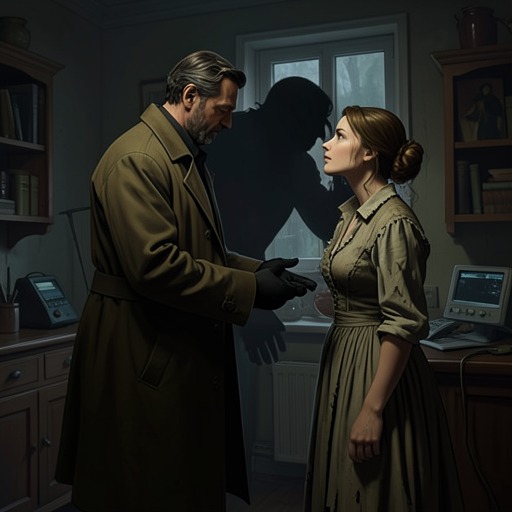
Faust summons the Earth-Spirit
FaustFaust summons the Earth-Spirit in a scene that tests the distance between intellectual aspiration and actual spiritual power. Hoping to break out of the confines of his study and enter into living contact with nature, he turns from one sign in Nostradamus’s Book to another and invokes the Spirit. Its appearance seems to promise the encounter he desires, but the Spirit judges him by the fear he displays and disappears. Faust is left to reckon with the difference between imagining himself godlike and being able to endure the presence he has called.
Setting and Preparation
The scene begins with Faust’s desire to escape a world he experiences as constricted and lifeless. He has invoked Nostradamus’s Book as a possible source of knowledge and power, but book learning alone cannot satisfy his longing for contact with the forces of existence. The act of opening and reading the book is therefore more than a search for information: it initiates a movement from study toward invocation.
The first sign he encounters, the Macrocosm, seems to reveal a universe in which each part contributes to a living whole. Faust responds with exhilaration, imagining a reciprocal order of powers and a nature made harmonious through their interaction. Yet the vision remains, in his own recognition, only a show. He sees an encompassing pattern but cannot make the boundless nature it represents his own. That insufficiency prompts him to turn the pages impatiently and seek a more immediate encounter.
The Call and Invocation
The sign of the Earth-Spirit affects Faust differently from the Macrocosm. It seems nearer, and he feels his powers grow clearer and stronger. The image awakens confidence that he can meet both the suffering and the joy of earthly life, and that even a violent reversal will not defeat him. In this moment, the Spirit’s sign appears to offer what the earlier vision could not: not merely a picture of nature’s order, but a force with which Faust might enter into relation.
Faust then calls upon the Earth-Spirit to reveal itself. The scene marks a shift from contemplation to action: he takes the book and pronounces the sign, and the Spirit appears in a flame. The appearance fulfills the immediate request, but it does not confirm that Faust is prepared for what he has summoned. His hopeful self-assurance gives way to alarm, and his reaction becomes the decisive evidence by which the Spirit measures him.
The Spirit’s Judgment
The Spirit addresses Faust by recalling the scale of his aspiration. Faust had sought to see and hear the Spirit, and his yearning has brought it to him; nevertheless, the Spirit asks where the expansive self is that seemed capable of containing a world and joining the company of spirits. It contrasts that former ambition with Faust’s present fear. The rebuke makes the encounter a test not of whether Faust can perform the invocation, but of whether he can sustain the spiritual stature his call implies.
Faust attempts to answer the challenge by asserting that he is Faust and the Spirit’s peer. The Spirit refuses that claim: Faust resembles only the spirit he can comprehend, not the Earth-Spirit itself. It then disappears. The answer establishes a boundary between Faust’s conception of supernatural power and the being he has actually encountered. His command of a sign and his intense desire do not make him equal to the force addressed.
Aftermath and Significance
Left overwhelmed, Faust repeats the Spirit’s denial and questions what it means for his image of himself as godlike. The encounter therefore ends not in possession of the power he sought, but in a crisis of self-understanding. He has briefly experienced confidence, called the Spirit, and been confronted with a measure beyond his capacity; the reversal exposes how readily imagined affinity can collapse under the pressure of an actual encounter.
The episode also distinguishes two forms of access to nature. The Macrocosm offers Faust a vision of interconnected forces, but that vision remains external to him. The Earth-Spirit seems more immediate, yet its presence cannot be assimilated into the identity Faust claims for himself. The movement from vision to invocation and then to rejection gives the scene its structure: aspiration produces action, action brings contact, and contact reveals a limit. Faust’s desire to overcome the separation between himself and the world is real, but the Spirit’s departure leaves that separation unresolved.