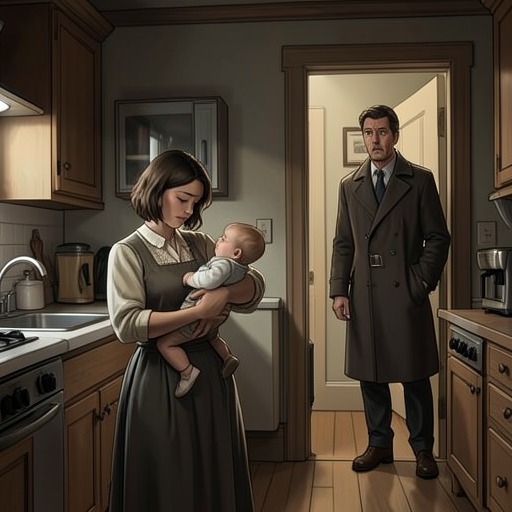
Margaret’s drowning of her child
FaustMargaret’s drowning of her child is revealed during the Dungeon scene, where her fragmented recollections move between longing to care for the baby, the belief that it has been taken from her, and recognition that she drowned it. The crime becomes the decisive point in Faust’s effort to free her: she imagines rescue for the child, refuses to leave, and ultimately entrusts herself to God, after which a voice from above declares her saved.
Disclosure in the Dungeon
The setting is an iron-doored Dungeon, where Faust arrives with keys and a lamp. Margaret’s first account does not present the child’s death as a settled memory. She says she wants to suckle the baby, recalls blessing it through the night, and believes it was taken away to vex her. She knows others say she killed it, but her speech shifts between that accusation and uncertainty about how the story has been interpreted.
Her words also register the social aftermath: she says people sing songs about her and complains that they construe her story as they do an old tale. The child’s death is therefore present both as a fact she cannot initially hold steadily and as a public accusation she hears repeated around her.
Recognition and Responsibility
As Faust urges her to hurry, Margaret’s speech changes from confusion to direct acknowledgment. She says she killed her mother and drowned the baby born to Faust, making the child’s parentage explicit. She then asks whether the baby had not been given to them both. Her recognition links the child’s death to a shared relationship with Faust, even as her words make clear that she herself performed the act.
The scene does not supply further circumstances of the drowning, and Margaret’s earlier uncertainty remains part of how the crime is presented. Its force lies instead in the reversal from her hope of recovering a living child to her recognition of what happened. Her account makes the child’s death an intimate loss and a source of culpability, not merely the charge others repeat.
The Imagined Rescue and Refusal to Leave
Before that recognition, Margaret urges Faust to save the child. She gives him a route: along the ridge, beside the brook, over the bridge, and into the wood, toward a plank placed in a pool. In her account, the baby is still trying to rise and struggling, so the directions turn her wish to undo the death into an urgent rescue mission. Faust tells her to recall her wandering will and says that one step will make her free, but her attention remains fixed on the child.
This imagined rescue does not resolve into an escape. Near the end, Faust tells Margaret that she will live; she answers by giving herself to God. Faust and Margaret thus reach different endings within the same scene: he presses for flight, while she refuses to make freedom from the Dungeon her final choice.
Judgment and Salvation
The child’s drowning stands within a larger movement from accusation toward judgment. Earlier, in the Cathedral, the Evil Spirit had confronted Margaret with the death of her mother and the blood at her threshold, and had asked what stirred beneath her heart. In the Dungeon, Margaret names her crimes herself and submits to divine judgment. Mephistopheles announces that she is judged, but a voice from above immediately declares her saved.
That final contrast makes the scene’s outcome more than a rescue thwarted. Margaret does not leave with Faust, yet the heavenly voice gives her a different form of release. The child’s death remains acknowledged rather than erased; the ending places that acknowledged guilt beside a salvation that the play assigns to a voice beyond Faust and Mephistopheles.