The Lord and Mephistopheles’ wager over Faust
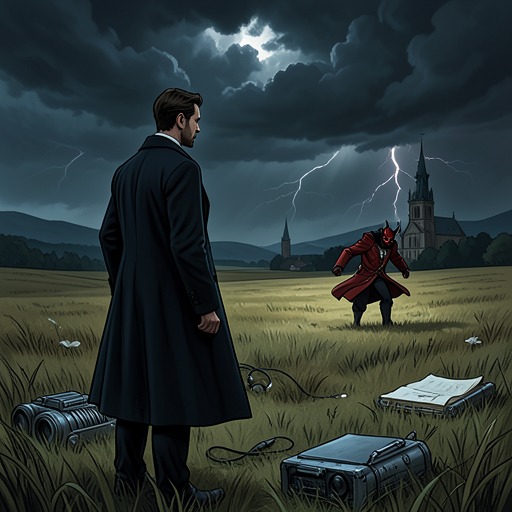
FaustThe Lord and Mephistopheles’ wager over Faust sets the terms of the drama’s central spiritual contest. Mephistopheles asks permission to guide Faust along his own road and believes he can win him; the Lord permits the attempt for as long as Faust lives, but expects that human aspiration will remain capable of error without losing its deeper orientation. The wager is therefore not simply a contest over possession: it tests whether active striving can be diverted from its source or will, through its mistakes, continue to seek what is good.
Background and Stakes
The exchange begins with Mephistopheles’ account of Faust’s dissatisfaction. No earthly food or drink suffices for him; he reaches toward the highest pleasures of Earth and the fairest stars of Heaven, yet neither what is near nor what is far can quiet the tumult within him. Mephistopheles presents that restless desire as an opening: Faust’s aspirations make him vulnerable to a guide who promises a different road.
The Lord answers with a contrasting image of growth. Like a gardener who sees both future flower and fruit in a budding tree, the Lord regards Faust’s present confusion as an unfinished condition, not a final verdict. He says that he will lead Faust toward a clearer morning. The wager thus turns on competing interpretations of the same restlessness: Mephistopheles sees a chance to capture it, while the Lord sees the possibility of development.
Permission and Terms
Mephistopheles makes his proposal explicitly: if given full leave, he will gently train Faust along his own path. The Lord grants permission for the span of Faust’s earthly life, explaining that while human desires and aspirations remain in motion, a person cannot avoid error. The allowance is broad, but bounded by that mortal term; it gives Mephistopheles room to act without declaring his interpretation of Faust correct.
The Lord further authorizes Mephistopheles to turn Faust away from his source, plant snares, and lead him downward. Yet the permission carries a challenge within it: Mephistopheles must eventually stand abashed if the good person, through even the most obscure aspiration, retains an instinct for the one true way. The wager’s outcome is therefore framed not only as a question of temptation, but as a test of what persists beneath confusion and misdirection.
Opposing Expectations
Mephistopheles accepts with confidence. He calls the trial short and says he has no fear about the wager; he anticipates Faust’s abasement and imagines him consuming dust with appetite. His confidence rests on his belief that restless longing can be converted into a path away from the good. The Lord, by contrast, does not claim that Faust will remain free of error. His case depends on the distinction between straying and being irretrievably lost.
The Lord explains why Mephistopheles is permitted to act. Human activity, when it flags, tends too quickly toward levelness and unqualified repose; the Lord has given humanity the companion who works, excites, and must create, identified here as the Devil. Mephistopheles’ disruptive energy consequently has a place in the arrangement, even though his own intention is to lead Faust downward. The passage holds destructive purpose and productive consequence in tension rather than treating them as identical.
The Wager’s Larger Meaning
The Lord says that beings like Mephistopheles have never moved him to hatred and calls him the least troublesome among the bold, denying spirits. That judgment places the wager within a larger order in which denial and opposition can provoke movement. The Lord’s final address turns from Faust’s individual trial to the creative power that works through enduring schemes: the Three Archangels are urged to remain joined in love and to fix what appears wavering into lasting form. The scene therefore sets the contest over Faust against a more encompassing vision of creation and stability.
The wager defines Faust’s errors as consequential but not necessarily final. Mephistopheles receives genuine freedom to test and redirect him, while the Lord’s confidence rests on the possibility that aspiration itself may preserve a direction the aspirant cannot yet clearly see. This tension establishes the governing terms of Faust’s trial: striving creates exposure to misjudgment, but it also prevents repose from becoming the last word.