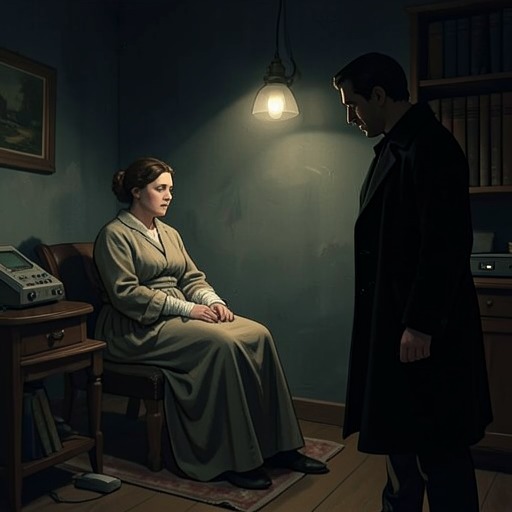
Faust’s attempt to rescue Margaret
FaustFaust’s attempt to rescue Margaret turns the consequences of her imprisonment into an immediate confrontation between responsibility and evasion. Discovering that she is in a dungeon, Faust demands her release and lays the blame on Mephistopheles for keeping him ignorant; Mephistopheles counters that Faust shares responsibility for her ruin. The rescue proceeds not as a simple act of deliverance but under the shadow of Faust’s guilt and the danger attached to his return.
Discovery and Accusation
Faust learns that Margaret has been imprisoned and is suffering. He calls her a gracious but ill-fated creature, shut away as a criminal and exposed to torment. His shock quickly becomes anger: he accuses Mephistopheles of concealing Margaret’s worsening condition while distracting him with what he calls empty diversions. The discovery recasts their relationship. The companion who had facilitated Faust’s pursuits has, in Faust’s eyes, withheld the news while Margaret’s situation deteriorated.
Mephistopheles replies that Margaret is not the first person to suffer in this way. When Faust curses him and orders him to rescue her, Mephistopheles refuses the role of sole culprit: he cannot undo the jail’s restraints or overrule the authority that holds her, and asks Faust who plunged her into ruin. The accusation makes the rescue a reckoning as well as a mission. Faust’s urgency does not erase his part in the events that led Margaret to prison.
A Rescue with Limits
Faust demands to be taken to Margaret, declaring that she will be free. Mephistopheles warns him that the killing Faust committed remains an active danger: avenging spirits wait at the place where the victim fell for the returning murderer. Faust answers by again demanding Margaret’s release, even as he recognizes the peril and assigns Mephistopheles blame for the wider devastation.
Mephistopheles agrees to help, but defines the limits of his power in concrete terms. He cannot command all forces in heaven and earth; he can, however, cloud the jailer’s senses, secure the key, and lead Margaret out by ordinary human means. He also promises to keep watch and says that horses are ready to carry them away. The plan therefore depends on concealment, access, and flight rather than on any power to cancel the judgment or undo what has already happened.
The Journey to the Dungeon
The scene shifts to night in an open field, where Faust and Mephistopheles ride swiftly on black horses. Their movement gives the rescue its forward drive, but the next scene places Faust at a standstill before an iron door. He has a bunch of keys and a lamp; instead of immediately unlocking the cell, he pauses, overcome by the suffering around him and by the knowledge that Margaret is within the dark, damp walls.
Faust recognizes that Margaret’s crime grew from delusion, yet recognition does not at once overcome his hesitation. He asks himself whether he is delaying her freedom and whether he fears seeing her again. The verse turns the delay into part of the action: his shrinking, he acknowledges, only leaves death nearer. When he finally reaches for the lock, Margaret’s singing comes from inside.
Margaret Behind the Door
Margaret’s song is fractured and disorienting. It speaks of her mother and father, a younger sister who lays bones in the woods, and a bird flying away. The song establishes her distress before Faust has entered the cell, while its images of family and death echo the consequences surrounding her imprisonment. Faust whispers that the hour of freedom has come, but Margaret does not recognize the encounter as a straightforward rescue: she throws herself before him and appeals for pity.
Faust warns that her cries may wake the guards and lead to her capture, then takes hold of her fetters to unlock them. Margaret, on her knees, asks who gave him power over her and pleads that he show mercy and let her live. The exchange leaves the rescue unresolved at this point: Faust has reached her and begun to free her, but Margaret responds in fear, and the guards remain a danger. Her imprisonment has brought Faust face to face with consequences he can no longer keep at a distance.
Responsibility and Dramatic Form
The episode makes rescue inseparable from culpability. Faust’s demand that Mephistopheles act is answered by the reminder that Faust himself helped cause Margaret’s ruin; the murder that threatens the escape further complicates his claim to be her liberator. The movement from accusation to travel and then to hesitation at the locked door gives the action successive tests: the decision to go, the danger of getting there, and the human difficulty of meeting Margaret within the prison.
The translator’s introduction argues that poetic form contributes essentially to meaning and that rhythm carries part of a poem’s significance. That principle is especially pertinent to this rescue’s changing pace: Faust’s anguished address, the swift ride, his measured hesitation before the door, and Margaret’s broken song are presented in verse rather than reduced to prose summary. The episode thus stages both an attempted physical release and a confrontation with the consequences that neither speed nor magical assistance can simply undo.