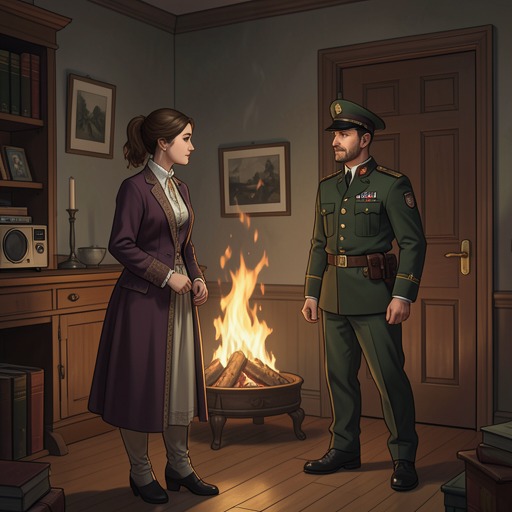
Charlie agrees to cooperate with the Shop’s fire tests
FirestarterCharlie McGee’s agreement to undergo the Shop’s fire tests reverses her firm refusal, but it is not an uncomplicated surrender. Still shaken by the Manders farm, she consents only after John Rainbird has made himself a trusted friend, argued that testing could help her gain control, and urged her to insist that the Shop proceed on her terms. Her decision is both an attempt to act for herself and a choice made within a relationship Rainbird has carefully shaped.
From Refusal to Negotiation
Rainbird raises the subject after nearly ten days without discussing fires since the blackout. Their conversations take place quietly in the kitchen, which he says has no listening “bugs.” He now calls her Charlie rather than “kid,” at her request: a small sign of the closeness she wants from him, and of the trust he has secured. Charlie has reason to feel indebted. On three occasions he risked his job to pass notes to her father, and he has brought her news that her father is well, relieved to know she is safe, and cooperating with the tests.
That trust does not make the proposal easy to hear. Since the Manders farm, even thinking about making fires leaves Charlie cold, tense, and trembling, a reaction Hockstetter’s reports classify as a mild phobia. She first repeats her absolute refusal. Although she wishes Rainbird would drop the subject, she listens because he has done so much for her, because she does not want to hurt him, and because she needs a friend. The pressure operates through affection as well as argument: refusing the tests now also risks disappointing the person she has come to depend on.
Rainbird’s Case for Testing
Rainbird presents the tests as a way for Charlie to acquire control, not simply as something the Shop wants from her. He suggests the staff know how the farm fire got out of control and would therefore take precautions; he does not expect them to test her in a room full of paper and oily rags. He also argues that control, once learned through repeated practice, could end her fear of losing control. To make that idea familiar, he compares it to learning to tie shoes or form letters in kindergarten.
The analogy has an edge of concealment. Rainbird returns to a metaphor associated with Wanless and likens control to toilet training, telling Charlie that once she has mastered it she will be safe from the same failure. Hockstetter has noted that the comparison is not invariably true, but Charlie does not know that. Rainbird is offering reassurance that supports his case, not a complete account of the limits of what practice can guarantee.
Charlie’s answer exposes what reassurance cannot settle. A few days after their first conversation, she says the tests would never end: if she began, the Shop would want larger fires, then bigger ones, then bonfires. Her fear is not only that she might lose control in a particular room; it is that a first agreement would give the institution reason to keep demanding more. Rainbird admires her intuition and recognizes that she understands something of the Shop’s plans. The narrative also reveals his private caution: if she were to discover that he was not the friend he appeared to be, he believes she could become dangerous to him.
The Decision and Its Conditions
Three days after Charlie voices her fear of escalating demands, she tells Rainbird she has decided to let the Shop conduct its tests. Her face is thin, pinched, and pale; the decision has not erased the distress that accompanied the subject from the outset. She says she will be careful and will make the staff be careful too if they do not know how. Rainbird does not simply celebrate the answer. He asks whether she has thought it through and whether she is doing it for herself, giving her space to reaffirm the choice rather than presenting it as his decision for her.
Charlie answers that she is doing it “For me. And for my father.” That qualification matters. She has been troubled by learning that her father is cooperating, but is beginning to understand that what is best for her may not be what is best for him. Her agreement joins her own wish to act with her concern for her father, without making her fear of the Shop disappear. Rainbird tells her to make the staff play by her rules, to avoid showing weakness, and to be tough. His advice acknowledges the imbalance between the child being tested and the institution controlling the tests, even as it encourages her to enter the process.
Charlie plans to tell Hockstetter the next day that she will cooperate “a little,” and to state what she wants. Rainbird advises her not to ask for too much at first, comparing the tactic to showing a midway carny some flash before taking the cash. The comparison turns negotiation into a performance: Charlie is to demonstrate enough to secure a return, while holding something back. The account marks the turn with the image of a fish swallowing a lure. Her consent is real, but Rainbird has helped bait the decision through friendship, selective reassurance, and coaching in how to bargain.
Significance
The event changes Charlie’s position from outright refusal to conditional participation. She has not abandoned her fear or accepted unlimited testing; instead, she intends to set terms and make the Shop take care. Her insistence that she act for herself gives the decision a measure of agency, while her concern for her father shows how family loyalty also shapes it.
At the same time, the scene makes the source of that agency uncertain. Rainbird has become someone Charlie trusts partly because he has carried messages and news about her father, yet he is steering her toward the tests and privately weighs the danger of her seeing through him. The agreement therefore advances the Shop’s access to Charlie not through a simple command, but through an apparent friendship that makes cooperation feel chosen. The contrast between Charlie’s pale, anxious resolve and Rainbird’s satisfaction gives the turning point its tension: her consent opens the door, while her fear of what the Shop will demand remains unresolved.