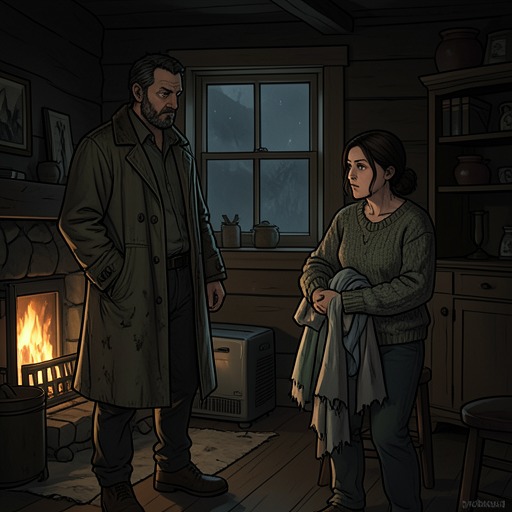
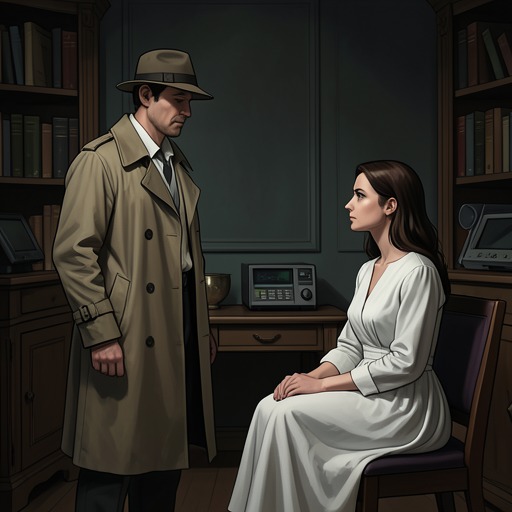
Charlie confides in Rainbird during the blackout
FirestarterCharlie confides in Rainbird during the blackout at the Shop, an encounter that converts his carefully cultivated presence into a rare opening for her to speak freely. In the dark, she tells him what she has endured and lets herself feel understood by someone she believes shares her pain. The intimacy is real for Charlie, but its conditions are engineered: Rainbird uses his own account of suffering to earn her trust, while privately treating that trust as part of his plan to control her.
A Familiar Voice in the Dark
Before the power fails, Charlie has increasingly watched and listened to Rainbird while he works nearby. He talks about ordinary matters—his bowling scores, his dog, and a broken television whose replacement parts cost too much. His questions do not feel like interrogations, and he does not insist on answers. To Charlie, his low, wandering voice offers a secret passage back to the outside world, distinct from Patrick Hockstetter’s sharp, probing manner. The familiarity has been building through small, unthreatening exchanges rather than a single dramatic appeal.
The blackout interrupts that routine. Charlie is standing at the bathroom door with one hand on the knob when the lights go out; the vacuum cleaner’s whine dies away. She suspects a trick, and when the lights return she stays inside. Rainbird comes to the door to ask whether they went out, then the power fails again. His voice changes: he sounds frightened, asks what happened, and cries that he has to get out and needs them to let him out. Charlie’s own fear of the dark begins to recede beneath her response to his. She opens the door and reaches out cautiously, still wary of tripping over the vacuum cleaner, but when she hears him crying she starts to feel her way toward him.
A Story That Opens a Door
Rainbird tells Charlie that interrogators had pressed him for information about troop movements, supplies, and light-infantry deployment. He says he was only a grunt, that they did not believe him, and that they withheld morphine and proper medical treatment until he answered. He describes being left in a hole in the ground, in a small earthen room with roots in its walls and only a glimpse of sunlight far above. According to his account, his captors warned that his injured face would become infected and that he would die, then covered the boards over the hole again when he begged to be released. He compares the darkness to being buried alive.
The account is presented as Rainbird’s disclosure, not as verified history. The narration makes clear that he is laying a deliberate emotional trap: he registers Charlie’s sympathy as another notch in a process he has been patiently advancing. His story nevertheless finds its mark. Charlie recognizes in its pattern of interrogation, threatened pain, and confinement something close to her own ordeal at the Shop. When he speaks of being disbelieved and treated like an animal, she thinks of Hockstetter and the steel tray of curly wood shavings he used to pressure her into demonstrating her power. She cries for Rainbird, but also for herself, her father, and her mother, and for the pain and rage she has held back over the previous five months.
The Confidence and Its Cost
Charlie answers Rainbird’s account with solidarity rather than suspicion. When he calls them both trapped, she tells him that being together matters more than whether the lights return soon. He asks her not to tell anyone what he has said, explaining that he needs the job and fears being fired. Charlie promises to keep the secret. That promise gives them a private bond, and Rainbird recognizes that the confidence has made her more accessible to him.
The blackout also loosens what Charlie has kept inside. She later cannot recall the conversation’s details, only its high points: her intense loneliness for her father and her terror that the Shop will find a way to make her use her pyrokinetic ability again. Rainbird asks why she has been locked up; she begins talking to distract him from the dark, then finds that the words are coming faster than she can manage. She cries, and he holds her clumsily. His apparent understanding resembles the comfort she associates with her father, helping explain why she gives him information she had meant to withhold.
By the time they reach the refrigerator, Charlie has told him nearly everything, including what happened at the Manders farm. She worries that the Shop will punish him if it discovers how much he knows, and the thought that he might be in danger moves her. What matters to her is not simply that Rainbird asks questions, but that he seems to receive her answers without the cross-examination and mistrust she expects. The exchange reverses the usual imbalance of her confinement: for a time, she is not merely being examined but choosing to disclose, and to someone she believes can understand.
Affection, Strategy, and Reversal
The connection is not reducible to a simple performance. Charlie embraces Rainbird and kisses him; he returns the embrace, and the narration describes his affection for her as real in his own way. Yet tenderness coexists with a lethal intention. Rainbird thinks of killing Charlie by putting his hands around her neck and imagines that he might then follow her into death. He hopes to read a particular signal in her eyes before sending her to her death. His fondness does not cancel the plan; it makes the relation more disturbing, because the person receiving her confidence is simultaneously measuring her for that final act.
The scene’s emotional turn comes after the comfort has taken hold. Charlie dozes beside Rainbird, and his abrupt suggestion that she should set the Shop’s fires if she can jolts her awake. Her shock exposes the limit of the apparent refuge he has created: the conversation has not taken her outside the institution or removed its demands. Rainbird has secured her confidence, and now he directs that closeness toward the very power she fears using. The blackout therefore produces both a temporary intimacy and a new avenue of pressure. Charlie’s confession gives Rainbird access to her grief and vulnerabilities; his final provocation begins to convert that access into leverage.