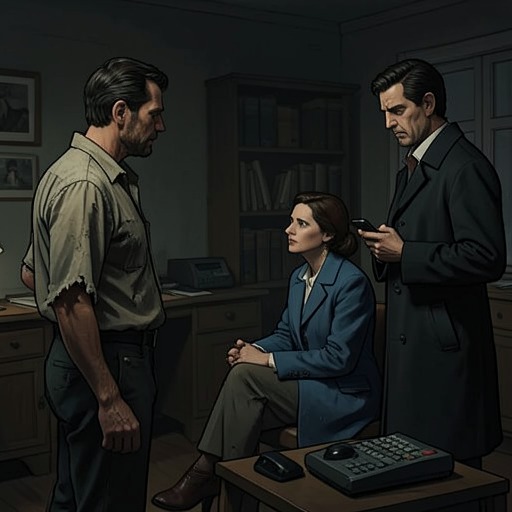
Rescue at an Ohio Turnpike rest stop
FirestarterThe rescue at an Ohio Turnpike rest area turns an ordinary roadside stop into a public confrontation between Andy McGee and the men holding Charlie. Andy’s recognition of a gray van leads him to his daughter, but the reunion is immediately threatened by guns. To get her back, he uses his mind-control ability after months of avoiding it, disabling both agents while civilians watch. The rescue restores their contact, but Andy knows the exertion will exact a price.
A Suspicious Van at the Rest Area
Andy is driving through heavy traffic beneath a bright sun when the glare from passing cars aggravates his headache. He slows, leaves the passing lane, and turns off at a rest-area sign. The place is modest: slant parking, a water fountain, bathrooms, and several cars, including a gray van. The sight of that van makes him nearly certain he has found the people he is pursuing. He turns in sharply, the station wagon’s tires wailing as he heads toward it.
The everyday scene around the van heightens the danger by making it difficult to distinguish threat from routine. Two families are eating at picnic tables; one is packing away lunch, while a young couple sits with a sleeping baby. Two young women are on the grass beneath elm trees. Andy sees no Charlie and no men who look like Shop agents. He switches off the engine and gets out, his heartbeat so forceful he feels it in his eyes. An elderly couple moves slowly through the lot, too, carrying on with an ordinary errand as Andy watches the van.
Then Charlie emerges from the men’s room. Two men in sport coats flank her, and she wears her packsack. Her face is blank with shock. She looks from one man to the other, speaks to one, and gets no response; the second shrugs and speaks over her head to his partner. They turn toward the drinking fountain with her. From Andy’s perspective, the men are the ones who killed his wife and took his daughter. Fear gives way to fury as he slips behind the van, with the agents’ backs turned.
The Reunion Becomes a Standoff
The men recognize Andy almost at once. Charlie recognizes him, too: the blankness leaves her face, replaced by gladness, and she cries, “Daddy!” Her attempt to run to him is cut short when one agent grabs her shoulder and hauls her back. He draws a gun and presses its barrel against her temple. His partner moves toward Andy with a hand inside his coat, reaching for his own weapon. The agents make the daughter Andy has come to rescue the leverage they need to keep him away.
The threat plays out in full view of the other travelers. One of the agents claims government business and tells a young man nearby to stay where he is; the man’s wife pulls him down by the arm. Andy answers the armed agent in a low, pleasant voice: “That gun is much too hot to hold.” The balding man looks puzzled, then screams and drops his revolver. It strikes the pavement and fires. As he dances in pain, white blisters rise on his palm. The sudden injury distracts the other agent, whose gun drifts away from Charlie’s head.
Andy uses that opening against the man still holding his daughter. “You’re blind,” he tells him, and pushes as hard as he can. Pain wrenches through Andy’s head; the agent screams, releases Charlie, and clutches his eyes. Andy calls her name. She runs to him and clings to his legs in a trembling embrace. The man in the information booth runs out to see what has happened, while the nearby families and picnic-goers witness pieces of the confrontation.
The Cost of Getting Charlie Back
The rescue is not complete when Charlie reaches Andy. The balding agent, still clutching his burned hand, runs toward them. Andy tells him, “Go to sleep,” and pushes again. The man drops sprawling onto the pavement, striking his forehead. Meanwhile, the blinded agent staggers across the grass, reaches a litter barrel, and falls among discarded sandwich bags, cans, cigarette butts, and soda bottles. Andy has stopped both men, but the violence remains visible and uncontrolled in a public place.
His head hurts badly. The effort is especially costly because he had not used the push since perhaps May, not even to prod a student whose grades were slipping. The months without using it have not made the power harmless: exertion brings immediate pain, and Andy expects that the charged-up state will be followed by a reckoning. He is glad it is summer, but he does not mistake relief from the immediate danger for freedom from consequence.
Charlie tells him how frightened she was and begins to cry. Her words return the scene to the father-daughter bond that had been interrupted by the agents’ guns: after shock, separation, and a violent struggle, she is again physically holding on to Andy. The rest-area rescue therefore shifts the immediate balance of power, not the wider danger surrounding them. Andy has recovered Charlie and shown that he can still use the push; the pain in his head makes clear that the means of protection carries its own cost.