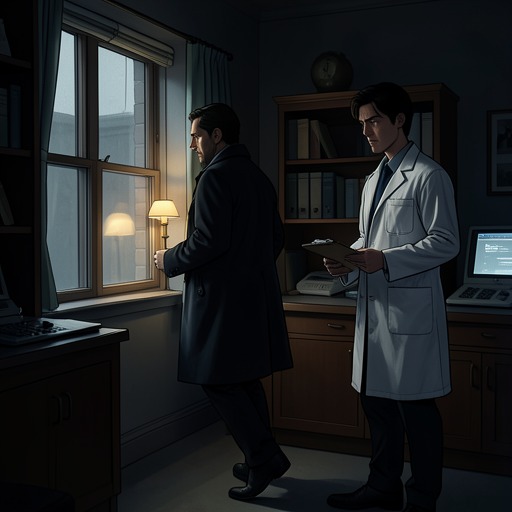
The Shop’s attack on the McGee family
FirestarterThe Shop’s attack on the McGee family is revealed not as one fully recounted scene but through fragments of memory: Andy’s grief over Vicky’s death, Charlie’s recollection of being taken, and Andy’s fear that the family could be seized again. Together, these passages establish the attack’s central consequence: the Shop’s violence destroys the family’s security and makes protecting Charlie an urgent, recurring struggle.
Background and Warning Signs
The danger surrounding the family appears first as a threat that is difficult to name openly. Andy remembers being afraid for himself, Vicky, and Charlie, and seeking information from his former roommate Quincey. Quincey warns that people may listen to telephone calls and invokes the atmosphere of the Watergate era before referring to an experiment involving twelve participants about six years earlier. His guarded explanation does not spell out the attack, but it places the family’s fear within a larger hidden operation and suggests why direct discussion feels unsafe.
Other memories show that the threat had already entered the family’s life through Charlie’s unusual abilities. Andy recalls that when Charlie was an infant, the pillow in her crib began to smolder; her parents stopped using the crib after the incident. He remembers fires occurring during her first year, including one involving curtains, and the strain that her parents experienced while trying to care for her. These events are not themselves the attack, but they establish the vulnerability around which the Shop’s interest and the family’s apprehension gather.
Vicky’s Death and Charlie’s Capture
Andy’s memory of Vicky’s fate is fragmented by grief and uncertainty. He understands that people connected with the Shop harmed her and that she eventually disclosed information, but he cannot settle on exactly how she died. His recollection holds on to the loss more firmly than to its precise mechanics: Vicky was dead, and the Shop stood behind the danger that had reached the family. Charlie’s later memory is more direct about the outcome. She recalls that the bad men killed her mother and took her away, placing Vicky’s death and Charlie’s capture within the same traumatic break in family life.
The difference between the two recollections matters. Andy’s account is shaped by a husband’s grief and by the uncertainty surrounding Vicky’s death; Charlie remembers the event from the position of a child who lost her mother and was removed from her father. Neither passage supplies a complete operational account of the attack. Together, however, they establish its essential results without resolving every circumstance: Vicky dies, Charlie is taken, and the family is forcibly divided.
Andy’s Rescue and Renewed Fear
The attack continues to govern Andy’s actions after Charlie is back with him. In one episode, he collects her from her second-grade classroom using an excuse about a sick grandmother. The urgent detail is his fear that he might arrive to find her seat empty and learn that people had already taken her away using a note supposedly from him. Charlie is there when he reaches the school, but Andy cannot know how narrowly he may have missed the people he feared. He later admits that he had been moving through the afternoon in blind panic, taking subways and buses and mostly walking, while Charlie grew tired beside him.
Their hurried travel ends with Charlie asleep in a cab. Andy has pushed the driver to accept his explanation, and he recognizes that he will have to pay the price for using that ability. His hand rests on Charlie’s leg as he watches her sleep. Her resemblance to Vicky brings affection and pain together: having Charlie physically beside him gives him relief, but it also recalls the wife he has lost. The scene shows the attack’s continuing force through practical decisions, fear of another abduction, and the burden Andy associates with using his power to protect his daughter.
Memory, Family, and the Attack’s Significance
Charlie’s memory places the coming danger alongside a change in her father’s behavior. When she was five, nearly six, Andy set aside her familiar storybooks and read aloud from nonfiction books about extraordinary events. He told her that the accounts were true and important, while her mother had previously stopped him from reading from a book devoted to pyrokinesis, saying Charlie should wait until she was older. In Charlie’s recollection, this unusual storytime belongs just before the men came for her mother and took her. The books therefore mark Andy’s attempt to prepare his daughter, even though the memories offer no basis for saying that he knew exactly what would happen.
The attack’s narrative shape mirrors the family’s damaged security. It is pieced together from fear, recollection, and aftermath rather than presented as a single, settled account. Andy’s careful attention to the sleeping Charlie, his memory of Vicky, and the remembered warning about watched telephone calls each disclose a different cost of the Shop’s intervention. The result is not only the loss of Vicky and Charlie’s capture, but a lasting pattern in which ordinary acts—collecting a child from school, explaining travel, letting her sleep—are overshadowed by the possibility that the Shop may reach them again.