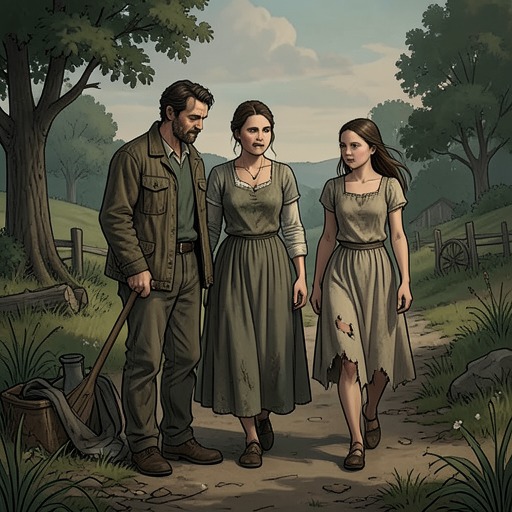
The Manders farm fire and the McGees’ escape
FirestarterThe Manders farm fire and the McGees’ escape mark the point at which a pursuit the Shop expected to control became a public-relations and institutional danger. Charlie McGee’s recollections connect the farm’s flames with her growing, frightening awareness of her own power; the Shop’s later response reveals how thoroughly its agents failed to understand that power. Andy McGee’s recovery of his daughter from two trained agents turned the escape into a judgment on the agency as well as a desperate family reunion.
Background and Escape
The incident followed the killing of Victoria McGee and the Shop’s abduction of Charlie. The agency’s failure to hold her was especially damaging because Andy was a college instructor with no military service, yet he took his daughter away from two trained Shop agents. One agent was left mentally impaired; the other fell into a coma lasting six months and was never again able to function normally. The contrast between the agents’ training and the outcome made the escape difficult for the Shop to dismiss as an ordinary operational setback.
The McGees’ success also extended beyond the farm. They had managed to stay ahead of the Shop for a prolonged period, making the escape part of a larger record of pursuit failures. For the institution, the problem was not only that Charlie and Andy had got away, but that the outcome invited a blunt comparison: a father acting to recover his child had overcome the agency’s trained personnel.
Charlie’s Memory of the Fire
Charlie’s later recollection gives the fire a private meaning distinct from the Shop’s institutional accounting. At night she saw again the men on the porch crowned with flame, the cars exploding, the chickens catching fire, and the teddy bear she remembered as something she had herself set alight. These images gathered the farm’s violence into a sequence she could not treat as a detached success. Her memories joined the danger to her own actions and to the knowledge that her power had grown more compelling the more she used it.
That attraction troubled her. Charlie understood the capacity as something that became harder to stop through repeated use, and she regarded the harm associated with it as evidence against herself. Her recollection therefore carries two opposing consequences of the incident: she had been able to use a power that helped make escape possible, but the experience deepened her fear and guilt about what using it meant. The fire was not simply a weapon in the contest with the Shop; it became part of the moral burden she carried afterward.
The Shop’s Failure to Recognize the Cause
For Cap Hollister, the farm incident had nearly brought the agency down. He understood that criticism was gathering around the way the McGees had been handled, from Victoria’s death and Charlie’s brief capture through Andy’s rescue and the consequences for the agents. The fire itself became the most dangerous part of that record because it threatened the Shop’s credibility beyond its own personnel. Cap anticipated whispering, memoranda, and perhaps testimony at secret congressional hearings, while the agency’s other business was being eclipsed by the McGee case.
Cap’s account also identifies a second failure beneath the tactical one: people inside the Shop would not accept that Charlie was pyrokinetic, a firestarter. Reports attributed the Manders farm fire to explanations such as gasoline, a broken kerosene lamp, or spontaneous combustion. Some reports came from people who had been present. In Cap’s view, this was not a lack of evidence so much as a refusal to acknowledge what the evidence implied. The institution could not respond effectively to Charlie while continuing to describe her ability as something else.
Aftermath and Significance
The escape left the Shop facing both operational embarrassment and a threat to Cap’s position. He believed the criticism had begun an undermining process that could not be stopped indefinitely. He had used years’ worth of favors to remain in his role through the winter, and he weighed the prospect of holding on for months against the possibility that a more aggressive defense might tear the agency apart. He did not want to destroy an organization in which he had invested half his life, but he was prepared to see the matter through.
The farm fire thus joins Charlie’s private reckoning to the Shop’s institutional crisis. To Charlie, the recalled flames signified power, damage, and a frightening loss of restraint. To Cap, the same incident exposed the agency’s failure to protect its reputation and, more fundamentally, its refusal to understand the threat it faced. The McGees’ escape was a concrete reversal of control; the Shop’s effort to explain away the fire ensured that the reversal continued to matter after they had left.