Charlie’s fourth fire test
FirestarterCharlie’s fourth fire test is the Shop’s most striking demonstration of her ability to concentrate heat, and a turning point in how she understands her control over it. In a room converted from the Shop’s chapel, she destroys a cinderblock wall and boils a tank of ice water despite extensive cooling equipment. The instruments record extraordinary temperatures but little corresponding physical exertion. The test strengthens her command of the ability even as its results leave the observers unsettled and Charlie herself overwhelmed by conflicting feelings.
Setting and Experimental Arrangement
The test takes place at two o’clock on an early October day in a long room that had been the Shop’s nondenominational chapel until the previous week. The chapel’s pews and wood paneling have been removed. Asbestos batting and heavy-gauge tempered steel cover the insulated walls and floor, while partitions divide off the former altar and nave for Patrick Hockstetter’s monitoring instruments and a computer terminal. The rapid conversion reflects how quickly the Shop’s testing program has advanced: the work began only four days before Herman Pynchot’s death, and the remaining tests on Charlie are now being held there.
The apparatus sets a formidable limit for the demonstration. A cinderblock wall stands in the middle of the room, with a six-foot-deep tank of water nearby containing more than two thousand pounds of ice. Eight industrial Kelvinator air conditioners are arranged around the room. They switch on when its overall temperature passes ninety-five degrees, pumping freezing air into the space. The cameras record the test in color, and a temperature probe at the wall’s center sends its reading to a digital display. This arrangement makes the test both an experiment and a visible contest between Charlie’s focused heat and the machinery meant to contain it.
Charlie, eight years old, stands before the wall in a blue denim jumper and red-and-black striped rugby socks, her blond hair in pigtails tied with black velvet bows. Patrick Hockstetter gives the signal over a hastily installed intercom. The first few seconds show little outward movement. On the camera’s inset temperature display, however, the reading rises from seventy degrees to eighty and then ninety; after that, the numbers change too rapidly to follow clearly.
Destruction of the Wall and Tank
The recording shifts to extreme slow motion because the action is otherwise too fast to capture in detail. The wall first begins to smoke. Mortar and concrete particles lift from its surface; the mortar between the blocks softens and runs, and the blocks crumble outward from the center. The sensor reaches a reading above seven thousand degrees and then freezes—not because the temperature has stopped increasing, but because the probe has been destroyed. Even the slowed footage cannot fully clarify the process, but it shows the blocks breaking apart under heat.
The cooling system does not prevent the room from heating. With all eight air conditioners operating, its expected temperature is minus fifteen degrees Fahrenheit, give or take five degrees. Instead, the recorded temperature continues upward through one hundred, one hundred and five, and one hundred and seven degrees. It eventually reaches 112 degrees. The observers’ sweating cannot be explained by heat alone, the account notes, suggesting that witnessing the event is affecting them as well as the room’s physical conditions.
The cinderblocks themselves catch fire, burning with blue and yellow flames before the wall is obscured by the outward burst of disintegrating particles and disappears. Charlie makes a half turn; the icy water in the tank then churns and boils. After the room’s temperature peaks, it begins to fall. The sequence gives the test a clear progression: the focused attack breaks down the wall, spreads to the tank’s water, and then recedes, leaving the monitoring equipment and observers with a record of effects that exceed the room’s capacity to control them.
What the Recordings Reveal
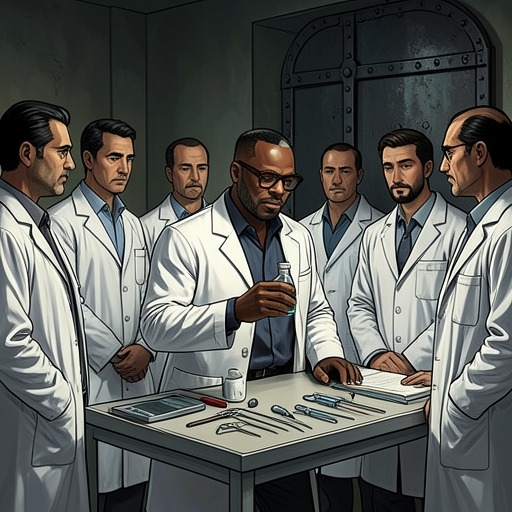
A memo about Test #4 considers the films and telemetry together. Its writer says the footage is difficult to accept as genuine and anticipates that viewers at a Senate subcommittee hearing on Lot Six appropriations and renewal may doubt it. The memo summarizes the findings as unresolved rather than claiming a scientific explanation. Charlie’s blood pressure remains within normal limits for a child of eight, with hardly any change as the wall is destroyed. Her alpha-wave readings are abnormally high; the memo’s writer and a colleague interpret their relative evenness as possibly indicating controlled imaginative dexterity and more precise manipulation, while acknowledging that the reading may mean nothing.
The metabolic data are similarly ordinary. The telemetry shows no unusual metabolic activity, and a Beal-Searles CAT test indicates a caloric expenditure of about twenty-five calories—roughly the effort of a handful of sit-ups or walking around the building twice. Yet the memo estimates that Charlie produced upwards of 30,000 degrees of focused heat. The contrast between that estimate and the small measured expenditure raises the central unanswered question: whether the heat comes from Charlie or passes through her from some other source. The memo does not resolve the problem; it stresses that the limited testing may never do so.
The writer’s response moves from technical uncertainty to apprehension about the implications. He warns that further testing should be reconsidered and wonders what Charlie might produce if she deliberately exerted herself. The concern is not proof of a discovered mechanism, but it marks how the test alters the observers’ assessment: the results are no longer merely evidence of a controllable capacity to ignite or heat objects. They suggest a scale of power that the existing measurements and procedures cannot confidently explain.
Charlie’s Changed Position and Aftermath
For Charlie, the tests have a different consequence. Repeated practice has weakened her fear of starting fires, like an earthen dam developing leaks, and has refined what had been a crude force into an ability she can direct with deadly precision. The fourth test therefore demonstrates more than strength: the training has changed the relationship between Charlie and her power. She understands the tests as an object lesson in who is in charge, and reaches the conclusion that she is.
That realization does not settle her feelings. After Patrick Hockstetter leaves, Charlie collapses onto the couch and sobs, experiencing guilt, horror, indignation, a measure of angry pleasure, and—most strongly—fear. She thinks that agreeing to the tests has changed things, perhaps permanently, and now needs to see her father for guidance. The passage sets her recognition of agency against her dependence and distress: she can command the force demonstrated in the room, but has not yet decided what that command means or how to live with its consequences.
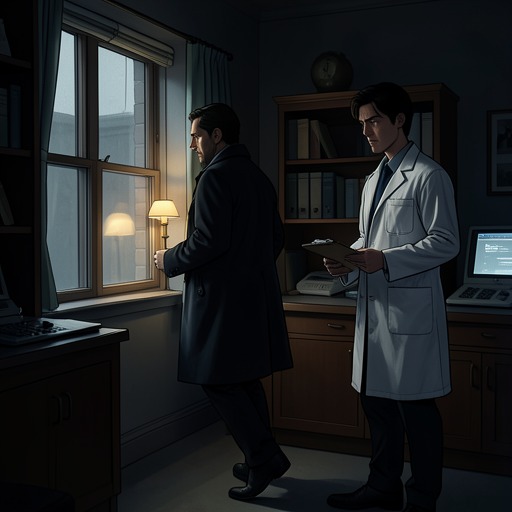
The test also unsettles the Shop’s own personnel. Patrick Hockstetter leaves afraid and angry with John Rainbird, who had anticipated what would happen without telling him. The following day, Hockstetter writes that any additional knowledge gained through testing should be weighed against hazards that, in his view, are increasing too quickly for comfort. The fourth test thus ends without an explanation of Charlie’s heat or a settled judgment that the experiments should continue. It leaves three linked outcomes instead: a record of extraordinary destructive capacity, a more practiced and self-aware Charlie, and a growing institutional fear that knowledge of her ability may carry risks the Shop cannot contain.