Carter
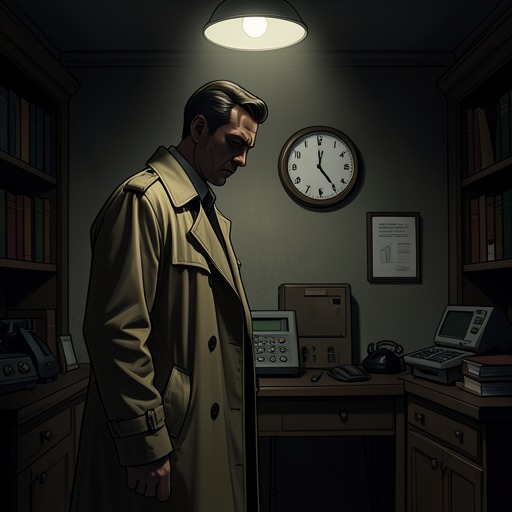
FirewallCarter is a senior financial operator turned conspirator whose alliance with Tynnes Falk gives a radical assault on the global financial system both institutional knowledge and technical means. He believes that power can be changed only from close to its source, but when reform within the financial order proves impossible, he decides to help destroy it. Falk’s death leaves Carter to carry their plan forward alone, under pressure from a police investigation that he cannot bring to a halt.
Identity and Early Formation
Carter is a wealthy white man living in Luanda, where his guarded home, armed protection, and private generator mark the distance between his position and the poverty around him. He understands the crime that surrounds him as a consequence of that inequality, and privately imagines that he might have robbed others himself had he been poor. His security is layered: guards and fences are not enough for him, and he keeps a gun beneath his pillow. Even ordinary disruptions, such as the unreliable electricity, expose how dependent his carefully controlled life is on systems he cannot fully command.
By the time of the events in Luanda, Carter is approaching sixty and has built a life around disciplined routines and distrust. Dawn leaves him vulnerable to memories of old wrongs; thoughts of revenge are what restore his composure. He despises his allergies as a weakness, and the prospect of sneezing can interrupt his lectures or bring on hives and watering eyes. These private irritations sit beside his capacity for cold planning: he is not free of physical vulnerability, but he tries to treat vulnerability as something to suppress or manage.
His political outlook formed through experience in Vietnam. Stationed near An Khe along the route west from Qui Nhon, he killed many soldiers and felt no remorse. He remembered remaining disciplined while other soldiers turned to drugs, and came away convinced that a person seeking to alter power had to stay close to its source. Years later, in Angola, that conviction became a governing principle rather than a wartime lesson.
Angola and the Abandonment of Reform
Carter left Columbia for a university in California after his year in Vietnam. He then learned Portuguese and secured a senior post in Angola, rising quickly despite competing candidates with greater experience. At first he treated the country as a place to listen and learn. He admired the joy and dignity he saw amid hardship, and felt that, unlike in Vietnam, he was welcome there.
It took him nearly two years to conclude that the bank he served was helping protect the very rich rather than enabling Angola to gain genuine independence and rebuild after war. He saw deference to rank masking corruption, weakness, and greed. Some independent intellectuals and politicians shared his assessment, but lacked influence. Carter repeatedly tried to persuade his superiors, making transatlantic trips to the head office and writing countless memoranda. Their response, as he understood it, amounted to well-meaning indifference. At dinner in Georgetown, his longtime mentor Whitfield told him that the issue was not whether Carter was right, but what the bank’s policy was. On the flight back to Luanda, Carter began to form a decisive alternative to reform.
He did not believe civil disobedience could reshape the world, nor did he trust the small, quarrelsome socialist organizations. Instead, he believed change had to come from within existing structures. That reasoning first brought him into the institution he came to oppose; later, it allowed him to see the institution’s vulnerabilities from the inside. His disillusionment did not lead him back toward conventional politics. It helped turn the language of structural change into a justification for destroying the structure itself.
Falk and the Jacob’s Marsh Conspiracy
Carter met Tynnes Falk by chance at Metropol, a restaurant in Luanda’s harbour. Falk, a Swedish engineer and technician on a consulting assignment for Angola’s neglected state telecommunications sector, spoke poor Portuguese; Carter translated for him when the waiter could not speak English. They continued talking after dinner and arranged to meet again. When Falk’s initial three-month project ended, Carter offered him another, largely to keep him in Luanda and continue their conversations.
The two men found that their political and moral views aligned, and each became someone in whom the other could confide. Carter helped Falk settle in Africa, finding him a comfortable house overlooking the harbour and paying him excessively for modest consulting work. He also guided Falk into a relationship with Rosa, the daughter of a Portuguese businessman and an Angolan housekeeper. These gestures helped turn a professional contact into a durable personal alliance; the two remained in regular contact for twenty years.
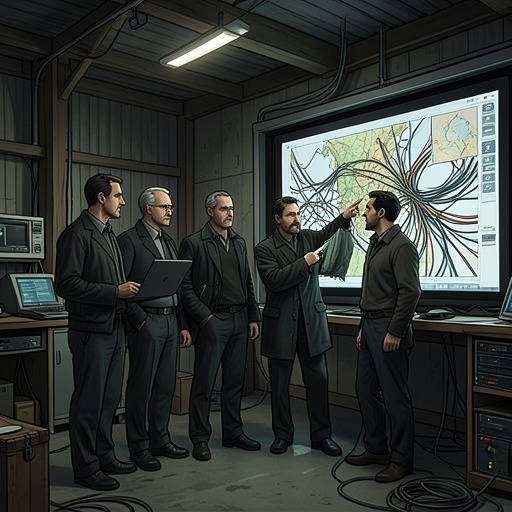
Their long conversations supplied the plan with its two complementary forms of expertise. Carter knew how the bank and financial institutions worked, had contacts, and understood the delicate balance of the global economy. Falk explained the reach of electronic communication and the possibility that future attacks could travel through computer networks and fibre-optic cables rather than arrive as conventional military force. Carter became convinced that control of electronic communication meant control of everything. They agreed to wait rather than strike hastily, and spent months refining their design.
Carter called the operation Jacob’s Marsh, a name drawn from Falk’s memories of a childhood marsh beside wildflower meadows. Falk had told him that a man named Jacob drowned himself there over an unrequited love. For Falk, the place came to represent life’s chaos and the prospect of drowning in it; Carter adopted the name as a private tribute to his friend. The same image also suited the destructive ambition of their project: the operation was intended not to reform the world’s financial arrangements but to make the existing order collapse.
Carter’s own justification hardened as he looked at Luanda’s poverty and social disintegration. He told himself that whatever rose from the ashes of the destruction he planned would be better than the city he saw. The conviction was not simply a technical calculation. His disappointment in institutions and his contempt for their failures had become part of the rationale for an attack whose consequences would extend far beyond them.
Falk’s Death and the Fraying Operation
Falk’s unexpected death in Sweden altered the plan at its most dangerous point, shortly before its intended strike. Carter initially refused to believe the news. He had allowed for interference beyond his control, but not for the death of one of the two people on whom the operation depended. He mourned Falk as a friend and recognized that he was now alone at the threshold of the planned action. The name Jacob’s Marsh became, in his mind, a gesture of remembrance as well as the operation’s designation.
Carter had sent an operative to Ystad after learning of Falk’s death, and believed that the situation remained manageable despite a series of troubling incidents. That confidence was shaken when an alert appeared during his daily computer checks in Luanda: two short flashes followed by one long one. Using the manual Falk had written for him, Carter understood that someone had breached the first layer of security on Falk’s computer in Sweden. The system still had deeper layers of decoys and firewalls, but the intrusion meant that someone might be moving toward its protected core. Carter sent a message into the network and received a reply.
Fu Cheng’s reports increased Carter’s concern. The police were still trying to enter Falk’s computer, and had enlisted Robert Modin, a young man Carter considered a potentially formidable hacker. Carter worried that Modin might be able not only to penetrate secure systems but to interpret what he found. He also recognized that the investigators were following the trail persistently, with Kurt Wallander identified as the policeman tracking them. The effort to stop Wallander had failed, and Carter had to make decisions more quickly than he wanted.
The consequences of that haste troubled even him. He acknowledged that removing Falk’s body might have been unnecessary and wondered whether the young woman who was killed also needed to die. He believed she could have talked, but the possibility of exposure had driven the choice. In the background, the investigation continued to connect people and clues that Carter had expected to remain protected. As the police penetrated Falk’s computer security, Carter watched the plan’s secrecy erode and recognized that his old partner’s death had left him to manage both the operation and its damage control.
Flight, Exposure, and Legacy
Carter’s reports from Luanda became increasingly unsettling, and he eventually decided to travel to Europe. He booked a flight from Luanda to Lisbon, then continued toward Copenhagen. At Lisbon, he entered under the identity of Lukas Habermann, a German citizen born in Kassel in 1939. After clearing customs, he destroyed that passport in a toilet and adopted another identity: Richard Stanton, an Englishman born in Oxford in 1940. He changed his appearance with an overcoat and wet-combed hair, avoided the customs officer who had processed him on arrival, and used a mobile phone only after finding a secluded place in the terminal.
His immediate reason for moving was operational. He heard that Fu Cheng had failed to report as expected, but also learned that Modin had been delivered into the conspirators’ hands. Carter judged the captured hacker to be their greatest threat and set aside his concern about Cheng’s disappearance. The shift shows how completely the crisis had narrowed his priorities: the survival of the operation came before the fate of an operative who had previously seemed dependable.
The case’s later review reconstructs Carter as the leader of a secretive, tightly controlled organization built with Falk. Its members included Fu Cheng, Elvira Lindfeldt, and Jonas Landahl, who were drawn in and ensnared within a hierarchy where Carter and Falk made the decisions. The police concluded that Carter was ruthless and calculating, and suspected that he had personally executed more than one unsatisfactory member. Elvira’s murder by Carter was never fully explained, though Kurt Wallander inferred that she may have known too much and become a liability. Carter had arrived in Sweden close to desperation, but the evidence suggested that he remained close to accomplishing his objective.
The attack was prevented because neither Modin nor Wallander put Carter’s Visa card into the cash machine at exactly 5:31 a.m. on October 20. Had that action occurred, it would have triggered an electronic assault on financial networks. Investigators later found that the vulnerabilities exposed by Falk and Carter’s preparations were serious enough to alarm security specialists around the world. In the event, a selection of cash machines in Skåne malfunctioned for a day before returning to normal operation. The dead Carter, identified by the investigators as coming from Luanda, left behind a conspiracy whose central leadership had collapsed with him and Falk. Their plan did not destroy the financial system, but it revealed how much damage their knowledge and access might have enabled.