Martinsson
FirewallMartinsson is a capable, sharp-minded police officer whose stubbornness makes him a valuable partner to Kurt Wallander in the investigation around Tynnes Falk and the deaths connected to Falk’s computer network. Yet the same partnership is eventually undone by Martinsson’s private criticism of Wallander and a breach of trust that neither man can repair. His arc joins the novel’s procedural work to its personal cost: the investigator who helps Wallander pursue a hidden pattern becomes the colleague Wallander can no longer trust.
Identity and Working Style
Over the years, Wallander has become increasingly convinced of Martinsson’s abilities as a police officer. Martinsson is both stubborn and sharp, qualities that help him persist when a case resists easy explanation. His judgment is not infallible, however. Impatience can overtake his intelligence, and he sometimes produces careless background work. He also tends to be in a hurry, often entering Wallander’s office without knocking. Their different working habits are visible in small details: Martinsson leaves his office door open, while Wallander needs a closed door to concentrate.
Martinsson has previously considered leaving the police. The most serious crisis came after his daughter was attacked at school by offenders who said they targeted her because she was a policeman’s daughter. Wallander persuaded him to stay then, but Martinsson warns that the next attempt to talk him out of quitting will not be so easy. Wallander fears losing him as a colleague, a concern that gives their eventual rupture the weight of more than an ordinary workplace disagreement.
The Lundberg Case and Its Human Cost
When Wallander and Martinsson discuss the assault on Johan Lundberg, Martinsson initially gives the practical explanation: the young women needed money. But he does not pretend that this resolves the case’s disturbing violence. Lundberg remains unconscious and in critical condition, and Martinsson admits that he does not understand what drove the attackers. Wallander insists that understanding matters to their work, even when Martinsson is unsure he wants to pursue the question.
The case becomes grimmer when Lundberg dies. Martinsson reports the death at the morning briefing, where Wallander explains that Sonja Hökberg and Eva Persson planned the attack, carried weapons, and have not denied their charges or blamed one another. Martinsson’s earlier unease about Persson is not limited to the investigation’s facts: his daughter knows her, and he thinks about what Persson’s parents must be going through, since she appears to be their only child. The case is thus not merely an exercise in assigning responsibility; Martinsson recognizes the families and young people left behind by the violence.
Pursuing Falk’s Death and the Missing Body
Martinsson brings Wallander the report of Tynnes Falk’s death beside a cash machine. Falk had been found with a head wound, but the evidence did not establish whether he had been struck or had injured himself in a fall. His wallet still contained money, and he had a balance slip in his hand without having withdrawn cash. Martinsson also identifies Falk as a divorced computer consultant who lived nearby. When the case is first treated as a natural death, its wider significance remains unseen.
After Sonja Hökberg is found dead at the power substation, Martinsson and Wallander compare the possibilities of murder and suicide. They note that the station is three kilometres away and that an escape on foot seems implausible given the police search; someone may have driven her there. The gates were forced, but the door was not, making access to the substation keys another question. Martinsson helps assemble the list of five key holders and reports that each accounted for the keys, while only one had visited the substation in the preceding days. At this stage, the evidence still leaves the cause of Hökberg’s death unresolved.
The disappearance of Falk’s body changes the investigation. Martinsson tells Wallander that the body was missing from a morgue locker and that a broken electrical relay had been left on the stretcher. He reconstructs the window of the theft: the body was present when the janitor left at 6 p.m. and gone when the morgue was checked around 8 p.m.; a back-door lock had been broken. Martinsson arranges for the relay and morgue area to be examined for fingerprints. He and Wallander agree that the relay looks like a message and that the body may have been removed to conceal something, though Martinsson cautions that theft alone does not prove Falk was murdered. Their discussion turns toward Falk’s life, his ex-wife’s report that he had enemies, and the possibility of links among Falk, Hökberg, Persson, and Lundberg.
Falk’s Computer and the Emerging Network
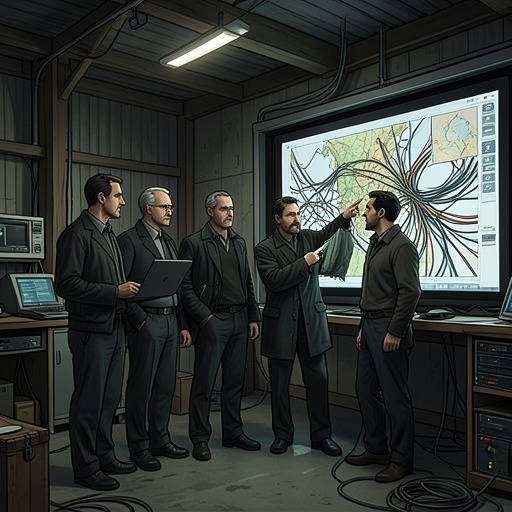
Martinsson takes the lead in examining Falk’s computer, despite his own doubts about how much he can manage. When he starts the machine, it connects automatically to a server; an attempt to open a file appears to notify someone elsewhere that it has been accessed. Martinsson finds the files protected by complicated codes and barriers, but later works with Robert Modin, whose technical skill takes the investigation further. Wallander sees Martinsson absorbed at the screen, coordinating the work as Modin operates across three computers and keyboards.
As the computer is breached, Martinsson reports connections to institutions including the National Bank of Indonesia, a bank in Liechtenstein, a French telecommunications firm, and a commercial satellite company in Atlanta. Modin identifies an ordered pattern among the network’s identities and a time element in their changing coordinates. With 74 identities and the recurring number 20, the pattern appears to point toward October 20. Martinsson considers the approaching date urgent, while Wallander questions whether the computer is the right route into the case. When Wallander decides to bring in a National Police specialist, Martinsson carries out the instruction, and Modin leaves disappointed; neither man notices that Modin copies remaining material before he goes.
Martinsson also supports Wallander’s effort to understand how the conspirators might know so much about the police investigation. He reports no clear answer to a message routed through a server called Vesuvius, and he laughs at first when Wallander wonders whether someone is penetrating the police computers. Yet the question gives their work an uneasy dimension: the investigators may be tracing a network while their own information is exposed. Their collaboration remains effective on the case even as trust between the two men is beginning to fail.
Conflict and Broken Friendship
The break becomes explicit after Wallander confronts Martinsson over what he has told Lisa Holgersson. Wallander learns that Martinsson described him as having ordered Martinsson to stay back during a dangerous field operation. Believing the account false, Wallander strikes him, then wrestles him into the mud while accusing him of spreading lies and criticizing him behind his back. In the aftermath, Wallander recognizes that the fight has added another allegation of inappropriate force to the scrutiny already surrounding him.
Their final conversation makes clear that the dispute is not just about one report. Wallander accuses Martinsson of undermining his leadership and suggests that he is positioning himself for a future career. Martinsson replies that Wallander has lost his grip and says his own fault was failing to say so earlier. He maintains that Wallander does not really listen and claims Holgersson must have misunderstood what he said about the field operation. Wallander still feels the urge to hit him, but no longer has the energy to act on it. Neither man changes his position.
Wallander experiences the end of their friendship as a loss of camaraderie as well as trust, and wonders whether the friendship had ever been as secure as he believed. Martinsson’s place in the story is therefore deliberately double: he is a resourceful colleague who helps expose the investigation’s hidden connections, but also a critic whose judgment of Wallander becomes impossible for Wallander to accept. Their partnership produces investigative progress; its collapse leaves Wallander more isolated and doubtful about how long he can continue in police work.