Nyberg
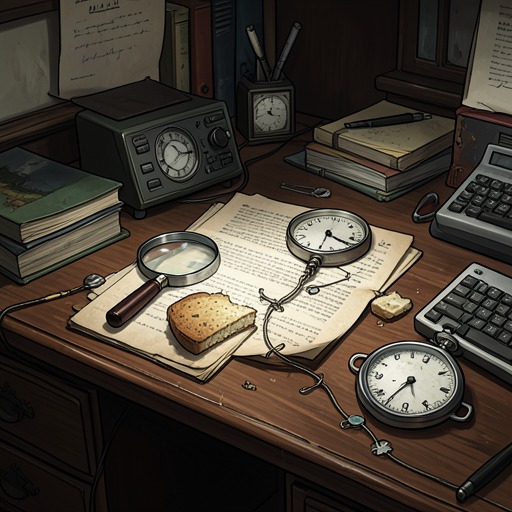
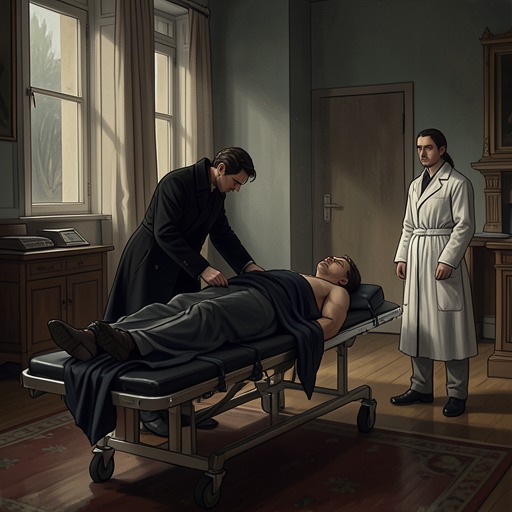
FirewallNyberg is the forensic investigator whose patient examination of objects, bodies, and crime scenes repeatedly gives Kurt Wallander’s investigation a firmer direction. His contribution is not merely technical: by noticing what does not fit, he helps turn isolated evidence into a pattern, even as several central mysteries remain unresolved.
Forensic Work and Investigative Judgment
When Tynnes Falk was found dead beside a cash machine, Nyberg’s initial assessment was cautious. Apart from a head wound, nothing pointed clearly to a crime, and Falk had probably suffered a heart attack. The blood-spattered receipt in Falk’s hand showed that he had checked his account balance at 12.02 a.m. but had not withdrawn money. Kurt Wallander wondered whether the unexpectedly low figure might have mattered; Nyberg’s assessment kept the uncertainty open rather than prematurely turning the death into a murder inquiry.
The discovery at the power substation presented a different problem. Nyberg arrived to examine a completely blackened body trapped among electrical equipment while a major part of Skåne was without power. The scene could suggest suicide, but, as he observed, if it was murder it was exceptionally brutal, like an execution by electric chair. His response was to continue the examination rather than settle on either explanation: he wanted the body moved so he could check what lay behind it, while technicians searched the ground between the transformer building and the gates.
That search produced a woman’s handbag, found about 15 metres from the transformer building. Nyberg’s team had located a clue whose placement itself demanded explanation; its distance from the body would later sharpen Wallander’s suspicion that it had been left to ensure the victim was identified. The bag belonged to Sonja Hökberg, confirming who had died in the substation. Nyberg also followed the physical evidence surrounding access to the site: the gates had been forced, while the reinforced steel door showed no sign of being forced, suggesting that whoever entered had used a key.
Nyberg’s work connected the substation death to Falk’s world through an electrical relay recovered by colleagues in Malmö. Once the substation workers showed exactly where the relay belonged, Nyberg told Wallander there was no room for doubt about its origin. The connection between Hökberg and Falk was thus established by an object whose significance was initially unclear, giving the investigation a concrete link without yet explaining what it meant.
Trace Evidence and the Hidden Room
Nyberg’s attention to small physical details gave the investigation several of its most concrete leads. He reported that the knife used in the taxi driver’s killing had been found after his team searched through leaves. It was a large kitchen knife with a broken tip, probably snapped when it struck a rib; the damage suggested that Sonja Hökberg had used considerable force. The weapon strengthened the case against her, while its ordinary origin made the violence more disturbing rather than less.
At Tynnes Falk’s flat on Runnerströms Torg, Nyberg noticed a discrepancy in the room’s dimensions. Renovations could account for altered floor plans, but he measured the space, tapped the walls, and heard a hollow sound. A loose skirting board and a crack concealing painted-over tape led him to a low hidden door. Behind it was an approximately eight-square-metre room, windowless except for a small air vent, with a table like an altar and two candles. A photograph of Falk hung on the wall; in it he held what appeared to be a remote control. Nyberg had found a concealed space that complicated the picture of Falk as merely a computer consultant, although neither investigator could yet explain its purpose. Their search found nothing else in the room, which appeared to have been cleaned recently.
Nyberg also recovered a group photograph from Falk’s flat: three men holding up a salmon during a fishing trip in Norway in 1983. Its importance lay partly in what was missing from the investigation. Wallander had remembered an Asian man at a restaurant, a forged identity in the name of Fu Cheng, and the photograph that had been taken from Falk’s home; the recovered image offered a possible route toward identifying Falk’s associates. Nyberg’s findings from a separate break-in at the flat were less conclusive: fingerprints could all have belonged to Falk, and the body’s disappearance made comparison harder.
Later, Nyberg’s examination of Jonas Landahl’s car supplied a more discriminating trace. After technicians had worked on the vehicle in the garage at Snappehanegatan, he found a still-wrapped stick of spearmint gum on the back seat. Its packaging had helped it escape notice during the first inspection. Wallander connected the brand to gum he had given to Hökberg, prompting him to ask whether Eva Persson had shared hers with her. The small object shifted the inquiry from a general search for traces in the car toward a specific link between the girls and the vehicle.
The car’s tyres offered another connection to the substation. Nyberg compared their tread with photographs of the unexplained tyre marks at the scene. One rear tyre was underinflated and worn on the inside because the wheels had not been properly balanced. That distinctive wear made Landahl’s car the strongest match, though Nyberg carefully stopped short of claiming certainty: the pattern could not identify the vehicle beyond all doubt.
Nyberg’s contribution extended from collecting evidence to reconsidering what the evidence meant. After Landahl’s death aboard the ferry, he brought together three unsettling details: the relay placed in the morgue, Hökberg’s handbag left by the substation fence, and Falk’s body returned to the cash machine with two fingers missing. Rather than assume that every striking detail belonged to one coherent design, he asked whether the investigation was overinterpreting events and whether some of them were meant to mislead. He proposed that the taxi-driver murder might be less significant than Wallander had thought, and applied the same doubt to the relay. The suggestion did not resolve the case, but it challenged the assumption that the most dramatic clues necessarily pointed toward the central plot.
Method, Temperament, and Limits
Nyberg’s method is patient and provisional: he reports what the physical evidence can establish, while keeping its uncertainties visible. A search of Falk’s flat yielded no fingerprints that could be identified as anyone other than Falk, and the dogs found no further trace. Nyberg recommended sending the prints to Interpol, though he could not say whether its records covered Angola. The unanswered question mattered because Wallander was trying to connect Falk’s earlier life there to the investigation; the forensic result offered a next step, not a conclusion.
His caution was matched by a talent for recognizing which detail deserved another look. After Landahl was found dead aboard the ferry, Nyberg established that he had died about three hours before it reached Ystad, meaning his killer might still have been aboard. Wallander acknowledged that the police should have checked passengers before they disembarked. Nyberg did not turn that missed opportunity into certainty about the killer’s movements; he gave the investigation a tighter window and made its procedural failure plain.
When gunfire sent Wallander to a car park in pursuit of an armed man, Nyberg arrived with forensic technicians after the suspect had escaped. The team searched the van and sought fingerprints that might connect it with Apelbergsgatan, Runnerströms Torg, the power substation, Hökberg’s handbag, or Siv Eriksson’s flat. The dogs followed a scent toward the water, but lost it along the coast. At the scene, Nyberg’s work was a disciplined accounting of what could still be recovered, not a promise that the search would succeed.
Even late in the case, his findings helped distinguish a concrete link from a theory. A report from the ferry established that an empty case in Landahl’s cabin had belonged to Falk, although its contents were never found. In another urgent update, Nyberg identified the weapon as a 9 mm Makarov and said he thought it was the same weapon used in the flat on Apelbergsgatan; the dead man carrying it had three passports, from Korea, Thailand, and Romania. Such observations narrowed the field without making the larger design transparent. Wallander regarded Nyberg as thorough and well organized, able to judge what needed attention first and what could wait—a reliability that mattered in a case where even the most telling objects did not always yield their full meaning.
Temperament and Lasting Contribution
Nyberg’s exacting work is accompanied by the wear of a long career. When he called Wallander back to Falk’s flat, he was smoking on the landing, an unusual sign that he was close to exhaustion; the last time Wallander had seen him that strained was during the investigation that captured Stefan Fredman. Later, Nyberg joked about wanting retirement to arrive sooner, despite the poor pension, and warned Wallander not to ask about his vertigo. Wallander understood that the complaint masked fatigue and perhaps unease about leaving work. Yet Nyberg’s tiredness never erased the habits that made him dependable: he was thorough, well organized, and able to judge which parts of an investigation could wait.
His later reports continued to refine the case without pretending to solve it. Nyberg established that the empty case found in Jonas Landahl’s ferry cabin had belonged to Falk, though the contents were never recovered; he thought Hua Gang might have thrown them overboard to delay identification. Elsewhere, the post-mortem settled the question of Falk’s death: it had been natural, caused by a burst blood vessel in his brain rather than a heart attack. The answer corrected the investigators’ early assumptions but did not explain the missing fingers, Falk’s unrecovered journal, or the full purpose of his hidden arrangements.
That mixture of precision and limitation defines Nyberg’s part in the investigation. He could establish where a relay belonged, recover traces others might overlook, and put boundaries around what the evidence could prove. He could not make every object disclose its meaning. In a case where the distinction between deliberate design and coincidence repeatedly unsettles Wallander, Nyberg’s forensic discipline supplies something steadier: facts carefully tested, uncertainties kept visible, and conclusions no broader than the evidence allows.