Tynnes Falk
FirewallTynnes Falk is a Swedish computer consultant whose death initially appears to be an isolated medical event, but whose concealed past makes him central to a plot against the global financial system. As investigators follow the trail from a blood-spattered cash-machine receipt to a hidden office, an encrypted computer and an album from Angola, Falk emerges as both a technically gifted conspirator and an elusive, divided figure whose motives and final hours are never fully explained.
Identity and Background
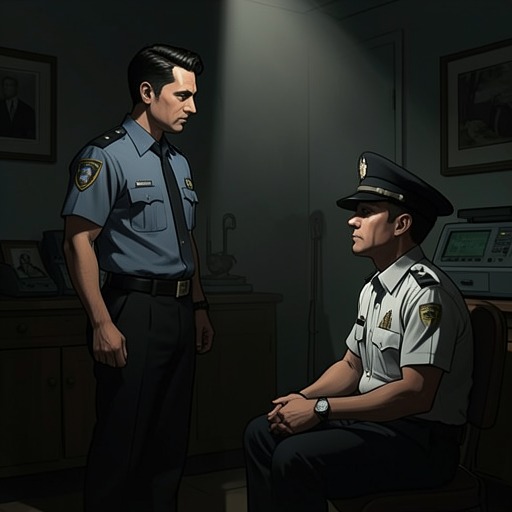
Falk is 47 when a night patrolman finds him dead in front of a cash machine outside a department store near the Inland Revenue. He lives nearby, in a top-floor flat at 10 Apelbergsgatan, and has just checked his account balance: the receipt remains in his hand, but he has made no withdrawal. His wallet still contains money. An ugly head wound complicates the first impression, yet the officers initially find no clear evidence of a crime, and the case is treated as a likely natural death.
His former wife, Marianne Falk, supplies a life that is at once ordinary in outline and full of omissions. He grew up on a farm outside Linköping, was an only child, completed military service and then took courses in several subjects at Uppsala before moving to Stockholm to attend business school. He met Marianne at a student party in 1972. He did not dance; for an early date he took her to Bromma to watch aircraft take off, explaining the planes as they stood nearby. Reserved and shy in manner, he was also, in Marianne’s view, self-confident and inclined to look down on other people. Their relationship developed into marriage and a family, but intimacy did not mean that he disclosed everything about himself.
Falk worked independently as a computer consultant and was careful about his health. His physician, David Enander, says that he had been Falk’s patient since 1981, regularly checked his condition and examined him comprehensively only ten days before his death. Enander describes Falk’s heart as being in excellent condition and rejects a massive coronary as a convincing explanation. Marianne, too, insists that he was attacked and recalls that in his final year he seemed anxious and spoke of having enemies. Neither can identify those enemies or provide a concrete account of what he feared, but their objections turn the apparently straightforward death into a question the investigation can no longer dismiss.
A Private Life Full of Gaps
The domestic spaces Falk leaves behind make concealment tangible. His flat is strikingly orderly: leather furniture, maritime pictures, a large bookcase, a brass compass, a green writing pad and pens lined up neatly beside an old clay oil lamp. A coffee cup and notepad remain in the kitchen; a note on it records the words Door to balcony. His bedroom is arranged with similar care. The apartment’s tidiness initially seems consistent with Marianne’s portrait of a man who took care of himself, but it also makes the gaps conspicuous. An investigator finds unanswered calls on the answering machine, including repeated calls from someone who only breathes, and photographs of Falk’s children, Jan and Ina.
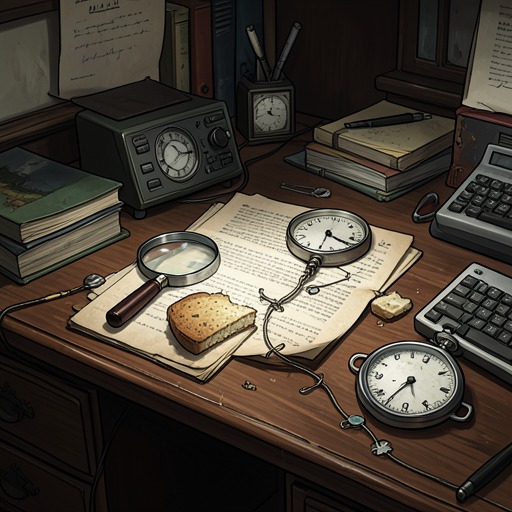
A second workspace, concealed behind a reinforced door in the attic of a building on Runnerströms Torg, is more austere. It contains a computer and a blueprint of the power substation where Sonja Hökberg was killed, but no ordinary accumulation of books, files or writing materials. A discrepancy in the room’s walls leads investigators to a hidden space roughly eight metres square. Behind a low, concealed door, they find a table resembling an altar, two candles and a photograph of Falk holding what appears to be a remote control. The room’s purpose remains unclear. The image prompts speculation, but the evidence does not establish what Falk believed or why he arranged the space this way.
Falk’s past in Angola is another concealed chamber in his biography. Marianne learns after his death that he was there from 1973 to 1977, although the Swedish International Development Agency had told her he went for two months to help install radio towers. She and Falk had married and had children, yet she never asked him directly what he had done during the rest of those four years. After his death she breaks open a locked steel trunk in the basement and finds a leather photograph album marked Angola 1973–1977. Its images include a burned-out bus, villages, war sites, radio towers and a group of nine men, a boy and a goat. The album establishes the span of his absence without resolving its full meaning.
Technical Reach and Conspiracy
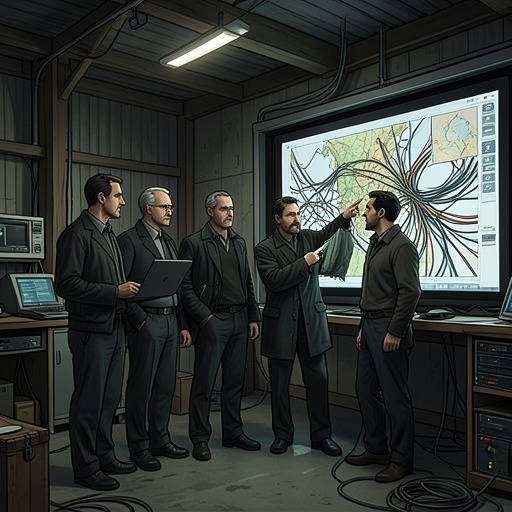
The investigation eventually breaks into Falk’s computer with help from Robert Modin, who cannot discover the password and instead connects his own computers to reach the system by another route. A file named Jacob’s Marsh contains phone numbers, codes and long numerical combinations identifying institutions in different parts of the world. The list includes institutions in the United States, Asia, Europe, Brazil and Nigeria; one recognizable entry is the Pentagon. The files indicate that Falk had penetrated institutional computer networks and accumulated classified information, though the investigators initially cannot determine the extent or purpose of the intrusions.
The wider investigation reveals the purpose behind that technical work. Falk and Carter met in Luanda during the 1970s and shared a grandiose sense of being chosen, pride and a taste for revenge. They began planning an electronic attack on the global financial system, combining Carter’s familiarity with financial institutions and Falk’s knowledge of the networks linking them. They built a secretive, hierarchical organization in which the two men made the decisions and drew in members including Fu Cheng, Elvira Lindfeldt and Jonas Landahl. The evidence suggests that Carter may have executed members he considered unsatisfactory; Falk’s precise part in the organization’s internal violence remains less certain.
The plan was set to be triggered by an apparently ordinary transaction. If Robert Modin or Kurt Wallander had inserted Carter’s Visa card into a machine at exactly 5:31 a.m. on October 20, the transaction would have unleashed an electronic attack. Experts later found that the financial institutions involved were alarmingly vulnerable. The attack was not activated, but cash machines across Skåne malfunctioned for a day before returning to normal. Falk’s scheme thus gives the quiet computer consultant’s coded files and secret workroom a global consequence: he had helped expose how fragile systems that appear remote and impersonal could be.
Death, Clues, and Unresolved Meaning
Falk’s death becomes still more suspicious when his body disappears from the morgue. In its place, someone leaves a large electrical relay associated with power substations. Investigators read the substitution as a deliberate message and suspect that the body has been removed to conceal something. The corpse later turns up again beside the cash machine, now missing two fingers. The sequence connects Falk to the investigation of Hökberg’s death, but does not by itself settle how he died or what the mutilation was meant to accomplish.
Other clues deepen rather than close the mystery. Falk’s hidden office contains the substation blueprint; investigators learn that the station keys were probably copied after technician Moberg’s house was burgled, and that Landahl travelled to the United States the following month. Falk also kept a post-office box in Malmö, while telling Siv Eriksson that his mail went to her address. His journal is never recovered, and the severed fingers are not found. The relay, the blueprint, the corpse’s return and the mismatched account of his Angola service form a pattern of deliberate concealment, but the investigators cannot explain every part of it.
Falk’s character remains more difficult to fix than his role in the conspiracy. The final account describes his long movement away from conventional politics, including an earlier shift from the extreme right to the radical left, before his break with ordinary political life and his involvement in the plot. Marianne’s memories disclose a man of habits and peculiar interests, while the hidden room and computer disclose a life of secrecy and extraordinary reach. The investigation establishes that he helped plan a catastrophic attack, yet it cannot fully reconstruct his first meeting with Carter, the precise nature of his beliefs, or the circumstances of his death. Falk is therefore both the center of the case’s largest revelation and one of its most persistent absences: a man whose elaborate systems of concealment leave behind enough evidence to expose his actions, but not enough to make his life entirely legible.