Sonja Hökberg
FirewallSonja Hökberg is introduced through a stark contradiction: a slight young woman who looks almost transparently innocent has confessed to striking a taxi driver repeatedly with a hammer. Her role in the attack on Johan Lundberg begins as an apparently pointless robbery, but the investigation gradually connects her past, her escape, and her death to a much wider chain of events.
Identity and the taxi attack
At nineteen, Hökberg was the older of two girls who ordered a taxi from a restaurant at about ten o’clock on a Tuesday night, asking to be driven to Rydsgård. As the car reached the outskirts of Ystad, she was sitting in the back while Eva Persson sat beside the driver. Persson asked him to stop so that she could move to the rear seat. When he pulled over, Hökberg hit him on the head with a hammer and Persson stabbed him in the chest. They took his wallet and mobile phone and left. Although Lundberg, about sixty, managed to make an emergency call over the taxi radio, his condition deteriorated after he reached hospital and he became unconscious.
The girls were arrested at home. The contrast between their ages and the violence of the attack unsettles the investigators: Persson was only fourteen, while Hökberg was legally an adult and therefore faced adult proceedings. Neither had been in trouble before. Persson had excellent school grades; Hökberg worked as a hotel receptionist, had previously been a nanny in London, and had applied for a place on a university foreign-language course. The surface picture of capable, ordinary young lives offers no immediate explanation for an assault that could have killed Lundberg.
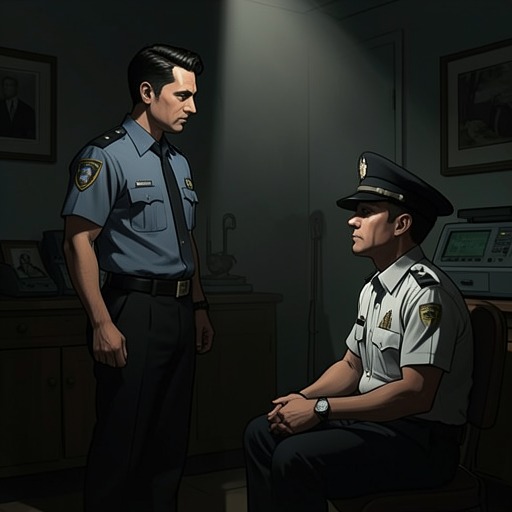
When Kurt Wallander first meets Hökberg in the interview room, her appearance sharpens that contradiction. She is small and thin, with shoulder-length blond hair and blue eyes; to Wallander, she could have been mistaken for an image of innocence. Nothing in her looks suggests the person he expected to find after reading that she had wielded a hammer. The evidence in her home is less ambiguous: she had put the hammer under her bed without even trying to wipe away the blood, while Persson had disposed of the knife.
Hökberg meets the questioning with an unexpectedly casual insistence on small comforts. Before the interview begins, she asks for chewing gum and says she will not talk until she gets some. She holds up a black handbag with an oak-leaf clasp, which surprises Wallander because it has not been confiscated. While he goes to obtain gum, he forgets that the tape recorder is still running. When he returns, he formally records that it is 4:15 p.m. on October 6, 1997, and that he is questioning her. Her attention to the gum and her apparent composure sit uneasily beside the seriousness of the charges.
In her account, the attack had been planned before the taxi stopped. The two girls had arranged their seating so that Persson could ask to move to the back and create the opportunity to attack the driver. Hökberg says they intended to use their weapons if the driver was older; if he had been younger, they would instead have tried to entice him into stopping by behaving suggestively. She admits that she hit Lundberg and that Persson stabbed him, but cannot say exactly how many times she struck him. Asked whether she understood that the wounds might be fatal, she offers no answer. Her only explanation remains that they needed money.
The stolen cash amounted to about 600 kronor. Hökberg says they divided the money, after which Persson threw away the wallet; Hökberg kept the mobile phone, which police found in her bedroom. Her confession is complete, but it does not provide the deeper motive Wallander suspects. Once the interview ends, she asks whether she can go home. Wallander explains that, at nineteen, she will be tried as an adult and must remain at the station. He leaves disturbed by more than the confession itself: to him, she has shown no sense of wrongdoing, and her controlled manner gives no sign that she grasps the possibility that Lundberg may die.
The room, the escape, and the death
Wallander’s attempt to understand Hökberg reaches beyond her confession to the private space she left behind. Her room seems suspended between childhood and adulthood: apart from clothes, the only visible sign of the young woman she might have become is a poster for The Devil’s Advocate tucked inside the wardrobe. The room’s emptiness unsettles him. He compares it with his daughter Linda’s teenage room, where pictures of changing idols had filled the walls, and wonders whether the quiet, detached girl in the interview room can be reconciled with the person who lived here. He has learned from Rydberg to treat rooms as evidence in their own right, as places that can disclose something their occupants cannot or will not say.
That question becomes urgent when Hökberg disappears from the police station. While waiting to be moved after meeting her lawyer, she asks to use the toilet. On her return, the officer guarding her has turned away to speak with someone in an office. Hökberg simply walks in the opposite direction and out through the front hall; nobody, including the receptionist, stops or sees her. The escape exposes a basic failure of custody, but it also forces the investigators to confront the gap between her innocent appearance and the violence they already know she has committed.
About thirteen hours later, investigators find a charred woman’s body at the power substation outside Ystad. A technician discovers a handbag north of the fence, its oak-leaf clasp unmistakable to Wallander: it is the bag Hökberg had carried into the interview room. The identification turns the missing prisoner into the victim. The blackout that accompanies her death has already affected large areas of southern Sweden, and the substation’s role in the power grid makes the site far more consequential than an isolated crime scene. The cause of her death remains uncertain at first, but Wallander increasingly believes she was murdered. He suspects someone feared what she might reveal, though the case has not yet established who brought her there or why.
A later conversation with Kalle Ryss, Hökberg’s former boyfriend, supplies a painful history that changes the meaning of her violence. Ryss says that Hökberg had told him she was raped in Ystad some years earlier, and that the trauma had made her uninterested in sex. Ann-Britt Höglund connects this account to Carl-Einar Lundberg, Johan Lundberg’s son, who had stood trial for a violent rape and been acquitted despite indications that he might have been guilty. Höglund proposes that the attack on Lundberg could have been revenge directed at his son. It remains a theory: the investigators do not know how Hökberg could have identified Lundberg as Carl-Einar’s father, or whether she knew who would be driving the taxi. But the possibility makes the assault more than an inexplicable attempt to obtain cash, while leaving its precise planning and target unresolved.
Erik Hökberg eventually explains what Wallander had sensed in the room. After the rape, Sonja took everything down from the walls and brought back the childhood belongings that had been stored in the attic. Her family never understood the change, and she did not explain it. Wallander reads the redecorating as an attempt to retreat into a time before the assault, alongside a turn toward revenge by proxy. The room thus offers no simple key to her actions; instead, its return to childhood registers the damage she could not put into words, while the violence of the taxi attack shows the destructive course her response may have taken.
Hökberg’s death also belongs to a second, initially separate investigation. Wallander’s chronology places her arrest and escape alongside the death of Tynnes Falk, the theft of Falk’s body from the morgue, and the discovery of an electrical relay from the substation left in its place. The relay makes the link between Falk and Hökberg’s death deliberate, though its meaning is still obscure. Wallander reasons that if Hökberg was killed, it may have been to prevent her from talking; he also considers whether the body and relay were arranged to make the connection impossible to miss. Later, Höglund argues that the perpetrators’ approaching deadline left them little room for error: Hökberg was in police custody and might have heard something from Jonas Landahl, with whom she had been involved. In that reading, she is not the central force behind the events but one of their outer rings, killed because others feared what she might know. Höglund also recognizes the grim limit of that explanation: Hökberg never told the police anything about the larger conspiracy, so the killing silenced her without gaining the secret her killers feared she would disclose.
Private ties and the unanswered call
Hökberg’s private life was largely opaque to her family. Erik Hökberg said she had never brought a boyfriend home, though she had asked for her own telephone line when she turned eighteen and it rang often. He had checked the answering machine and found no messages. When Wallander asked whether she knew how to use a computer, Erik said she surfed the Net and was fairly adept, though less technically skilled than her brother, Emil Hökberg. These details suggested a young woman with channels of contact beyond the household, but gave the family little knowledge of whom she spoke to or what she was doing.
A visit to the house on Snappehanegatan produced a more direct clue. On the answering machine, Wallander found a message in Hökberg’s voice: she said she would call again and that it was important. She did not give her name. The call established that she had been in contact with the boy who lived there, and the investigators believed it might have been made around the time she escaped. In the wider investigation, that connection was identified with Jonas Landahl, with whom Hökberg had been involved. The message conveys urgency without explaining its cause; it links her private relationships to the events around her escape, while leaving what she meant to tell Landahl unresolved.
The shifting account of the attack
After Hökberg’s death, Eva Persson withdrew her confession and said that Hökberg had used both the hammer and the knife. Persson claimed she had admitted taking part because she was afraid of Hökberg, whom she described as tough. Ann-Britt Höglund doubted much of this account: Persson’s answers seemed prepared, and she appeared controlled and perhaps unsurprised by Hökberg’s death. Yet Höglund also judged that Persson might have known little about Hökberg’s other connections. The reversal therefore altered the apparent division of responsibility without resolving what Hökberg had told Persson, or whether Persson’s fear explained her earlier confession.
Hökberg remains caught between competing explanations rather than reduced to one. Her own confession established her participation in the taxi attack, but the later accusation that she alone wielded both weapons came from a witness the investigators considered deceptive. The proposed revenge motive gives her violence a possible personal history, while the substation case places her near a larger secret she may never have understood. The investigation can connect these strands, but it cannot restore Hökberg’s voice to settle their uncertain edges.