Hansson
FirewallHansson is a senior officer at Ystad Police Station whose work helps carry the investigation from its first local deaths into a widening, urgent inquiry. He is repeatedly the person who receives or reports developments, reconstructs timelines, and puts witnesses and colleagues in contact with Kurt Wallander. His role is not that of the central interpreter of the case; it is the patient, sometimes improvised work of keeping its scattered evidence in motion.
Position and Working Role
Hansson is senior officer on duty when the police are first alerted to a death at a cash machine outside a department store. The officer taking the call from Sydkraft records the report and decides to contact him because a death is involved. Hansson says he will drive out immediately, then calls Martinsson, whose number he knows by heart. Martinsson in turn wakes Wallander. This chain of calls makes Hansson an early link between the power emergency and the police investigation.
At the scene outside Ystad, Hansson is waiting near a roundabout when Wallander and Martinsson arrive. The reported death is soon tied to a blackout affecting a quarter of Skåne. He accompanies the investigation at the high-voltage substation, where the body is found blackened and trapped among electrical equipment. Wallander asks Martinsson to obtain forensic support and a generator, while Hansson is part of the team confronting the immediate consequences of the discovery. The scene establishes the scale of the case before the investigators understand its cause: a death inside a substation has coincided with a regional power failure.
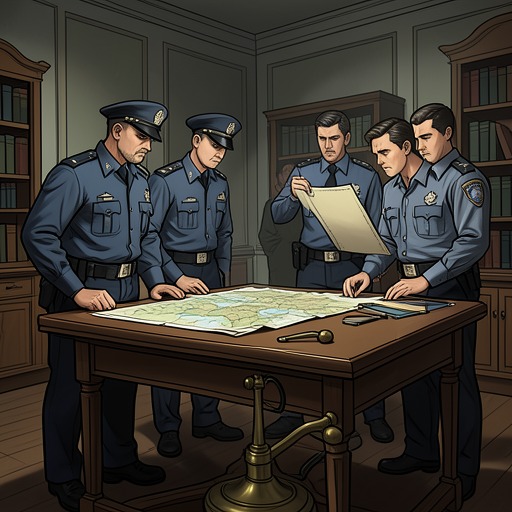
Hansson also appears in the routine, weary work of the police team. He is present at morning briefings and at later meetings where Wallander assigns tasks and evaluates competing explanations. He does not dominate those discussions, but he contributes practical information and follows instructions that require contact with other officers, witnesses, or agencies. His position gives him a recurring function as both investigator and conduit: he brings developments back to the team, where their significance can be judged.
The First Deaths and the Growing Investigation
When the case initially appears to concern the attack on taxi driver Johan Lundberg, Hansson is among the colleagues who gather as Wallander reports that Lundberg has died. The two young women, Sonja Hökberg and Eva Persson, have not denied the attack, and the recovered hammer, empty wallet, and mobile phone seem to bring the immediate inquiry close to its conclusion. Yet the reason for the violence remains unexplained. Hansson is present as the team confronts the gap between identifying what happened and understanding why.
That gap becomes more important as the investigation expands. In a later meeting, Wallander sets out new tasks: continue looking for witnesses, investigate how a body could disappear from a morgue, and pursue other lines that may connect Hökberg, Persson, Lundberg, and Falk. Hansson participates in this collective effort while the case’s apparent simplicity falls away. The inquiries no longer fit comfortably within a single robbery or a single act of violence.
Hansson’s work on vehicle movements gives Wallander one way to test the account of Hökberg’s departure from police custody. From home, while Wallander is ill, Hansson reports that he has reconstructed the times police cars travelled along the relevant road. The stretch was covered four times, and none of the drivers saw Hökberg. The negative result matters: it supports Wallander’s suspicion that she did not walk away unnoticed and must have received a lift or contacted someone after leaving the station. Hansson also asks what happened during Wallander’s encounter with Eva Persson, a conversation complicated by a damaging newspaper photograph and the possibility that Wallander himself is under suspicion. Even amid that pressure, he continues to discuss the evidence with him.
The Morgue and the Witness Trail
Hansson is involved in the response when Tynnes Falk’s body vanishes from the morgue. The report reaches Martinsson from Sture Pålsson at the coroner’s office in Lund, who found a locker improperly shut and an electrical relay on the gurney in place of the body. Pålsson had confirmed with the janitor, Lyth, that the body was present when he left at six in the evening; it was gone by the time Pålsson checked at about eight. A broken lock on a back entrance opening onto the yard suggests how someone may have entered. Hansson is part of the police effort to respond to the theft and its unsettling clue, an object associated with the substation where Hökberg died.
The investigation also depends on eyewitness details that are uncertain but potentially useful. Hansson helps bring Alma Högström to the station after she reports seeing a van near the cash machine on the night Falk’s body was returned. During the interview, he questions her while Wallander records her answers. Högström is certain of the time, about 11:30 p.m., because she had just checked her watch. Hansson uses an older folder of vehicle photographs and a colour chart to help her identify the van as possibly a Mercedes, dark blue or black. She saw a shadowy figure behind it, which her dog, Steadfast, noticed by pricking up its ears and straining toward the van. She thought the figure was a man, but had not seen a number plate or clearly established whether anyone was inside.
Högström’s route and timing give the observation a more precise frame. She passed the cash machine on her way home, found the van gone at about 12:10 a.m., and arrived home at 12:25 after a fifteen-minute walk. Neither she nor the dog noticed anything further on the return journey. Hansson’s questioning does not turn an uncertain sighting into proof; instead, it preserves the limits of what the witness actually saw while adding a time, a likely vehicle type, and a possible figure to the record.
Following the Vehicle and Computer Leads
The vehicle inquiry illustrates both Hansson’s persistence and the practical obstacles facing the investigation. When he calls Wallander about the van, he explains that the computer records have repeatedly crashed, but that he has finally established that the number plates were stolen from a Volvo parked in Malmö. It remains possible that the vehicle itself was stolen as well. Wallander treats the finding as support for the idea that a car had been watching events, and asks Hansson to contact Malmö police about the Volvo and issue a nationwide alert for the Mazda. The exchange shows Hansson supplying a partial result without overstating what the records establish.
A further check at a small Malmö rental company brings the dark blue Mercedes van into sharper focus. The company reports that it should have been returned on Wednesday and was rented under the name Fu Cheng, with payment made by American Express. Hansson tells Wallander that the renter gave Hotel St Jörgen as an address, although the hotel had no guest under that name. Staff did remember a Danish man named Andersen whose appearance matched the renter; he had paid cash for his room. The address he supplied in Vedbaek proved not to exist. With the trail ending at a false identity and a false address, Wallander tells Hansson to put the van inquiry aside temporarily while the team pursues more urgent leads. Hansson’s findings are substantial, but they do not yet identify the driver.
Emergency Response and Narrative Significance
Hansson’s role becomes immediate again when a shot is fired at Wallander in a fog-bound car park. Sirens approach, and Hansson arrives in the first police car after receiving a report of gunfire; he has also been told by Ann-Britt Höglund that Wallander is there. Wallander gives a brief account and insists that nobody enter without proper protection. The officers put on vests and helmets and establish a barrier while waiting for the fog to lift. When it clears, the van and Martinsson’s car remain, but the suspected shooter is gone. Hansson’s arrival converts Wallander’s isolated encounter into a coordinated search, though the attacker escapes on foot.
Later, Hansson reports new developments from the scene of Elvira Lindfeldt’s murder. A neighbour heard a car leave with squealing tyres at about 9:30 p.m.; the doctor found two entry wounds in Lindfeldt’s head; and Robert Modin is missing, with none of his diskettes found in the room where he had been staying. Hansson also passes on a report that a taxi had stopped at the house earlier in the day and a lightly dressed man had got out. Wallander suspects the visitor may be the man connected to Luanda, but that remains an inference, not a fact established by the witness. Hansson says that the local officer, Forsman, has had trouble forming a coherent picture and that he cannot simply command officers from another district. Wallander presses him to help locate the taxi, and Hansson continues the inquiry.
He then puts the taxi driver, Stig Lunne, through to Wallander. Lunne says he picked up a passenger at Sturup at 12:02 p.m. without a pre-booked job. He describes him as tall, thin, and suntanned; the passenger did not speak Swedish and communicated by showing him an address on a piece of paper. Hansson’s part in this exchange is modest but crucially specific: he secures access to a witness whose sparse recollections give the investigators another time, departure point, and description to compare with their other leads.
Across the case, Hansson is defined less by dramatic revelation than by continuity. He answers calls, reconstructs vehicle movements, works through faulty computer records, interviews a witness with old-fashioned reference materials, and passes on details from a homicide inquiry whose connections are still uncertain. The story repeatedly places him at the junction between fragmentary evidence and the team’s next decision. His reports do not solve the mystery on their own, but they help prevent its many separate strands from disappearing into the noise of an expanding investigation.