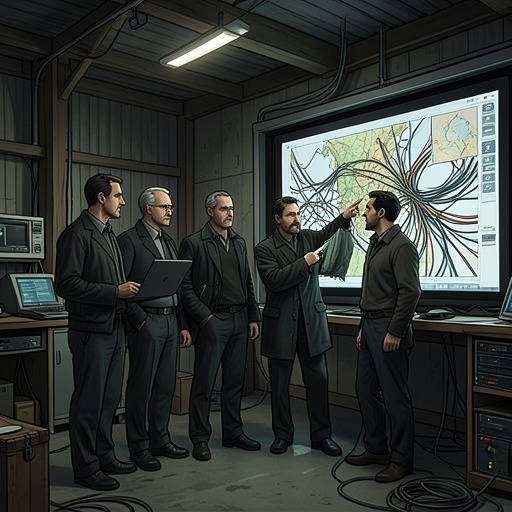
Robert Modin
FirewallRobert Modin is a nineteen-year-old computer expert whose talent makes him indispensable to Kurt Wallander’s investigation of Tynnes Falk. A former juvenile offender who once broke into the Pentagon’s computer network, Modin can read the hidden architecture of Falk’s files where the police cannot. His work ultimately helps expose a plan to attack the global financial system, and the knowledge places him in danger: he is abducted and used as a hostage before being rescued.
Identity and Background
Modin lives in Löderup with his parents. Wallander first hears of him through Martinsson, who proposes bringing him in after spending hours unable to penetrate the security on Falk’s computer. The recommendation rests on Modin’s reputation as one of Europe’s best hackers and on his earlier breach of the Pentagon’s supercomputer. He had been caught and spent a month in jail; Modin’s father says he thought the punishment was harsh because, to his son, the intrusion had been a game.
His interest in computers began early. At nine, Modin bought his first machine with money he had saved from picking strawberries, and his father recalls that he was soon absorbed by it. His mother opposed the hobby from the beginning, while his father had accepted it as long as Modin kept doing well at school. That history gives the skill that now attracts the police a personal cost: what began as childhood fascination had already led to imprisonment and family concern.
Wallander meets Modin’s father in the middle of the night to ask for help. The father does not press for details when Wallander says only that the case involves a complicated computer system. He wakes his son, reassures him that the police need his assistance, and provides coffee while they wait. Modin arrives from a party in jeans, a dress shirt, and a leather jacket; Wallander thinks his slight build, short hair, and round glasses make him look much younger than nineteen. His father worries that the police might be involving him in something dangerous, and Wallander promises that he is being asked to examine a computer, not suspected of a crime.
Recruitment and the First Barrier
At Falk’s flat, Modin is candid about why his earlier Pentagon intrusion failed. A break-in leaves traces, he explains, much like a cut in a fence; an intruder must cover them when leaving. He had been careless about cleaning up, so investigators could identify his computer even if they could not identify him personally. The lesson is practical rather than abstract: technical access is not enough if the breach itself points back to its source.
That expertise does not immediately solve the case. On his first examination of Falk’s machine, Modin studies the screen for about a minute, then switches the computer off. He tells Wallander that he has never seen security like it and cannot get through. He needs sleep, time, and freedom from pressure. Wallander recognizes that bringing him out in the middle of the night was futile and arranges for him to return the next day. Modin is willing to spend the day on the task, but the first attempt establishes the scale of Falk’s protection and the limits of a gifted hacker working without preparation.
The breakthrough comes after Modin has time to work. Rather than discover the password, he brings in two of his own computers and connects them to Falk’s machine, finding a way in through what he calls the back door. Martinsson and Modin work among three keyboards while Wallander waits for an explanation. The image of Modin moving between the machines like a musician at several instruments marks a shift in the investigation: the previously chaotic screen now displays orderly arrangements of numbers, and the files can at last be examined.
Reading Falk’s System
The material Modin and Martinsson uncover is not a simple list of phone numbers. Falk’s file called Jacob’s Marsh contains codes and long number combinations that serve as code names for institutions in different parts of the world. The locations span the United States, Asia, and Europe, with additional entries for Brazil and Nigeria. Modin recognizes the Pentagon among them. The finding raises the possibility that Falk had penetrated institutional networks and accumulated classified, perhaps illegally obtained, information, though the full meaning of the files remains uncertain at first.
Modin’s role is to interpret the patterns as well as to gain access. He works through a recurring number, 20, initially considering whether it refers to the year 2000 and the computer problems associated with Y2K. That interpretation fails to fit: he cannot find the missing zeroes, and the countdown appears to end much sooner than the turn of the year. He concludes instead that the date is October 20. The date is a deduction from the arrangement and timing of the data, not a complete explanation of what the plan will do.
To identify the target, Modin researches financial institutions already present in the files, including the National Bank of Indonesia, the World Bank, and a stockbroker in Seoul. He searches for the common point of weakness that could let someone enter the systems unnoticed. His conclusion is that the institutions form cornerstones of the global financial network: compromising enough of them could trigger a crisis, crash stock markets, provoke a rush to withdraw money, and destabilize currency exchanges. The scale of this possibility recasts the strange codes from evidence of isolated computer intrusions into components of a coordinated attack.
Modin’s work also depends on incomplete clues and unfinished questions. When Wallander later examines Modin’s room, he finds notes in difficult handwriting: equations and fragments of thought, the word delay repeated, and questions about a programming completion date and whether an insider is necessary. These papers show that Modin has been trying to understand how the operation works, not merely break into a protected computer. His progress is substantial, but the notes preserve uncertainty about the plan’s timing, its method, and the people needed to carry it out.
Exposure, Abduction, and Survival
As Modin advances, he becomes a target. Elvira Lindfeldt reports to Carter that the person disrupting their system is Robert Modin and identifies him as a resident of Löderup. Later, Modin receives an anonymous warning that he has been traced. He sends a message to the police asking for help, but leaves before they can reach him. At his computer, Wallander and Martinsson find the warning and Modin’s message; the sender’s identity is obscured, and a reply to the address fails. The trail makes clear that the computer work has exposed Modin to people beyond the investigation.
Carter abducts Modin and forces him to cooperate. Modin later tells Wallander that Carter threatened to kill his parents if he did not obey. He was shut in a bathroom while Carter berated a woman for failing in her work and showing weakness; Modin heard the shots that followed. Carter then made him pose as someone who had to remain in Malmö to finish his work. Modin was confined in the boot of a vehicle, where he could hardly breathe, and was brought to the cash machine where the attack was to begin. His technical knowledge has made him useful to the conspirators as well as dangerous to them: they need his labor, but they control him through threats against his family.
The confrontation ends with Modin alive. Carter directs him to walk toward Wallander and threatens his parents as a means of keeping him compliant. During the ensuing gunfire, Martinsson and Wallander intervene; Wallander shoots Carter, and the threat ends. Modin’s eyes fill with tears as he describes what happened, and Wallander tells him there is no need to recount everything at once. The rescue confirms the immediate danger he has survived without erasing its physical and emotional pressure.
Narrative Role and Significance
Modin bridges two forms of knowledge that the investigation struggles to join: the police can follow people, deaths, and physical clues, while he can read a system whose operations are hidden behind codes and digital barriers. His early failure prevents his talent from becoming an effortless solution; progress requires sleep, time, experimentation, and the willingness to abandon the password hunt for another route. Once inside, he helps turn scattered numbers into a date and a global financial threat, while the unfinished questions in his notes preserve the uncertainty that remains.
His trajectory also reverses the apparent balance of expertise. The young man initially brought in as a specialist becomes someone the police must protect, and the abstract stakes of network security become immediate when Carter uses his parents to compel him. Modin survives because the investigation catches up with the danger, but his experience shows the human consequence of information becoming power: the person able to decipher the system is also vulnerable to those who intend to use it.