Kurt Wallander
FirewallKurt Wallander is a detective in Ystad whose pursuit of apparently disconnected deaths and acts of violence becomes a test of how well he can read a case—and how much isolation he can bear while doing so. His investigative instincts are shaped by the colleague who taught him to notice what crime scenes conceal, but his reflections on a series of funerals reveal how deeply loss has unsettled his sense of continuity and companionship.
Identity and Background
Wallander approaches his work as a stubborn, energetic investigator, though he once regarded himself as an average policeman. The decisive change came through Rydberg, his colleague and mentor, who taught him to ask the right questions and to read information hidden at the scene of a crime. After Rydberg died of cancer, Wallander recognized that he had become not merely persistent but a good detective. He still conducts long conversations with Rydberg in his mind when an investigation leaves him unsure how to proceed; the habit keeps his mentor’s methods present, but also makes the absence a daily one.
That private inheritance of grief comes into focus as Wallander drives from Ystad to a funeral in Malmö. He dislikes funerals and considers this one optional, yet goes anyway. It is the fourth funeral he has attended in seven years. Rydberg’s death had been prolonged and painful; Wallander visited him at home and later in hospital as he gradually wasted away. Wallander understands that his loss will not simply recede with time.
His father’s death, three years earlier, remains less settled in another way. His father collapsed from a stroke in his studio, and Wallander still sometimes struggles to accept that he is gone, along with the familiar smells of turpentine and oil paint. The family house in Löderup has been sold to new occupants. Wallander has driven past without stopping, and his visits to his father’s grave have become less frequent; increasingly, he finds it difficult to summon his father’s face. The thought that a dead person can eventually seem never to have existed gives this fading memory a stark, unsettling form.
The death of Svedberg, one of Wallander’s own officers, brings professional loss into the same landscape. Svedberg died violently only a year earlier, and the investigation into his life showed Wallander how little he had known about a colleague with a more complicated web of relationships than he had imagined. By the time he sets out for the fourth funeral, grief is not confined to family or friendship: it has also altered how he sees the people beside him at work.
Investigative Method and the First Reversals
Wallander’s work on the taxi-driver attack begins with a violence that seems both senseless and disturbingly deliberate. Two girls had ordered a taxi to Rydsgård; as the car reached the outskirts of Ystad, one moved to the back seat and struck the driver, Johan Lundberg, with a hammer, while the other stabbed him in the chest. They took his wallet and mobile phone, leaving him critically injured. Their explanation was simply that they needed money. The apparent simplicity did not satisfy Wallander: neither girl had a prior record, and the brutality seemed out of proportion to the cash they took.
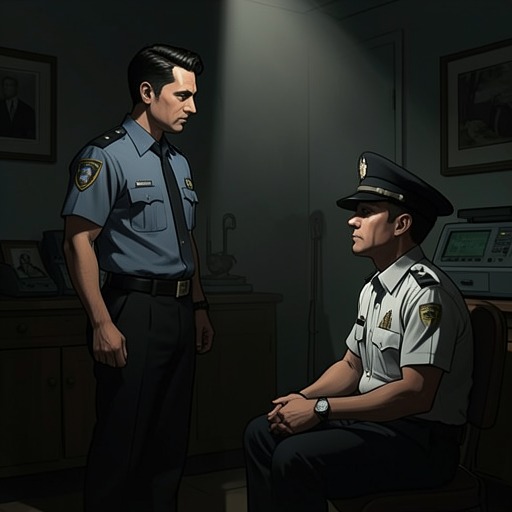
In his interview with Sonja Hökberg, Wallander asks about the plan, the weapons, and whether she understood that the blows could kill. Hökberg describes how she and Eva Persson meant to stop the taxi and how the attack unfolded, but shows no evident remorse. Wallander is shaken by her coldness and by the prospect that Persson, only fourteen, is similarly unmoved. He tells Martinsson that he cannot accept the robbery as a sufficient explanation. The girls might have needed money for a particular purpose, or the attack might have concealed some other motive; he decides to question Persson and her parents and to find the boyfriend Persson has mentioned.
The inquiry changes scale when a power failure leads to the discovery of a burned body at a substation outside Ystad. A quarter of Skåne has lost electricity. Wallander is ill, but Martinsson collects him in the dark and drives him to the site. The body and regional blackout turn what had looked like a local assault into a case with potentially wider consequences. Wallander’s first task is not to force a connection, but to distinguish what is known from what has only been assumed.
A more pointed clue arrives when Tynnes Falk’s body disappears from a morgue and an electrical relay is found in its place. The body had been present at six in the evening; by the time it was checked later, the morgue’s back-door lock had been broken and the corpse was gone. Wallander treats the relay as a deliberate message rather than an accidental object. Remembering Rydberg’s lesson that criminals may leave a greeting at a crime scene, he reasons that the body may have been removed to hide something. The evidence does not yet prove that Falk was murdered, but it makes the original assumption of an uncomplicated death harder to maintain.
At a case review, Wallander sets out the developing chain: Hökberg has escaped and later died at the substation; Falk had been found dead beside a cash machine, his case initially closed for lack of evidence of a crime; now his body has vanished and a relay has been left behind. Ann-Britt Höglund proposes that the object may point to a connection between Hökberg and Falk, while Wallander insists that the relay must be examined to establish whether it came from the substation. He also recognizes how his own habits can impede the inquiry: he has explored avenues without telling his colleagues everything. Even so, he delegates the renewed questioning of Persson to Höglund and goes with Martinsson to examine Falk’s flat, pressing the investigation beyond its first, apparently obvious explanation.
Escalating Danger and the Search for a Pattern
The inquiry into Tynnes Falk’s death turns physically dangerous when Kurt Wallander returns to Falk’s flat, where the police have left the disorder intact. He has just learned that someone broke into the flat and took Falk’s diary and a photograph, objects that might have helped explain his life. As Wallander moves to greet Marianne Falk at the door, he senses danger and pulls back. A shot tears through his jacket, missing his chest by nine centimetres; the rug catches his feet as he falls, and the assailant vanishes. Marianne is struck in the face on the stairs but cannot identify the fleeing figure. Even the officers in the patrol car outside see nobody leave. Wallander measures the distance between the bullet’s path and his heart that evening, connecting the narrow escape to an earlier stabbing that came within ten centimetres of killing him. His private reckoning turns survival into a grim measure of shrinking margins.
The attack deepens the mystery without resolving it. Wallander cannot identify the shooter, and the police search the building without finding a way to explain the escape. At the same time, he is trying to distinguish a genuine pattern from a collection of deaths that may only appear connected. He imagines the case as a solar system organized around a black hole: the missing centre draws every fact towards it but gives him no clear account of what holds them together. He rules out the attack on Johan Lundberg as the likely centre or catalyst, while the relay and the power-substation blueprint keep pointing back towards Falk and Sonja Hökberg. The case’s difficulty lies not in a shortage of clues but in the absence of a dependable way to rank them.
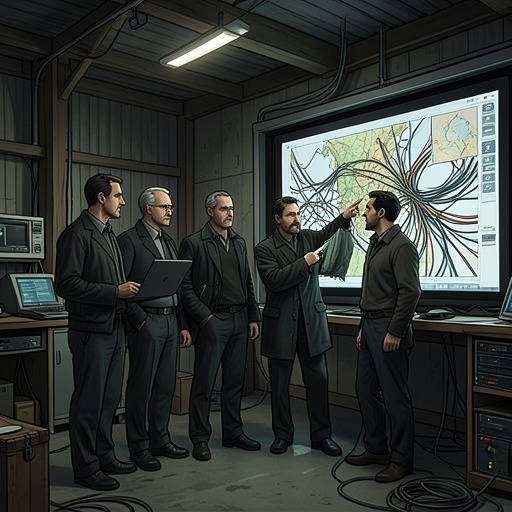
Wallander’s determination to test each line of inquiry is matched by his willingness to revise his theory. Information about Carl-Einar Lundberg’s earlier rape accusation raises the possibility of a connection to the violence, but Wallander doubts that it explains Johan Lundberg’s killing, Hökberg’s death, or the mutilation of Falk’s fingers. He instead keeps asking what Falk was doing and turns attention to Falk’s computer, even though he cannot promise that it will yield an answer. When Robert Modin eventually breaks through its security, the screen displays ordered arrangements of numbers rather than the chaotic patterns seen before. As the team identifies institutions in the network, a group they call the nocturnals shifts in a consistent direction. Modin discovers a time element: with seventy-four identities in the network and the number 20 interpreted as October 20, the pattern appears to be counting down towards a peak on the following Monday. Wallander considers whether the date marks an endpoint, perhaps a bomb, but the computer is only a monitor; the investigators cannot see the network clearly or determine where its activity is controlled.
The apparent countdown makes delay itself a danger. Wallander tells Martinsson that Hökberg may have been killed because someone feared what she could reveal, and that her relationship with Jonas Landahl may connect her knowledge to Falk. He also raises the possibility that the people behind the scheme are learning about the police’s work, perhaps by breaking into individual officers’ computers rather than through a person inside the station. The idea is not established, but it fits a case defined by hidden access and deliberate concealment. When Robert receives a threatening email and flees, Wallander treats the threat as real, sends Ann-Britt Höglund to organize a search, and goes out himself to look for signs of who may be watching the house. He tells the team that the danger extends beyond Modin: someone is acting to protect a secret, and may believe the police are close to preventing whatever the October 20 countdown signifies.
Betrayal, Loss, and Continuing Resolve
When Wallander reaches Elvira Lindfeldt’s dark house with Hansson, he finds her dead on the sofa, shot in the neck, and Robert Modin gone. The empty house changes his immediate fear from certainty of death to the possibility that Modin is still alive. He understands the abduction as part of the case’s continuing pattern of concealment: someone has taken Modin because he may know something the killers need kept secret. Unlike the earlier deaths, this danger arrives while the police already have reason to believe that a larger operation is under way, and Wallander is driven by the chance that their knowledge may still help them act.
His response is efficient, but its force comes from several injuries at once. He is afraid for Modin, furious at himself, and shaken by the renewed loss of a possible companion. He cannot say that he misses Elvira herself: she had found him through his letter to a dating agency and approached him to deceive and manipulate him. Her performance had persuaded him, and the shame of being taken in is acute. The betrayal does not cancel the loneliness that made the prospect of companionship matter; instead, it leaves Wallander confronting both his longing and how easily it was used against him.
Wallander sends Hansson to alert the Malmö police and investigate Elvira’s background, including whether she had any connection to Angola and whom she knew in Malmö, while he hurries back to Ystad, where he believes the case’s centre remains. He gives no account of how he knew Elvira well enough to place Modin in her care. Hansson does not press him, and the investigation never establishes exactly what had passed between them. Wallander’s silence preserves a private boundary even amid the urgency of the case, while his decision to keep pursuing the danger shows how quickly personal shock is converted into responsibility for the missing young man and the threatened public.