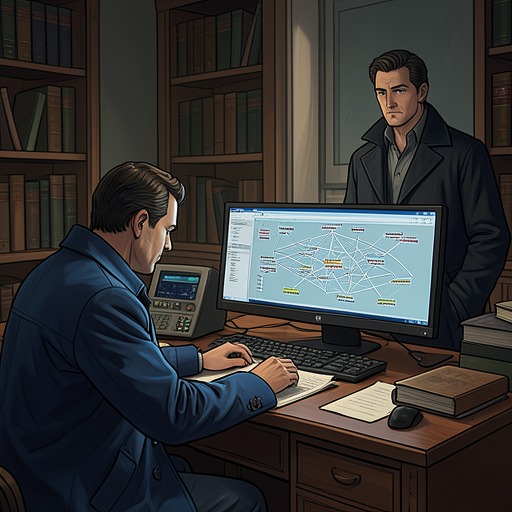
Hans Alfredsson
FirewallHans Alfredsson is a Swedish National Police computer specialist brought into the investigation of Tynnes Falk’s computer as the police begin to suspect a coordinated cyberattack. His role is to interpret the technical danger and help carry the warning beyond Ystad; he contributes urgency, but also repeatedly acknowledges the limits of what the investigators can yet establish.
Identity and Introduction
Alfredsson is first identified as the specialist who will come to Ystad after Wallander asks what the national computer experts have said. His name provokes laughter around the table: Hans, or Hasse, Alfredsson is also the name of a legendary Swedish comedian. The exchange briefly breaks the grimness of the meeting, but the visiting Alfredsson is there as a police specialist, not as a comic figure.
Joining the Investigation
When Alfredsson joins Martinsson, Wallander, and Robert Modin in a conference room, he resists Wallander’s wish to review everything from the beginning, saying that too many elements remain unclear. The difference is one of method: Wallander wants a complete account, while Alfredsson cautions against treating a still-fragmentary technical picture as settled.
Modin’s analysis points toward October 20 and a possible common weakness linking several institutions. Alfredsson listens as the discussion turns from the countdown to the institutions themselves, including the National Bank of Indonesia, the World Bank, and a stockbroker in Seoul. He does not claim to have identified the mechanism or the point of entry; the computer work remains Modin’s, while Alfredsson helps situate its implications.
Assessing the Threat
Alfredsson explains that computer warfare is moving beyond the familiar image of computer-guided missiles. He describes the emerging objective as disabling an enemy’s networks and missile systems, or even turning those systems against their operators. When Wallander questions how certain this picture is, Alfredsson confirms that such capabilities are being developed but emphasizes that weapons systems are complicated and much remains unknown.
That caution matters when Modin argues that the institutions may be cornerstones of the global financial network. A sufficiently extensive compromise, Modin says, could trigger market collapse, panic withdrawals, and wild currency fluctuations. Alfredsson calls such an attack an extreme form of terrorism, but his response does not turn the hypothesis into proof: the group still has to determine what Falk’s computer contains and whether October 20 is truly the deadline.
Warnings and Coordination
Alfredsson offers to consult his colleagues in Stockholm and prepare a report that can be circulated internationally, so the institutions involved can take precautions. Modin’s muttered concern that it may already be too late goes unanswered, leaving the proposed warning shadowed by the possibility that the countdown is close to its endpoint.
By the later planning discussion, Wallander recalls that the report needed his signature before it could be sent to police organizations around the world. Martinsson has signed it to save time, and no replies have yet arrived. Alfredsson’s contribution is therefore both practical and limited: he helps turn a local computer investigation into an international alert, but the available evidence gives the investigators no confirmation that their warning has reached the institutions or changed the danger they face.