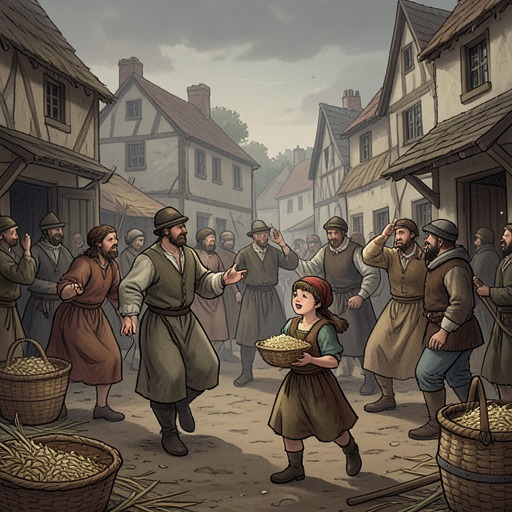
Charles Kent Secures the Detainees’ Release
HarvestCharles Kent Secures the Detainees’ Release is a negotiated reprieve for Lizzie Carr and two imprisoned women, won by Charles Kent after the village has been emptied and Edmund Jordan’s appetite for witchcraft proceedings has faded. The agreement ends their punishment, but not their separation from home: they are to be escorted out of Jordan’s estate and released only at a marketplace three days away. Charles secures their freedom by appealing to kinship, mercy, and conscience, yet the price of that freedom is exile.
Background: a village already broken
The intercession comes after the village has been cleared, its people dispersed by alarm and driven from their homes. Charles tells Walter Thirsk that, in only five or six days, the village has been lost to him and to everyone who belonged there. He has considered setting a light to his own home rather than witnessing the changes ahead; the dovecote and lofts have already suffered damage. His plea for the prisoners arises from this wider collapse, not from confidence that the old life can be restored.
The change in Edmund Jordan is decisive. Once the villagers are gone, his interest in the captives and in talk of sorcery suddenly wanes. The matters that had occupied the manor—Philip Earle, Mistress Beldam, alchemy, and witchcraft—seem trivial beside Jordan’s proposed land of progress. Charles recognizes this shift and uses it. The women and child are no longer at the center of Jordan’s attention, but they remain subject to his power; their release depends on turning his indifference into consent.
The threatened punishment also stands in sharp contrast to the village’s customary uses of its pillory. For years, the wooden structure had served less as an instrument of punishment than as the village cross: Charles Kent conducted marriages and baptisms there, and the community gathered there to mourn the dead, bless seed corn, and give thanks for harvest. Its prisoner openings could hold rosaries or flower chains. That shared sacred and communal purpose had made the spectacle of the newcomers locked there especially painful to Walter Thirsk. Now the wider disorder has carried the women and Lizzie into custody, and the decision about their fate rests with the estate’s lord rather than the village community.
Charles’s appeal and Jordan’s answer
Charles asks Edmund to consider the prisoners’ supposed sins as minor foolishness and argues that ending their punishments would be kind, wise, and honorable. Edmund answers with a taunt that turns the prospect of their release into an image of execution: he asks whether Charles means to let them meet their Maker immediately and whether he may use Charles’s firewood for the pyre. The exchange exposes the danger beneath the negotiation. A plea for leniency is being made to a man who can treat death as a joke and punishment as a matter of estate authority.
Charles refuses to let the discussion remain on those terms. He proposes that the prisoners be allowed to live and walk freely, not as witches or sinners, but as country people separated from their families who will do no worse than follow them. This recasting is the essential act of the intercession. It does not establish their innocence in Jordan’s eyes or challenge his authority to expel them; instead, Charles asks him to stop treating them as supernatural offenders and permit them to rejoin the people from whom they have been sundered. He also makes the appeal personal by acknowledging that their release would spare his own conscience.
Edmund consents, but makes clear that mercy will have strict boundaries. He wants Walter counted among the forfeits Charles must pay: Walter must remain behind to watch over the land until sheep take charge of it. The women and Lizzie will not be freed on Edmund Jordan the Younger’s estate. They are to be escorted away in custody, and their release will occur only when they reach the marketplace after three days of travel. Jordan also bars the Rogerses, Gosses, and Carrs from his lands forever. The agreement therefore separates release from restoration: the captives will no longer be held, but neither they nor their families may return to the place they have lost.
Terms, witnesses, and cost
Charles will accompany the prisoners to ensure that Edmund keeps his word. He wants to witness the widow, daughter, and wife walking freely in a town’s streets. That promise gives the release a concrete test: the women’s freedom is not complete when Jordan agrees to it, or even when their escort begins, but when they reach the marketplace and are allowed to walk untethered. Until then, custody and distance remain part of the settlement.
The bargain also binds Charles to the estate at the moment he is preparing to leave it. Edmund’s condition makes Walter’s continued service part of the price, linking the prisoners’ release to the same land conversion that will replace the village’s fields with sheep pasture. Charles accepts the arrangement, but his words to Walter make plain that he does not imagine returning. The agreement offers no reconciliation between the estate and its former inhabitants; it manages their departure.
After the terms are settled, Charles takes Walter in his arms beneath the horses in the orchard, and the two old friends nearly topple onto the apple-strewn ground. The orchard’s patterned rows and the crossing paths worn by centuries of feet frame their embrace. The image is intimate but unsettled: two gray heads seem like seed husks caught in a wind that gives no indication where they will land. The tenderness between them does not undo the bargain’s losses; it marks the human bond that survives inside a decision defined by dispossession.
Significance
Charles’s success is real but sharply limited. He saves the detainees from continued punishment and secures their release from custody, yet he can do so only by accepting Edmund’s jurisdiction, the permanent ban on their return, and the prospect of his own departure. His appeal works because it addresses what Edmund is willing to value—honor and control—while also invoking the personal burden of conscience. The result is mercy without restitution.
The scene also completes a reversal in the meaning of freedom. Earlier village customs gave communal rites to a structure built for public punishment; now the village itself has disappeared, and freedom is granted only beyond the estate boundary. Lizzie Carr and the two women may walk freely in the town, but not at home. Charles’s intervention keeps them from being treated as witches to the end, while revealing how little protection a compassionate plea can secure when land, authority, and the right to remain belong to someone else.