Edmund Jordan Arrives at the Estate and Searches the Village
HarvestYoung Edmund Jordan’s arrival and search of The Village transform a succession of local calamities into an exercise of estate authority. He comes upon a burned barn and the body of an older newcomer, then, after Willowjack is killed, orders a search for evidence and threatens formal punishment. Through Walter Thirsk’s observations, the investigation is both a hunt for a culprit and a demonstration that Charles Kent no longer commands his own estate without interference.
Arrival amid disaster
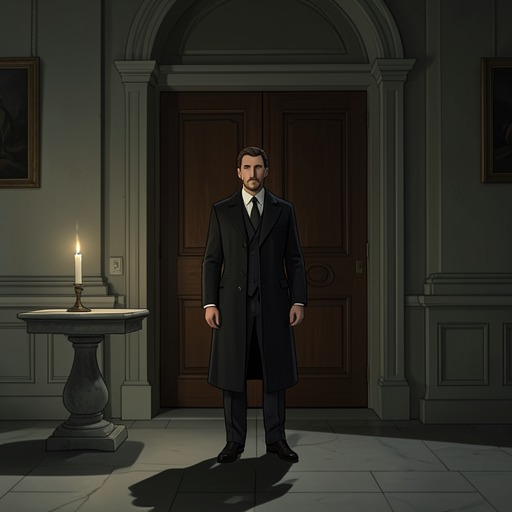
Young Edmund Jordan has not visited the valley before. He announces his approach with six blasts on a saddle horn, arriving with five companions: his steward, a groom, and three sidemen. Their progress through the lanes brings them past no working hands, a silence that makes the young landowner’s anticipated welcome seem misplaced. He appears to have expected a grander reception, a rest at the Manor House, and then the orderly conduct of estate business.
Instead, he meets evidence of disorder before he can settle in. A barn has recently burned, and Charles Kent and Philip Earle are carrying the body of the eldest newcomer toward the Manor House. Walter, unable to help bear the body because of an injury, follows with Willowjack. The dead man had been confined in the pillory; his younger companion remains there, distressed and still fastened in place. The attempt to carry the body to the porch and lay it on a stone bench cannot undo the death. It does, however, confront the arriving party with the human cost of the village’s recent violence before anyone can present the situation as a matter of simple estate management.
Young Edmund Jordan’s entrance therefore coincides with two competing demands: hospitality toward the new authority and an unsettled reckoning with what has already happened. The gentlemen are received in the Manor House while the sidemen attend to the luggage. Walter is given the ordinary servant’s task of leading the horses to makeshift accommodation, and he resents the groom’s assumption that responsibility for saddles confers superiority. The difference in rank is present from the first exchanges, even as the household tries to receive its visitors.
From arrival to investigation
After Willowjack is found dead, Young Edmund Jordan sets the inquiry in motion. He gathers the villagers in the threshing house while barley work continues, and frames the matter as a search for someone responsible for stealing a valuable mare. His argument is that the killer will have left blood-marked clothing behind. On that reasoning, he orders the cottagers not to leave the barn and announces that their dwellings and gardens will be searched. He also anticipates severe punishment, including death, before the investigation has established who killed the horse.
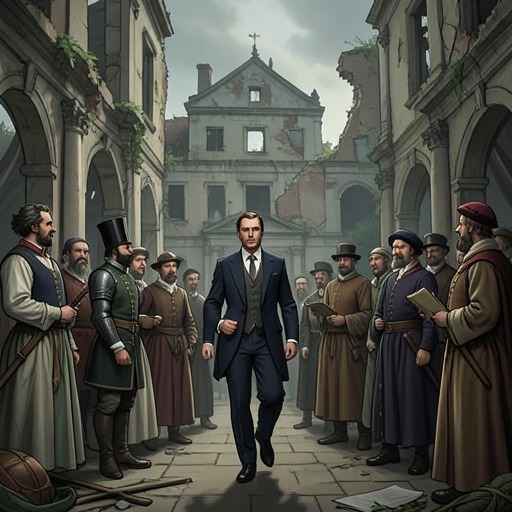
The command changes the village’s immediate circumstances. Residents who have been living amid shared labor and customary routines are now held together under the scrutiny of an unfamiliar authority. Young Edmund Jordan does not first give them a clear account of his identity or intentions. His clothes, attendants, and Jordan family badge make his status legible to them, while Charles’s silence and deferential posture show that the established master is not in control of the proceedings. To Walter, this is a startling reversal: Charles has usually exercised authority subtly, as a familiar and comparatively even-handed presence. Now he listens while his cousin directs the assembly.
Young Edmund Jordan invokes ordinance, regulation, law, and customary dues as standards the community has failed to meet. He presents the damages accumulated at the Manor House as grounds for a reckoning, and treats the suspected theft of Willowjack as its next outstanding charge. His language gives the search a legal appearance, but the threat of punishment precedes proof. The villagers are not simply asked to assist; they are warned that someone among them will be made answerable.
The search of private homes
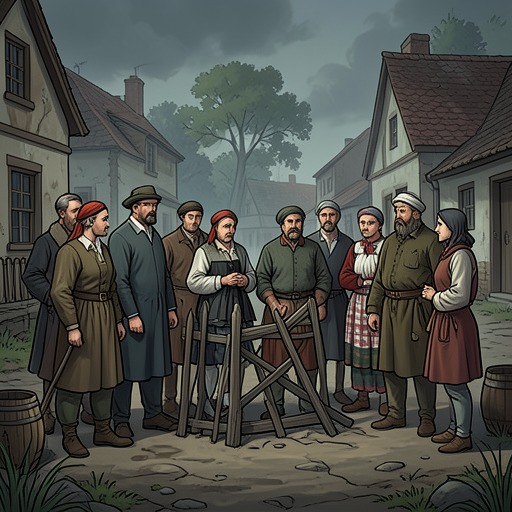
Walter is assigned to guide the search party from house to house, identify absent residents, and stand beside Charles as the sidemen enter. The intrusion reaches rooms that neighbors ordinarily leave private: coverings are pulled away, mats and reeds lifted, chests opened, and barrels and benches shifted. The search extends beyond houses to animal enclosures, brewing and storage buildings, latrines, and other places where bloodied clothing might be hidden. The domestic spaces reveal differences in the villagers’ material circumstances, but Walter recognizes that the appearance of a home cannot disclose what a person does in secrecy.
At the Carrs’ dwelling, Walter’s friendship with John Carr makes his position especially uncomfortable. They ordinarily meet and talk outside rather than intrude on one another’s hearths. Walter asks the searchers to take care, but his request does not stop their impatient disturbance and seems only to increase their suspicion. He withdraws rather than enter the house to oppose them, a choice he knows John may not understand. The search thus tests not only the villagers’ privacy but the ordinary discretion that sustains their relations with one another.
At Walter’s own home, the searchers find a blood-marked kerchief. Its presence makes him a possible suspect until Charles explains that Walter had been at the burning stable block and had shown courage there, helping to save hay. The discovery is therefore accounted for, but only after Walter’s master intervenes on his behalf. This episode exposes the unequal terms of the inquiry: an object can prompt suspicion, while a landowner’s testimony can release a servant from it.
The most consequential find comes at the tenement where Cecily was raised. Young Edmund Jordan enters and soon emerges holding a heavy, bloodstained cloth. Charles and Walter initially think it too dark to be Mistress Beldam’s velvet shawl; its silver threads and distinctive Turkish mauve color make the identification increasingly difficult to dismiss. Young Edmund Jordan throws the shawl across a fence and invites them to identify its owner. Neither Charles nor Walter speaks. The scene supplies a striking piece of evidence without resolving, in that moment, what the find proves or who is ultimately responsible for Willowjack’s death.
Legal authority and the unresolved reckoning
The investigation also gives Young Edmund Jordan a means to claim judicial power. He says the pilloried newcomer was responsible for the earlier burning of the farm buildings and the killing of the doves, and asks Charles to confirm the charge. Charles acknowledges that the prisoner had threatened revenge in anger, but points out that he remains securely confined and could not have harmed Willowjack except through sorcery. Young Edmund Jordan declines to blame the horse’s death on him without proof of sorcery; nevertheless, he says the prisoner should be questioned and charged with sedition and incitement. He calls himself the place’s de facto magistrate and proposes that the case go to court.
This proposed prosecution links the inquiry into the mare to the earlier conflict with the newcomers, although the evidence has not established that the prisoner killed Willowjack. Young Edmund Jordan’s declared concern for justice sits beside his impatience with the village’s customs and disorder. His search is at once an effort to identify responsibility and an assertion that the community’s own ways of managing conflict are inadequate. The investigation ends without a named culprit for the mare’s death, while the velvet shawl and the proposed court case leave the village facing a wider and more formal reckoning.