Walter Thirsk Leaves the Village
HarvestWalter Thirsk leaves The Village after its communal life and the estate around it have been broken apart by fire, violence, and abandonment. At the boundary stone he marks his own body against the limit that once defined where he belonged, then steps beyond it with a blank sheet of calfskin vellum and the few possessions he can carry. His departure is both an exile from the world he has served and a final claim to choose what happens next.
The boundary and the life behind it
For years, the village boundary has been more than a line on the land. Walter remembers being taught as a child where he did and did not fit, and Master Kent’s assurance that staying within the bounds meant there were no bounds to stop them. That promise has its reverse: one step beyond the merestone, Walter understands, and a person’s home, standing, and possessions are left behind. He has not come so close to the edge for several years; now there is nothing left to keep him inside.
The life he is leaving was built around the shared demands of cultivation. In a poor harvest, the villagers still had to bring in enough grain to last the year. Reaping required every able person: children cleared weeds, strong workers cut the stalks, women bound sheaves, and older people raised the stooks. Their shared labor also made room for gossip and jokes, and gathered people who did not always like one another into a single field. This work was not an idyllic attachment to the countryside. Walter learned that the land was stern and impatient, exacting effort from dawn to dusk while the community defended itself against hunger. His eventual departure therefore means leaving not simply a place, but a difficult, interdependent way of life.
A village remade and then emptied
The customs Walter leaves behind had made ordinary places serve several purposes at once. With no church built on its reserved ground, the village used its wooden pillory as a cross: Master Kent held marriages and baptisms there, spoke at funerals, comforted the bereaved, and blessed seed and plows. The same village structure could therefore hold religious observance and punishment, shared memory and public shame. Walter’s departure follows the collapse of that familiar order, rather than a clean break from a life that had been secure.
The prospect of replacing cultivation with sheep farming had already exposed the fragility of village belonging. Master Kent presented wool as a more dependable source of prosperity than crops, which depended on sun and rain; the imagined future of shepherding and weaving concealed the loss of the sheaf to sheep. Harvest customs offered a contrasting image of continuity. On Gleaning Day the villagers selected a queen to enter the stubble first, and little Lizzie Carr began the rite barefoot, finding a whole ear of barley. By the time Walter reaches the boundary, that pattern of collective work and ritual has been interrupted: the fields and settlement are no longer the secure common world those customs presupposed.
The last reckoning at the stone
Walter pauses at the merestone and deliberately performs a painful act of remembrance. He snaps a blade of grass from the village side, tastes it, and bumps his head against the stone three times, repeating in his own way the boundary lesson once taught to village children. The gesture makes his departure physical and chosen: he is not simply carried away by events but acknowledges that he is crossing into a place where the old claim of belonging no longer protects him.
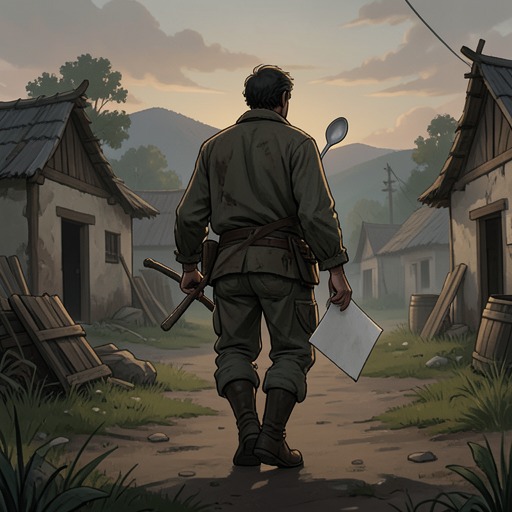
He inventories four marks and keepsakes from the preceding seven days, including the mark on his palm, the effects of earlier violence, and the newly made mark at the boundary. The most consequential object is not a title deed or a finished map, but the calfskin vellum he prepared himself. Walter burned Philip Earle’s two charts: one depicted the commons, fields, and lanes that formed village life; the other proposed future pastures. Philip Earle, who painted them, died in the fire. Walter nevertheless saved an unused flap of calfskin. Unlike the charts, the blank sheet does not fix the land in lines or prescribe its future. It remains capable of being made into a map of somewhere else.
A final view and an uncertain road
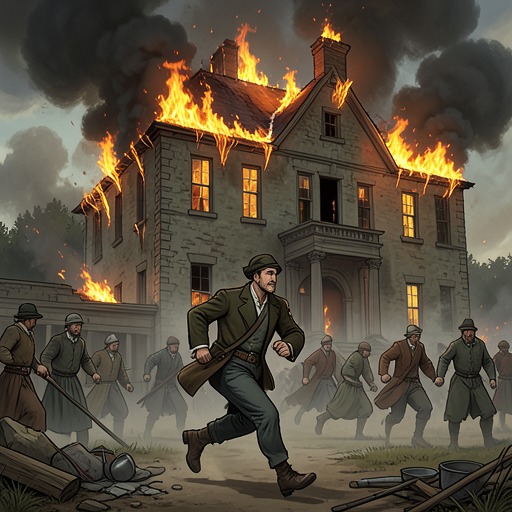
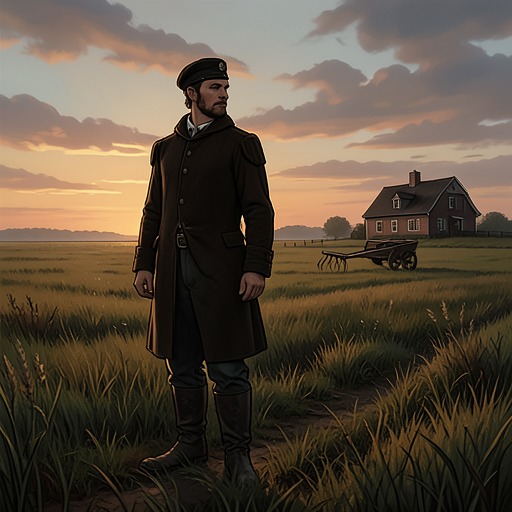
Facing back toward The Village, Walter sees a place without its usual sounds of tools and animals. The quiet makes the settlement seem like an Eden emptied of its people, but the image is unsettled by the estate’s destruction: the manor house still smokes above blackened roofs and browned tree canopies, with Philip Earle among the remains. Beneath that devastation, Walter’s winter wheat is swelling in the furrow he has sown. Its growth continues without witnesses, a modest agricultural future he will not stay to observe.
Walter considers a story he could tell if the Jordans demanded an account of why he failed to save the manor. In that invented explanation, Mistress Beldam is an orphaned witch who destroyed the property after bringing harm to the doves, Willowjack, and others. Walter knows this is a story, not an account of what he can establish, and he does not disclose that she may also be taking him away. The Beldams’ cart has left ruts in the lane beyond the boundary, but Walter’s final act is described as his own: he gathers his stick, silver, belongings, unmarked vellum, remorse, and memory, then takes his first step out of bounds. The next place is unknown; the land beyond the hedges is rougher and less ordered, yet its nuts and berries may sustain him until he finds somewhere to rest. His departure closes the village story without supplying a settled destination, turning the blank vellum and the unbounded road into signs of a future still open.