Harvest Feast and Gleaning Queen Ceremony
HarvestThe Harvest Feast and Gleaning Queen Ceremony brings the village together at the threshold between harvest and winter, but its apparent abundance cannot settle the community’s anxieties. A shared meal, music, and a customary crowning briefly make the village feel whole; the arrival of Mistress Beldam exposes the shame beneath that fellowship, while the next morning’s rite places a child at the center of a more fragile renewal. The sequence also gives Charles Kent an audience for his vision of a future built around sheep rather than grain.
The Feast and Its Unsettled Abundance
The feast takes place in the barn that survived the fire, where harvesters lie on hay bales and eat from Charles Kent’s platters. They have manchet bread, ale brewed from the previous year’s barley, parsley balls, salted offal, stewed giblets, cured bacon, and a calf Charles Kent had kept after its mother rejected it in the spring. The calf is roasted for the gathering; its hide dries above the fire. The meal makes the harvest’s material success visible, and for a moment the villagers appear to have enough.
That plenty is set against the labor required to obtain it. The crop had been disappointing in the shaded and stony parts of the fields, and the remaining barley had to be reaped by a diminished village workforce. At harvest, children weed the field, the strongest workers swing sickles and scythes, women bind sheaves, and older men set the sheaves upright to dry. The customary division reserves most of the sheaves for common use and leaves a smaller share for gleaning. The feast is therefore not simply a celebration after work: it follows collective effort and depends on the grain that effort has secured.
Yet the company is uneasy. The fires and skirmishes of the day remain present in their thoughts, as does the violent treatment of the woman they have shorn. Walter Thirsk judges that most villagers, unlike Charles Kent and Philip Earle, have worked out who carried a flame to the dovecote. The feast gathers people who share both food and knowledge of wrongdoing. Their fellowship does not erase responsibility; it makes them feel implicated together.
Charles Kent’s Vision and Philip Earle’s Music
At the height of the meal, Charles Kent describes a future in which sheep farming will spare the village the uncertainty of crop growing. Grain depends on sun and rain, and harvests can be flattened by wind, ruined by mildew, or taken by birds. Wool, he argues, grows without sunlight and is less exposed to seasonal risk. He imagines villagers shepherding and shearing instead of plowing and reaping, then making cloth at home: looms will replace oxen, and wool from their own livestock will become garments worn by people far away.
The appeal is sharpened by its setting. Charles Kent offers this prospect when the villagers are fed, drinking his ale, and gathered under his roof; he can defer their anxieties and let the feast continue. Walter recognizes the change concealed inside the attractive picture: grain cultivation is giving way to sheep. The imagined leisure does not remove work so much as replace field labor with shepherding, shearing, and textile production. The feast thus becomes an occasion for Charles Kent to make a consequential economic proposal seem compatible with the community’s desire for relief from uncertain harvests.
Music gives the gathering another form of temporary agreement. The village piper begins a reaping rhythm, but Philip Earle joins him on fiddle, first echoing the tune and then taking it over. The fiddle draws laughter and tears at once. Children abandon their game to slide across the straw; the Derby twins and other unruly young people begin the dancing, followed by married couples and then the unmarried girls. The dancing turns the barn into a shared space of movement and courtship, while the harvest custom gives it a purpose beyond entertainment: one of the girls will be named Lady of the Harvest, or Gleaning Queen, and will step into the harvested field first the next day.
Mistress Beldam’s Arrival and the Broken Dance
The celebration stops when Mistress Beldam appears at the barn gate. She is small, with a roughly shaven head and the heavy velvet shawl by which the villagers recognize her. Philip Earle sets down his bow and rises; the dancers turn toward the figure at the edge of the light. The change in mood is immediate: the villagers had been moving freely, but now they stand still and watch.
Her presence recalls what the community has done to her. Walter senses that the villagers ought to make amends, and for a moment imagines them bringing her into the dance and making her Queen. That reconciliation remains only a possibility. As the dancers move toward her, Mistress Beldam backs away, still facing the company, then turns at the gate and disappears into the dark. The music cannot resume. The villagers exchange uncomfortable farewells and leave, their communal pleasure interrupted rather than repaired.
The interruption also gives the ceremony a sharper social meaning. The village’s usual celebration depends on shared participation, but the woman it has injured cannot simply be absorbed into its circle by an act of welcome. The villagers can imagine crowning her and restoring the evening’s harmony; their actions do not make that restoration happen. The break in the dance carries the unresolved shame into Gleaning Day.
Lizzie Carr Opens Gleaning Day
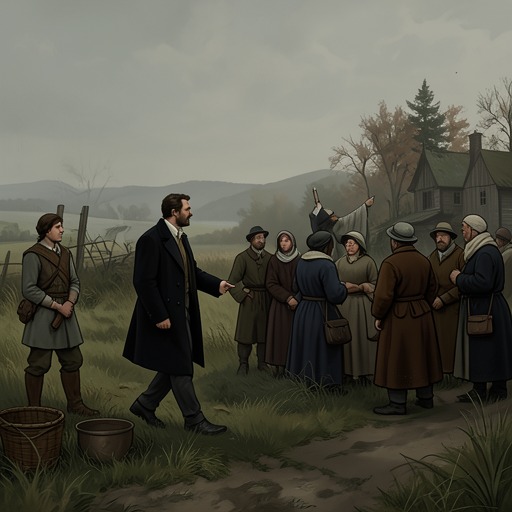
The following morning, after a storm has washed and muddied the village, the people gather at the entrance to the barley field. They had failed to nominate a Queen before the previous night’s dancing ended, and the storm added another interruption. Their customary selection is overdue: the girls and unmarried young women appear in finery assembled from borrowed ribbons and garden and hedgerow flowers, including tansy, ragwort, and hawkweed. Some have colored their cheeks and arms with yellow petals. Charles Kent arrives on Willowjack wearing his best hat, decorated with two woven cloths, one yellow and one green, that had belonged to his wife.
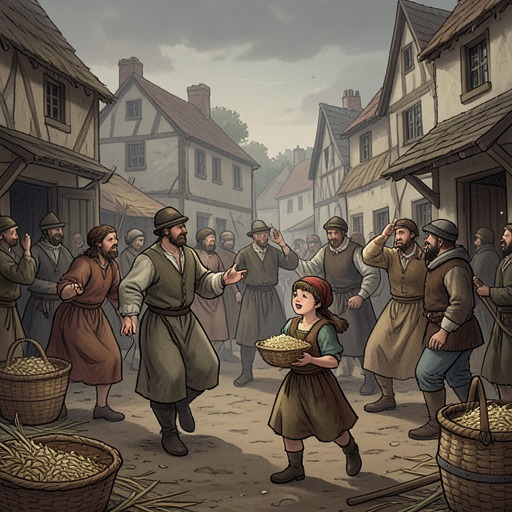
Philip Earle chooses Lizzie Carr, John Carr’s niece, rather than one of the older girls. She is not yet five, is gawky, and has tried to make herself especially yellow with flowers. Her selection is gentle but not comfortable: she is frightened when Philip Earle approaches, and her sister has already pinched her leg. Charles Kent takes the green sash from his hat, places it on Lizzie Carr’s head, and tells her she may keep it. The older girls are jealous, while Lizzie is left at the center of attention without being sure she wants to be there.
Her father and John Carr carry her toward the edge of the stubble in a chair made by joining their hands across each other’s wrists. Charles Kent dismounts and helps her down. He instructs her to remove her slippers, step barefoot onto the field, and find one grain; the first step is painful on the tough stalks, and she moves toward a barer patch before kneeling to search. The sash falls from her head, but she does not retrieve it. Instead she finds an intact ear of barley and separates its grains by running her fingers against the awns, then blows away the chaff and holds the barley in her palm.
The villagers cheer. The small handful of grains condenses the year’s work into a visible token of bread and drink, and the child’s discovery gives the delayed ritual its proper beginning. In contrast to the previous night’s imagined future of effortless prosperity, this renewal depends on the actual field and on the act of finding what remains after the harvest. Lizzie Carr’s crowning does not settle the shame surrounding Mistress Beldam or the fires, but it restores the custom’s immediate purpose: the community gathers around the first gleaning and marks its hope for the colder season ahead.