Villagers Attack Jordan’s Groom
HarvestVillagers Attack Jordan’s Groom marks the point at which village anger becomes an open assault on a servant of Edmund Jordan. The violence erupts while Walter Thirsk is withholding information about Mistress Beldam’s whereabouts, and the groom’s taunt about Lizzie Carr turns a tense exchange into a collective attack. Although the groom survives, the beating and the flight that follows make clear that the villagers have moved beyond a conflict they can contain within their customary community.
Background and Immediate Stakes
Before the attack, ordinary work has already begun to lapse. The harvested barley is unattended, a spilled sack lies uncared for, and duties involving cattle, pigs, waste, and the paths through the village have been left undone. A fallen bough from the Kips’ cherry tree remains across a path, while cattle wait heavily with milk and a gate hangs loose. These details give the village’s inactivity a material cost: it is not a chosen rest, but a sign that shared routines are failing as attention turns to more urgent and uncertain matters.
A gathering has been called for noon, but Walter does not intend to attend. The immediate encounter begins when his neighbors see him speaking with Jordan’s Groom. Walter is not telling the groom where Mistress Beldam may be hiding, leaving the question of her whereabouts active beneath the conversation. The groom, a smaller man than the Jordan constables and lighter-built than the steward, is nevertheless dangerous in his position as a gentleman’s servant. Gervase Carr approaches and asks after his daughter, Lizzie, who is at Edmund Jordan’s house, as Gervase understands it.
The Exchange and the Attack
The groom answers that Lizzie has admitted her wrongdoing. Rather than leave, he turns toward Gervase and makes a quip about Lizzie burning with the other accused women, adding that she would make good charcoal. His attempt at humor treats the accusation and its possible consequences as entertainment. It also converts Gervase’s worried question into a public provocation, with a crowd already gathering behind him.
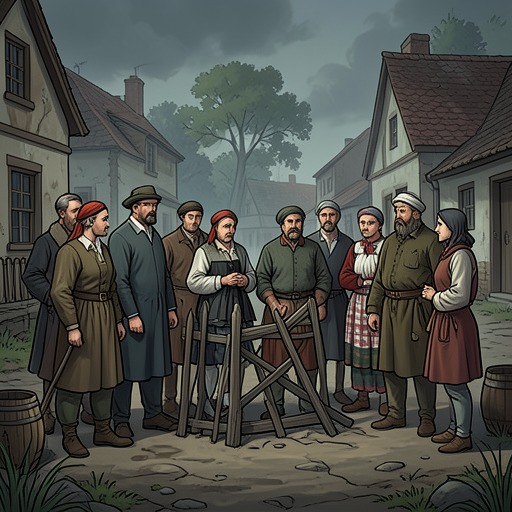
Lizzie’s mother reaches the groom first, taking him by the ear and then by the hair. Gervase follows her lead. Others press in, and the attack becomes a group assault rather than a private confrontation between two men. Walter is knocked backward from his bench into the rain ditch beside his cottage. A second blow prevents him from standing at once, and a boot strikes his face. He curls up and stays out of the scrum; he does not join the attack.
The assault grows out of accumulated anger, but the evidence also makes its escalation specific. For a time, the crowd’s blows leave open the possibility that the groom might escape with bruises rather than more serious harm. Then one of the Saxton lads steps forward with a pruning blade and cuts the groom’s face. That act changes the character of the encounter: a taunt answered with collective force has become an assault that can be carried beyond the village as an unmistakable injury to one of Edmund Jordan’s men.
Blood, Restraint, and Witness
The sight of blood brings the attack to a sudden halt. The crowd steps away, and the villagers turn to cleaning themselves and their belongings: Gervase wipes his knuckles in the grass, the Saxton lad goes to wash his blade, and two sisters scrub splashes from their aprons. The abruptness of this retreat contrasts with the speed of the violence. The villagers’ anger does not disappear, but the presence of blood makes the consequences immediate and difficult to ignore.
When the lane empties, Walter and the groom are left alone. The groom is barely moving, but Walter recognizes that he is alive. Walter is also the only person present who can say that he did not strike him. His relief that the groom survives is bound to the possibility that he may serve as a witness, although Walter doubts that the injured man will be able to speak. The scene therefore leaves both a possible account of events and uncertainty about whether that account can be given.
Flight and Wider Consequences
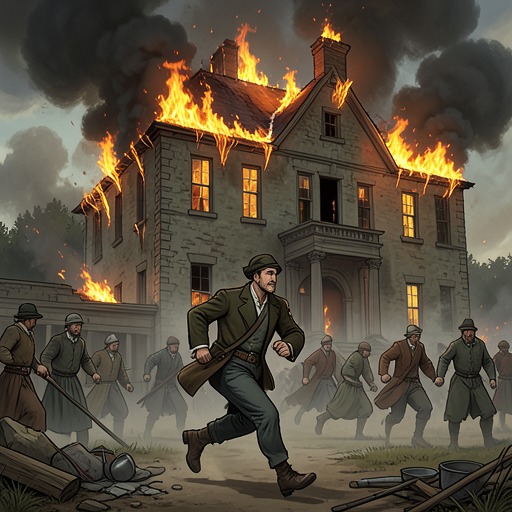
The villagers leave quickly because the groom’s injuries have changed what they fear Edmund Jordan’s side can do to them. Walter understands the attack as a threshold: theft from the master’s property might go unpunished, but beating and cutting one of Jordan’s men invites outside authority and a demand for formal justice. His anxious blessing for the village gives way to the recognition that no one is safe. The assault has made the prospect of collective punishment more immediate than the grievances that had gathered around the groom.
The Carrs and Saxtons are the first to go, knowing that their participation places them in particular danger. John and his wife, Emma, also decide to leave, joining John’s brother’s family. The groom is expected to make his way back to Jordan Manor House and report what happened. John departs with bundles and packs, leaving behind the customary life to which he belongs. Walter and John had made peace earlier that morning in the darkness of Walter’s room; nevertheless, John does not look back as he leaves. Walter interprets the family’s flight not as indifference to Lizzie but as an attempt to protect other Carrs beyond the village before considering how the family might be made whole again.
The event’s significance lies in this double reversal. The villagers’ attack briefly asserts their capacity to act together against Jordan’s servant, yet the injury gives Jordan’s side grounds to answer with a form of justice beyond the villagers’ control. Their communal routines were already faltering; now people begin to abandon the village itself. Walter’s position as both witness and nonparticipant cannot stop that movement, and his silence about Mistress Beldam remains a separate thread of danger within a conflict that has become public.