Gleaning and Lizzie Carr’s crowning as Gleaning Queen
HarvestGleaning and Lizzie Carr’s crowning as Gleaning Queen make the harvest’s shared labor visible as both livelihood and community ritual. In a year of uncertain crops, the village gathers to reap, celebrate, and preserve grain for winter; the ceremony gives a young child a place at the center of that collective life. Its symbols do not protect her, however: the green sash that identifies Lizzie as queen later helps draw her into a search for Willowjack’s killer.
Harvest and Communal Labor
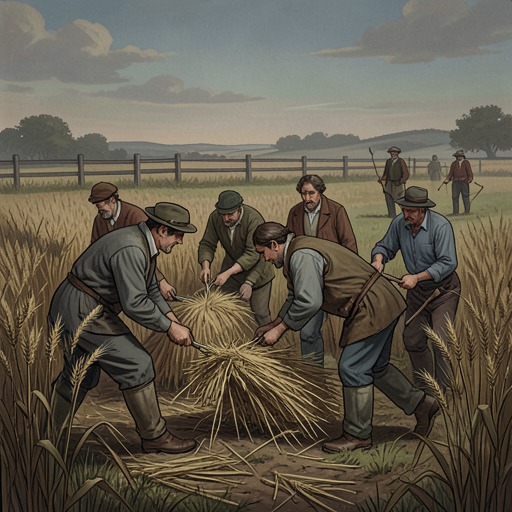
The ceremony follows a harvest that has demanded hard work from a depleted village. The lower, shaded ground and neglected stony slopes have yielded weak plants, while the higher barley field has ripened into a more promising crop. Reaping is organized across the community: children clear weeds, strong workers cut the stalks, women and girls bind sheaves, and older people make the stooks. The work supplies grain for the year, but it also brings the village together in a single field, where labor and conversation are shared.
That gathering has its own customs and pleasures. The harvest’s collective effort makes room for loud gossip and teasing, while the arrangement of the crop divides the sheaves between common use and later gleaning. After the reaping, the season’s remaining grain belongs not only to those who cut it but also to those who will search the stubble for what has been left behind. Gleaning Day thus extends the harvest’s communal economy: small portions gathered from the field matter to household stores and winter feed, even when the main crop has already been brought in.
The village’s agricultural life is not presented as an easy pastoral idyll. A harvest can fail through poor weather, disease, or damage to crops and animals, and the work of the fields allows little time for contemplation. Walter Thirsk recalls that he once admired the countryside without understanding how thoroughly its beauty was joined to toil. Gleaning and harvest ritual bring those two views together: the field is a place of seasonal beauty, but also a demanding source of food that the community must work to secure.
The Interrupted Feast and the Queen’s Selection
The communal celebration continues into music and dancing. Philip Earle joins the village piper, Thomas Rogers, on the fiddle, and the music draws children, young people, and married couples onto the barn floor. The dance briefly loosens ordinary distinctions and gathers the village into a shared celebration. The selection of a Gleaning Queen is to follow, and the chosen girl will lead the next day’s gleaning by stepping first into the harvested field and finding a grain.
The evening changes when Mistress Beldam appears at the barn entrance. The sight of her recalls the village’s recent treatment of her and the imprisoned newcomers. For a moment, the dancers imagine welcoming her into the celebration and making her queen, as though this gesture might repair the harm and restore the community’s customs. But the welcome remains only an imagined possibility. Mistress Beldam withdraws, and the dancing ends without a queen being chosen.
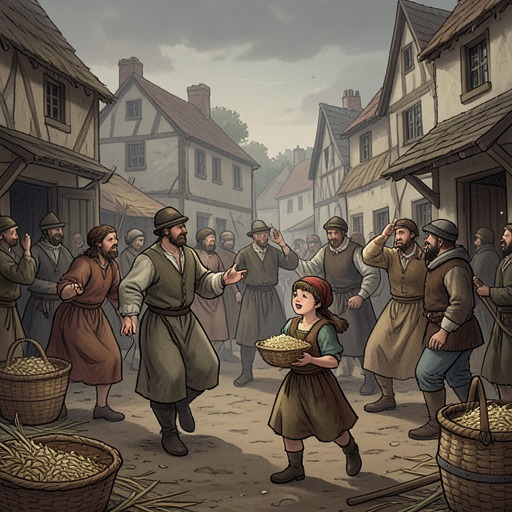
The next morning, the girls arrive dressed for the ceremony in borrowed ribbons and garden flowers. Charles Kent, who has come on Willowjack, settles the delayed choice by selecting Lizzie Carr, John Carr’s niece. She is not yet five, is not among the older and more conventionally admired candidates, and has decorated herself with particular effort. Philip Earle’s choice is unexpectedly gentle: Lizzie is young enough to stand apart from the rivalry among the older girls. Charles Kent removes the green sash from his hat and places it on her head as her crown, telling her she may keep it.
Lizzie’s father and John Carr carry her on a chair made by joining their hands at the wrists to the edge of the stubble. Charles Kent helps her down and instructs her to take off her slippers and find a single grain. She steps barefoot onto the field, searches among the cut stalks, and finds not merely one loose kernel but a complete ear of barley. She separates the grains and blows away the chaff, holding the barley in her palm for the village to see. The crowd cheers: the harvest’s promise is condensed into a few kernels resting in a child’s hand. The sash, a bright green mark against the harvested field, makes her role visible as the year’s Gleaning Queen.
From Ritual Recognition to Suspicion
The crowning’s meaning changes when Edmund Jordan’s men search for Willowjack’s killer. The men have been told about a dangerous woman and are looking for clues connected to the murder. Lizzie leaves the threshing barn while still wearing her green sash, apparently hoping to renew the yellow flowers she wore at her crowning. In Walter Thirsk’s reconstruction, her fine cloth and floral decoration make her seem suspicious to the searchers, who associate valuable garments with the bloody velvet shawl connected to Mistress Beldam.
Lizzie tells the men that Charles Kent gave her the sash and that she is queen for a year, but Walter imagines that they doubt her explanation and take her to answer questions before Edmund Jordan. He also imagines Anne Rogers and Kitty Gosse intervening when they see the child being taken. Their attempt to help Lizzie brings them into the same custody. This account is explicitly Walter’s reconstruction of events he did not see directly; he understands that the three women were detained, but cannot establish precisely how the two women became involved.
When the prisoners are brought out to leave the estate, Lizzie still wears the sash, now dirty and torn. Walter remembers her earlier as the small, nervous child who had searched the stubble and displayed her grain. The contrast between that public moment of welcome and her later fear makes the cost of her arrest especially clear. Charles Kent has intervened, and Walter expects the women to be freed elsewhere, but their release does not undo the separation from the village or the distress of their detention.
The Ceremony’s Afterlife
The crowning persists in memory after the harvest custom has been disrupted. Later, as Walter looks back on the barley field, he remembers Charles Kent’s assurances that gleaning would benefit families, cattle, geese, and hogs. Yet the field’s future is changing: it is intended for winter wheat, while Edmund Jordan’s plan promises that the plow will no longer be needed. The ceremonial recognition of gleaning therefore stands at a point of transition between customary grain-growing and the proposed conversion of land to sheep raising.
That conflict makes Lizzie’s sash more than a festive token. Within the village, it marks her temporary authority and the shared promise that gleaned grain can help carry people through the colder season. Outside that customary understanding, the cloth is treated as a clue in an investigation. The same object that affirms a child’s belonging becomes part of the process by which she is removed from her community. The episode joins the harvest’s practical work to its social meaning, while showing how quickly a ritual of recognition can be overtaken by suspicion and official power.