Villagers Leave the Village En Masse
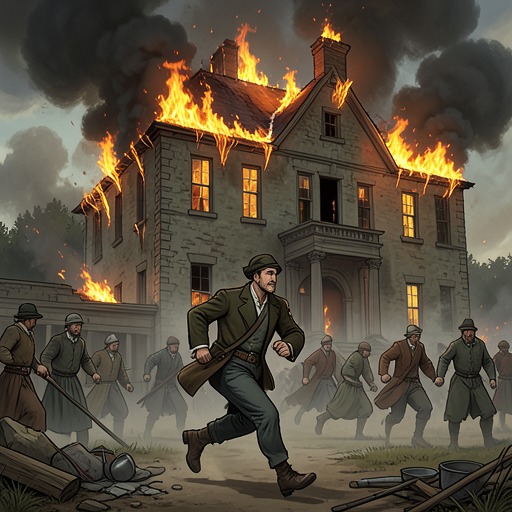
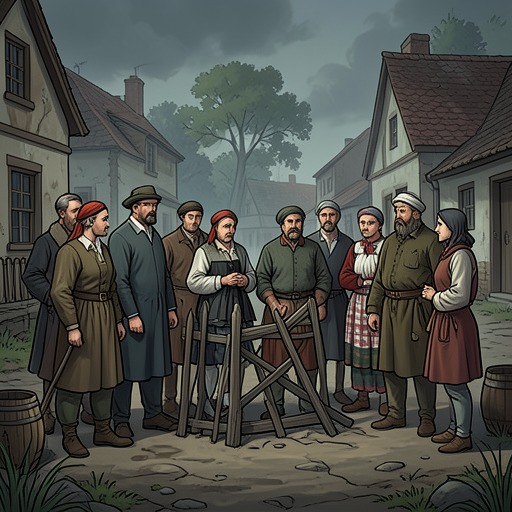
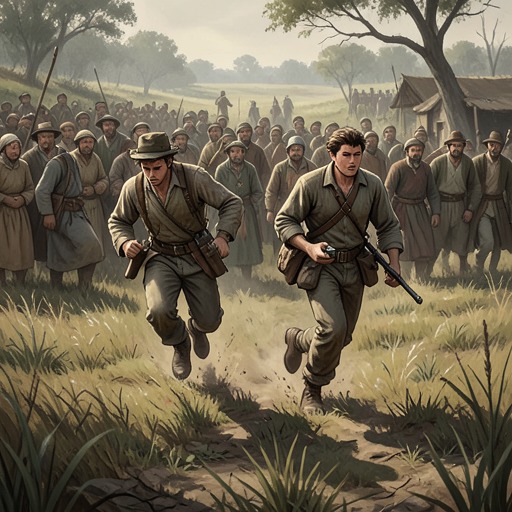
HarvestThe villagers’ mass departure from The Village is both an attempt to escape punishment and a break with a life bound to familiar fields, homes, and neighbors. What begins with the families most exposed to retaliation becomes a collective exodus: people leave with animals and household goods where they can, divide between the broad road and the forest, and cross the village limits toward uncertain lives beyond Edmund Jordan’s estate. Walter Thirsk watches the departures from a position of painful exclusion, seeing grief and fear mingle with a freedom that some villagers have never before experienced.
Causes and the First Departures
The exodus begins in the afternoon with the Carrs and Saxtons, whom Walter expects to leave first because their part in the attack on Jordan’s Groom gives them particular reason to fear punishment. Jordan’s Groom has returned to the manor after being assaulted while serving Edmund Jordan. The possibility that he will identify those involved makes the threat of retribution immediate, and the consequences extend beyond the people who took part. John Carr and his wife, Emma, decide to join John’s brother’s family in flight; Walter observes that even their neighbors have been persuaded that leaving is safer.
The families of Brooker Higgs and Christopher and Thomas Derby leave next. Their sons have already gone ahead, so the older family members are following them and can expect to reunite on the road. Four men carry old mother Derby on a winnowing screen used as a litter. She shares it with the family’s luggage and clothes and tries to keep its load light by lying still with her knees drawn up. Walter sees no tears as they set off; their departure appears calm and practical, a decision made before the anticipated trouble can begin in earnest.
A Choice Between Loss and Risk
Other families hesitate. Some believe their smaller part in the assault may spare them the harshest penalties, and for a time they weigh the losses of departure against the danger of staying. Those losses are not abstract: some have not yet finished gathering their barley, and they worry about the hens. They also reckon with land and lineage. Families who have worked these fields across many generations do not expect to be driven out easily, and leaving would mean losing not only property but familiar names, faces, and prospects in a place where they would be strangers.
That calculation changes as the afternoon progresses. The villagers have not fully measured what remaining might cost, Walter suggests; they have more readily counted what they would have to surrender by leaving. Yet memories of alternating feast and famine offer a different measure of the risk: people accustomed to precarious circumstances may be more willing to face an uncertain road than those who expect their inherited place to protect them. The numbers leaving steadily grow. At last, everyone Walter has known in the line of cottages accepts that distance from Edmund Jordan’s men—and especially from Jordan’s Groom—is the safer choice.
Two Routes Out of The Village
Most departures take the broad lane Baynham rode on horseback. Its width matters because it allows people to bring livestock and household goods: a cow or goat can be led, while hens and geese travel in baskets on barrows and carts. The Kips manage an especially substantial load, setting an ox between the shafts of a hay wagon and taking nearly everything they own, including stoppered bottles of cordial and their gleaning sacks. They leave with their possessions, but also with their names and family identities, carrying those attachments beyond the familiar tracks and driftways of Edmund Jordan’s property.
The road leads toward gravel and the established traffic of post-horn carriages, packhorse trains, and carts hauling goods. For Walter, that direction also points toward the towns and their restless, paler populations. The contrast is stark: the departing villagers move from a close-knit settlement into a wider world of unfamiliar people and places, taking what their vehicles can bear as they pass beyond the limits of the life they have known.
The Carrs and Saxtons instead choose a deeper route through the forest. They have spent their lives fearing a prolonged absence of daylight or moonlight, and the forest’s heart may hold neither a familiar path nor places where people have gone before. This choice means they cannot bring carts or their more valuable animals; the animals must forage for themselves. In return, the wooded route offers protection from mounted pursuit. Walter hopes the families will not be caught or hunted down, and imagines they might reach another boundary and someone else’s common ground within a day or two. Their route trades possessions and certainty for a better chance of escaping their pursuers.
The Departure’s Emotional Turn
Walter does not participate in the farewells. He watches as neighbors prepare bundles and arrange their burdens, imagining embraces that remain in his dreams rather than taking place in the scene before him. His distance makes the exodus both communal and isolating: almost everyone he has known is leaving, yet he is left to observe their departure rather than share it. The houses may be busy with preparations, but the village’s social ties are being carried away along its roads.
The mood does not settle into grief alone. Once the decision to leave has been made, Walter sees a determined, turbulent happiness arise alongside anger and sorrow. Some younger villagers almost smile with relief: they are escaping the prospect of capture, but they are also moving toward a future whose shape they cannot predict. Leaving the village limits for the first time in their lives transforms fear into a reason to press onward. The exodus therefore marks a reversal as well as a loss: the villagers abandon home under pressure, yet some experience the departure as their first opening onto possibility. Walter’s restrained, watchful account holds both truths together—the material cost of flight and the hope that begins only once the familiar bounds have been crossed.