Thirsk Plows the Barley Field and Sows Winter Wheat
HarvestWalter Thirsk’s plowing of the harvested barley field with Young Beldam, followed by his sowing of winter wheat, is both a last act of husbandry and a quiet refusal of Edmund Jordan’s sheep-farming future. The work begins as a practical task requiring two pairs of hands and ends as a deliberate message written into the land: even as the light fails, Thirsk scatters seed for a crop Jordan’s plans do not include.
From Harvest to a Threatened Future
The field had only recently yielded its barley, and its harvest had depended on the collective labor of a shrinking community. Children cleared weeds, stronger workers swung sickles and scythes, women bundled sheaves, and older villagers built stooks. The work was difficult, but its yield meant grain for the year ahead. The cut stubble also preserved the workers’ different habits: John Carr’s careful, low sweep left little behind, while Brooker Higgs’s wide, distracted strokes missed more of the grain. The field was not an abstraction or an empty surface; its marks recorded who had worked it and how.
That cycle of cultivation now faced an imposed end. Edmund Jordan had declared that the villagers would never need the Plow again, as the estate was to turn from crops toward Sheep. Thirsk remembers that, during the harvest festivities, the promise of prosperity through wool had been offered as a future of shepherding, shearing, and textile work. But the change would also displace the familiar sequence of plowing, sowing, and reaping. Thirsk understands the new field not as a neutral improvement, but as the possible end of the community’s agricultural future.
Assembling the Plow
In the hot tool barn, Thirsk chooses the wheeled Plow rather than the lighter swing plow. With only two Oxen and two workers, he judges that the wheels are necessary to support the beam; without them, the implement would be difficult to control and would not cut a deep furrow. He pulls the parts into the light and begins laying them out. His practical decision makes the day’s work possible, but also shows how much depends on matching tools, animals, labor, and soil.
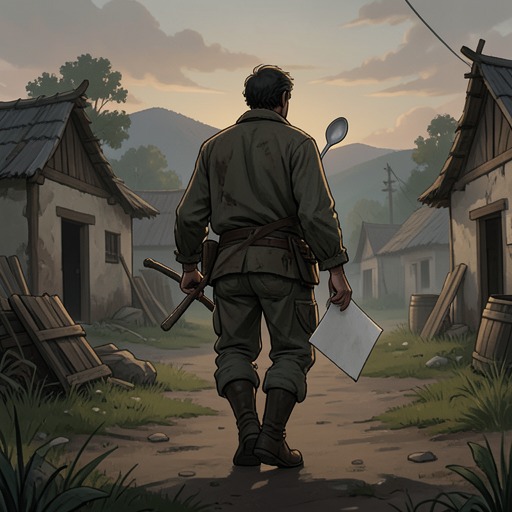
Young Beldam has come to stand with the Oxen, carrying a sword. He does not offer help until Thirsk calls him. Then he says, “Nose before ear,” naming the proper order of the Plow’s parts: the coulter must open the soil before the share cuts it, and the moldboard must follow to turn the ridge. The instruction is both technical and proverbial. In country usage, the phrase insists that work proceed in its necessary order: one cannot reap before plowing and sowing. Thirsk reads Young Beldam’s words as recognition that this labor is a pledge of continuity, a way of marking the ground for a future beyond the coming winter.
Young Beldam’s handling of the equipment reveals experience that his present condition had not advertised. Thirsk recognizes his slightly uneven gait as the characteristic skew of a former plowman, shaped by the different levels of furrow and ridge. He lets Young Beldam assemble the implement, steadying the share-beam while his companion secures the blades, moldboard, and yoke. Together they set out with a pair of Oxen to turn the stubble.
A Deliberately Small Furrow
The task is not to restore the whole field. Ordinarily, plowing it would take twelve days, four Oxen, and twenty strong men taking turns. Thirsk and Young Beldam intend to make only one pass down the field, turn at the headland, and return. They aim for a narrow but straight and honest mark, with a central ridge and two deep furrows. Thirsk fixes their line on a tapered oak above the hedgerow, trusting the tree’s stillness as a guide for the Oxen and the Plow.
Young Beldam takes the handles, sets his feet in the soil, and leans against the pull. The act changes his bearing: Thirsk sees him become intent and forceful as he finds the leverage needed to work with the Oxen, beam, and ground. Thirsk leads the animals, while Young Beldam guides the Plow. Their cooperation is physical before it is conversational. Young Beldam whistles as the ridge and furrow take shape; Thirsk talks about the troubles of the preceding week, Cecily, Charles Kent, and Philip Earle. He also voices his distrust of Sheep, imagining that people will end up serving the animals rather than living from the crops they once cultivated.
The work remains laborious. Mud clogs the Plow’s wheels, and Thirsk has to free them repeatedly, sometimes with a kick and sometimes with his bare hands. Rooks and starlings follow in the damp wake, picking through the newly turned furrows. The field is not made fertile by symbolism alone: it takes animal strength, bodily effort, maintenance, and a chosen line across the ground.
Sowing Against Enclosure
Once the blades are cleaned and the Plow returned, Thirsk sends Young Beldam away and undertakes the next task alone. He brings a bag of wheat seed into the field and selects the heaviest grain for his baskets. Good practice would be to let the turned strip mellow for a week, or to wait for rain to break down the soil. Instead, he sows at once. The delay is a luxury the circumstances do not permit: he has only this afternoon to make his mark.
Thirsk knows that winter wheat will eventually need to be rolled after its green shoots emerge, crushing them so the ground firms and the plants take hold. He describes this harsh treatment as a form of nurture, and sees in it a likeness to the capacity of people to be pressed down and still stand. His act is at once skilled farming and personal defiance. He calls the narrow sowing a farewell gift and his countryman’s revenge on Edmund Jordan and the Sheep. The seed does not undo the estate’s plan, but it asserts a different future in the very ground designated for conversion.
The Field at Dusk
As Thirsk completes the sowing, drizzle begins, watering the seed as it leaves his hand. He walks the furrow for the final time, still scattering grain, while the light drains from the sky. Beyond the hedgerows and the oak, gray-purple clouds gather; the remaining light briefly touches the wood, rooftops, and clouds before withdrawing. The field itself lies black, then shines with wetness. The day’s work ends as darkness settles, leaving the newly sown strip as a small, vulnerable continuation of the agricultural cycle.
The scene brings practical labor and political resistance into the same gesture. Thirsk’s furrow cannot secure the village’s land or guarantee a harvest, and the narrow strip is far smaller than the field that once required a full community to plow. Yet sowing it matters precisely because the future is contested. Against a policy that would make plowing unnecessary, Thirsk puts seed into the soil and accepts the risks of a crop whose harvest he may not see. The field’s last light does not resolve the conflict; it leaves his act in darkness, awaiting whatever comes next.