Thirsk Burns Down the Manor
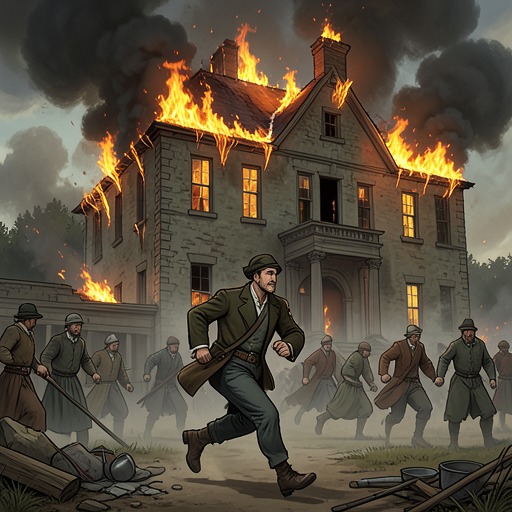
HarvestWalter Thirsk burns down the manor after discovering Philip Earle dead in an upstairs travel chest and seeing the Beldams leave the devastated estate with a cartload of plunder. The act turns his guilt at having failed his friend into a decision to finish the destruction already begun around him. Its first fuel is not timber but the brittle titles, deeds, and other papers that embody the estate’s claims to land and authority.
Discovery and uncertainty
Walter recognizes Philip Earle by his gentlemanly clothes, painted fingers, shaped beard, and the familiar physical imbalance that marked him as the Chart-Maker. Earle lies in the chest, still wearing the clothes he had worn when Walter last saw him pursuing Mistress Beldam at the midnight pillory. Walter does not need to turn the body to identify him. The discovery confirms that Earle has been killed, but it does not settle when or by whom.
Walter’s brief examination suggests that a sword was used, and that the same blade may have cut the ropes at the stairwell entrance. He cannot determine how long Earle has been dead. The killing might have happened the previous night or during the night when the women named him under torture. The poor condition of the attic stairs makes it probable that Earle was killed in the upper rooms and placed in the chest before he bled too much. Walter considers the Beldams and the Jordan men as possible responsible parties, but the evidence gives him no resolution. The murder remains an uncertainty at the center of his decision.
A friend left behind
Walter’s first response is not a plan for revenge but a sense of personal failure. He believes he has failed Earle once already and is failing him again by leaving him where he lies. In Walter’s reckoning, his friend deserves burial at Turd and Turf, among the week’s other dead, with a proper marker of piled stones and within sight of the longpurples. Earle had liked that place for its blossoms, light, solitude, and birdsong. Walter cannot carry him down the stairs by himself, however, and the fire threatening the manor makes the attempt impossible.
This inability to give Earle the burial Walter considers fitting becomes part of the pressure behind his later choice. The burning cannot retrieve the body or resolve the murder, and Walter does not claim that it can. It does, however, offer him a way to act where helplessness has so far governed him. He thinks of the manor as a possible cremation for Earle, rather than leaving him in the chest to be consumed by vermin and birds. That idea joins mourning to retaliation without making the act a remedy for the unanswered questions around the death.
The Beldams depart
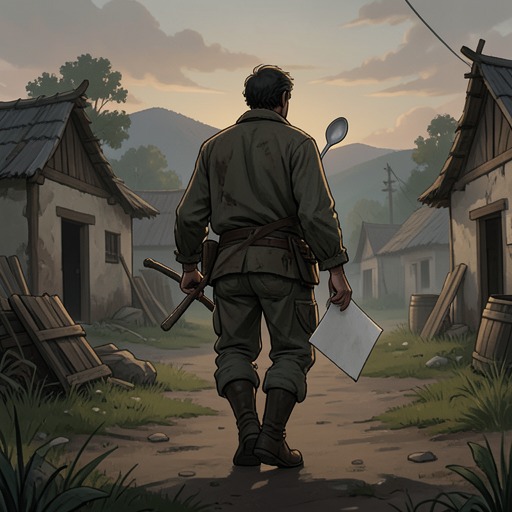
Outside, Walter sees the Beldams already retreating along the lane. Young Beldam leads the oxen, while Mistress Beldam rides on the cart among the plunder, a short sword across her knees and velvet over her shoulders. The sight gives Walter no clear explanation of Earle’s death. Mistress Beldam may be unaware that he is in the manor; Walter also allows that she may not be the murderer. He recognizes that he will never know the truth.
The couple’s departure follows destruction across the village: its homes have already been put to the torch, and their cart is loaded with property. Their retreat makes the manor the remaining target in Walter’s immediate surroundings. In a dream he imagines following them, but only after Mistress Beldam calls him close and assures him that he is welcome and safe. He postpones that imagined reconciliation. For the present, he wants to watch the manor burn, and frames its destruction as the completion of what the Beldams have begun.
Ignition and reversal
Walter’s decision marks a change from his earlier search for courage to a specific, dangerous course of action. He had wanted to redeem some mischief and had not settled on a plan. Now he means to put more timbers into the fire and watch the flames travel through the rooms and up the stairs. He imagines the turret burning above the estate, its blaze higher than a steeple. He also recognizes the cost: this deed may make it unsafe to remain as Master Jordan’s trusted winter man, and he does not know whether it will satisfy either the witnesses he has in mind or himself.
The means are close at hand. Walter rekindles the parlor fire’s ashes and lights a candle. The overturned coffer has spilled Charles Kent’s titles, muniments, and deeds across the floor; dry and brittle as barley husks, they can catch from the candle. Walter chooses these papers as kindling at the moment he turns toward setting the manor alight. The choice gives the act a significance beyond the destruction of a building: the documents that record and enforce the estate’s holdings become fuel for its ruin. The village’s wooden pillory had once served as a gathering place for marriages, baptisms, mourning, and harvest blessings, as well as punishment. Walter’s fire brings another kind of judgment to the estate, but offers no formal verdict on Earle’s killer. It is an act of grief and reprisal carried out under uncertainty, and the evidence leaves that uncertainty unresolved.