Stable and Dovecote Fire
HarvestThe Stable and Dovecote Fire begins as a scheme to drive birds away and becomes a disaster that exposes the Village’s loyalties and evasions. After the barley harvest, Christopher and Thomas Derby and Brooker Higgs use a dry Moonball to carry fire into Charles Kent’s buildings. They do not intend the blaze to spread, but when it does, they help fight it and then direct suspicion toward newcomers living near The Woods. Walter Thirsk knows enough to question their story, yet chooses not to speak.
Causes and Setting
The fire follows an exhausting harvest in a year when the grain has not been plentiful. The shaded and stony fields have yielded poorly; the higher barley field, left to ripen last, has offered the more promising crop. Harvesting is collective work: children clear weeds, stronger workers cut the stalks, women bind sheaves, and older people set them to dry. The labor is also a time for shared gossip and fellowship, and its completion gives the Village a reason to expect a rest day and celebration.
Once the barley has been gathered and carted away, the community settles into that expectation. The coming Harvest Feast and Gleaning Queen Ceremony promise ale, veal, and the customary choice of a queen to begin gleaning. The three unmarried men take a different course: Christopher and Thomas Derby and Brooker Higgs go to The Woods. They have found Fairy Caps and, after devising a way to retaliate against the birds that steal from the community, use a Moonball as a portable source of flame. The planned target is the dovecote, whose white birds they regard as thieves.
How the Fire Spreads
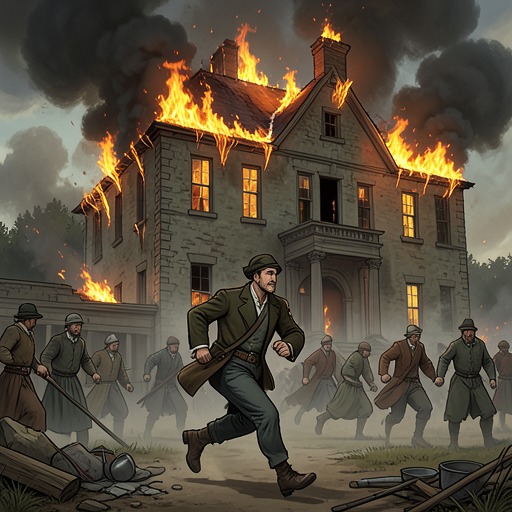
Before first light, the men push the Moonball into the dovecote. They mean to create smoke and drive the birds out, not to set fire to the estate. But the ember reaches the dry chaff and nesting material in the loft. The flame takes hold of the roof beams and reaches the summer hay stored above. The birds’ movement helps the fire spread, and the buildings become difficult to save.
The fire kills many of Charles Kent’s doves and destroys both his stable and dovecote, along with the hay. His mare is rescued. The loss is material, but it also makes the men’s small plan impossible to contain: what was intended as a furtive act against the birds becomes a blaze visible across the estate. By morning, the stable yard bears unmistakable signs of the dead birds, and the three men face the consequences of a scheme that has escaped their control.
Concealment and Blame
When Charles Kent arrives, Christopher and Thomas Derby and Brooker Higgs make a conspicuous effort to help. They carry water from the pond and cisterns and use spades against the flames. Their eagerness is presented as loyalty, but Walter sees their guilt in how insistently they try to attract Kent’s attention. Brooker, especially, moves quickly from fighting the fire to organizing a search for whoever started it.
The account of an accidental fire is not persuasive: no lightning struck, no nearby burning farm waste explains it, and nobody was sleeping in the stable with a candle. Brooker nevertheless turns suspicion away from the men and toward strangers. The damaged ladder provides a pointed contradiction: it is the ladder Brooker and his accomplices had leaned against the stable that morning to reach the dovecote. Rather than disclose that connection, Brooker presents the fire as malicious work by an outsider. A second plume of smoke, rising from the newcomers’ camp beyond the fields, gives the accusation an apparent target.
Charles Kent says the newcomers should be questioned, but only after the buildings are made safe. He is distressed by the fire and understands that suspicion may require him to act firmly. The Village, however, has no magistrate or constable, and Kent is reluctant to impose punishments that would deprive families of their men. The likely local penalties for a proven offense would be a beating, expulsion beyond the Village’s boundaries, and possibly the taking of animals in recompense—not death. The absence of formal authority leaves the response to local judgment, where both kinship and expediency matter.
Walter’s Silence and the Event’s Consequences
Walter knows that a Moonball can carry flame and realizes that he should identify it or confront Brooker. He does neither. A Moonball, he reasons, is not proof, and he senses that the Village would rather let the episode subside than lose its holiday. The men are their neighbors’ sons; the buildings and birds matter, but Walter does not wish to value them above those families. His silence protects the bachelors from immediate exposure while allowing the accusation against the newcomers to gather force.
That choice makes the fire more than an accident or an act of arson: it becomes a test of what the Village is willing to see and say. The same people whose harvest depends on mutual labor choose, for the moment, not to interrupt their celebration with an accusation against their own. Meanwhile, the smoke from the newcomers’ camp supports a convenient alternative account. The fire’s immediate destruction is therefore joined to a larger danger: concealment redirects attention toward outsiders and helps set the terms for the conflict that follows.