The Beldams Loot and Burn the Village
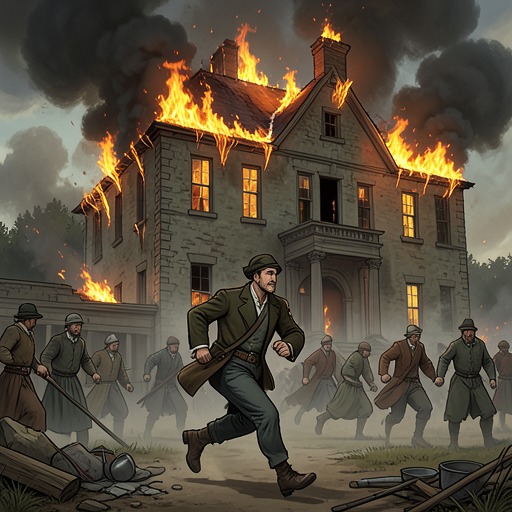
HarvestThe Beldams Loot and Burn the Village is the late-stage act of retaliation in which Mistress Beldam and Young Beldam strip The Village of possessions and set its homes alight. Seen from a turret by Walter Thirsk, the attack advances in separate plumes of smoke before becoming unmistakable: buildings blaze, a stolen cart carries goods away, and Young Beldam hacks at the Village Pillory where he had been confined. The event turns a place shaped by harvest work and communal rites into a scene of systematic destruction, while leaving Walter trapped above the danger and uncertain whether the manor will be spared.
Setting and accumulated tension
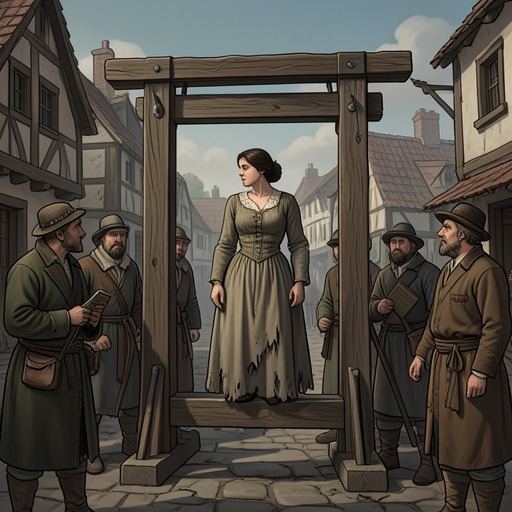
The destruction gathers meaning from the places and customs that precede it. The Village has no completed church: at The Unbuilt Church Ground, graves, unlaid stones and a foundation block mark the building that never came to be. Instead, the Village Pillory, a large oak structure at the unbuilt church’s gateway, has served as a communal cross. The villagers hang rosaries and flower chains from its prisoner openings, and Charles Kent uses the site for marriages, baptisms, eulogies, mourning, harvest thanks and the blessing of seed and plow. Its penal purpose has not disappeared, but communal life has given the structure another use.
That shared life is already under strain. At the harvest dance, Philip Earle takes up his fiddle alongside Thomas Rogers’s pipes, and the music draws children and adults into the same celebration. The arrival of Mistress Beldam, her head shorn and her velvet shawl visible at the barn entrance, interrupts the revelry. Walter imagines her welcomed as a Gleaning Queen, but the reconciliation remains only a wish: she backs away from the dancers and leaves. On Gleaning Day, the villagers proceed with the rite, choosing Lizzie Carr, who steps barefoot onto the stubble to find a grain. These ceremonies preserve a pattern of common work and belonging, but they do not repair the conflict surrounding the Beldams.
Smoke becomes a village-wide fire
The attack is revealed through Walter’s limited view from the turret. After climbing twenty rungs to the trapdoor, he reaches a space long undisturbed by anyone else. From its windows he can see the orchard, the fields, the village roofs and the church ground, but not the courtyard below. At first, smoke from the tool barn appears almost like blackened dust, slow to rise in the windless air. A second plume comes from the whitehouse, followed by smoke from the cottages.
The change from uncertain haze to deliberate burning comes in stages. Thomas Rogers’s cottage is among the first homes to smoke; it is the house where he played his pipe and his mother, Anne Rogers, sang. At that point, the smoke remains thin enough to resemble ordinary cooking fires. But once the fourth and fifth cottages have been set alight, the tool barn and whitehouse are already lit orange, with flames climbing their sides and blackening the wood. The widow Gosse’s home and Walter’s own cottage also begin to smoke. What began as isolated signs becomes a spreading assault on the inhabited settlement.
Loot, revenge and the Village Pillory
Walter identifies the perpetrators as the Beldams and sees that they have taken a cart and the pair of oxen once used to plow the final mark into the summer barley field. The cart stands loaded in a clearing by the Village Pillory. Its cargo includes possessions from village homes and the manor house: Charles Kent’s tapestries and better chairs, his late wife’s loom, and the assembled parts of the plow. The stolen objects make the raid more than an attempt to destroy shelter; they show the couple carrying away the material remains of both household and agricultural life. Walter connects the attack to the death of Young Beldam’s father, treating that loss as the price for what is happening, though the passage does not detail the couple’s full reasoning.
Young Beldam turns from the cart to the structure that held him for most of a week. He judges the Village Pillory with an axe, first striking too high against the hard oak upright, then finding a lower, weathered section where the wood has been softened by time and damp. The first successful blow removes a chip; he cuts from the other side as well, leaving a visible hollow. The strikes make the pillory’s double meaning concrete: the same oak that the villagers had used as a communal cross is also the instrument of his confinement, and now he attacks it as part of the destruction. The narrator hears each blow but loses sight of Young Beldam while the burning elsewhere demands attention.
Mistress Beldam’s work and Walter’s peril
Mistress Beldam moves between the final cottages with a burning faggot, checking that nothing remains to be stolen before setting fire to anything dry. Her head and shoulders are wrapped in velvet against the smoke, and she carries Walter’s Short Sword in her free hand. Walter likens her path through the houses to a moth’s erratic trail. The image captures her small, mobile presence amid the expanding fire, but the details also establish the practical thoroughness of her actions: she carries the means to ignite the houses, searches them for remaining goods and keeps a weapon with her.
From his elevated position, Walter suspects that the village fires are not the end of the attack. He expects Mistress Beldam to leave the last cottage, make her way down the lane with livestock panicked by the blaze, and rejoin Young Beldam by the damaged pillory. He then anticipates that the pair will continue through the apple-strewn orchard toward the manor farm buildings, where Brooker Higgs and the Derby twins had previously left their mark. This is Walter’s prediction, not a witnessed account of those buildings being set alight. The distinction matters: the fires are already consuming the village, while the fate of the manor remains imminent and uncertain.
Consequences and significance
The scene’s force lies in the reversal of familiar uses. The grain field, recently the setting for harvest labor and the choosing of Lizzie Carr as Gleaning Queen, had offered the villagers a shared measure of continuity. Now the plow used in that work is part of the Beldams’ loot, and the communal cross is being chopped apart. The contrast does not suggest that ritual had erased the village’s violence; rather, it shows how much common life depended on places and objects that could also carry the memory of punishment.
Walter’s vantage offers sight without safety or control. From the turret he can identify the sequence of fires and recognize the stolen goods, but he cannot see the courtyard or reach the threatened buildings directly. He knows that the manor may be next and calculates the dangers of getting down: the turret is high, its ladder is wooden, the staircase has collapsed, and the wide stairway lies between him and the flames. The episode thus ends not with the attack resolved, but with Walter isolated above a village being emptied and burned, facing the possibility that the fire will reach the manor too.