A maiden's choice in marriage
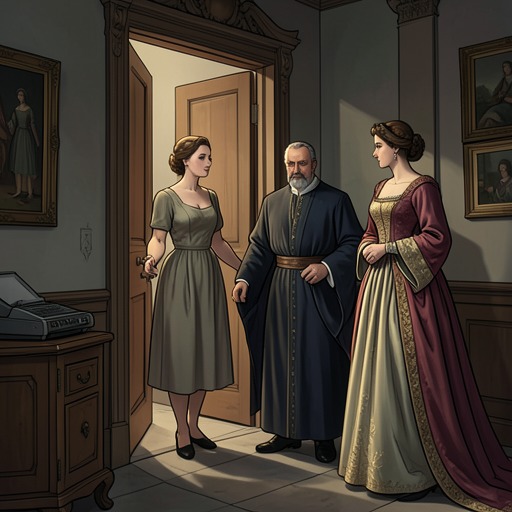
KalevalaA maiden’s choice in marriage is a principle made explicit in the courtship of the Maiden of Pohyola. Wainamoinen and Ilmarinen agree to woo her without force or deceit and to let her choose between them; she then rejects wealth as a basis for marriage and names the qualities by which she will judge a husband. Her decision gives a woman’s expressed preference a central role in a story otherwise shaped by family arrangements, suitor claims, and the departure of brides from their homes.
Choice as a Rule of Courtship
The principle first appears as an agreement between the two suitors. Ilmarinen asks Wainamoinen to let the maiden marry the man she chooses, and Wainamoinen accepts: neither force nor faithless measures should govern their courtship. The unsuccessful suitor is also expected to harbor neither wrath nor envy. The agreement treats choice not merely as a private feeling but as a rule for how competing suitors must behave. It places a limit on rivalry and makes the maiden’s decision, rather than a contest between men, the condition that settles the courtship.
That rule matters because the suitors are not approaching the maiden on equal terms in age or reputation. Wainamoinen is described as ancient, and the maiden rejects him directly. Her refusal is not presented as a failure to appreciate his wisdom: she says that wisdom has little use when compared with gold and silver in the suitors’ competing claims, then insists that she will not marry him. The scene makes rejection part of choice. The right to choose includes the right to rule out a suitor, even when he is a famous and respected figure.
The Maiden’s Grounds for Choosing
The maiden also refuses to treat marriage as a transaction measured by gifts. When costly presents and the wealth of Kalevala enter the discussion, she answers that she will not marry for riches or countless treasures. Her objection reaches beyond the particular offers before her: she objects to anxious mothers effectively selling daughters to suitors whom the daughters do not love. The language sets maternal matchmaking and material advantage against the daughter’s own judgment, making the question not simply which man is richest but who has authority to decide.
Her own criteria are affirmative as well as rejecting. She says that a husband should be chosen for worth, youth, fine appearance, noble form and features, and good behavior; she names Ilmarinen for his wisdom, worth, and conduct. The decision therefore cannot be reduced to preference for youth or appearance alone. She combines outward qualities with character and discernment, and she selects Ilmarinen without accepting wealth as the decisive inducement. The poem gives her a reasoned standard, not just a verdict between two names.
Aino as a Contrast
Aino’s story supplies a sharper contrast to this explicit choice. Youkahainen offers his sister to Wainamoinen as the price of release from torment, promising her as a bride without her consent being shown as part of the bargain. Aino later addresses her mother in sorrow. Against that sequence, the Maiden of Pohyola’s courtship is striking because the woman’s decision is openly solicited and then spoken for herself. The contrast reveals that the ideal of choice is present as a question precisely because marriage can also be arranged through obligations and exchanges made by others.
The difference should not be mistaken for evidence that every marriage in the poem follows the same rule. Aino’s sorrow shows the cost when a young woman’s future is pledged by another; the Maiden of Pohyola’s words articulate a claim that such arrangements can violate. Together, the episodes set a promised bride beside a choosing bride, making consent and family authority visible as distinct forces rather than treating marriage as a single, uniform custom.
Choice and Departure
The Maiden of Pohyola’s selection leads into a marriage and a separation from her birthplace. The bride’s farewell identifies the transition through what she leaves behind: she speaks of childhood scenes and departed happiness, then leaves her native fields and fallows and Sariola. Her choice of a husband therefore does not erase the emotional cost of leaving home. The poem holds decision and loss together: a bride may follow the husband she has chosen and still grieve the place and life she departs.
The wedding material also places her decision within a larger social passage. The bride is addressed as a chosen life-companion and told to join her suitor; Osmotar appears as the bride-adviser who addresses the young woman before married life. These moments frame marriage as more than the instant of selection: the chosen pair must enter a new household and the bride must leave her former home. The principle of choice gives the maiden authority at the point of courtship, while the farewell preserves the cost and change that follow.
Significance
The concept’s force lies in the contrast between a stated rule and the pressures surrounding it. Wainamoinen and Ilmarinen accept that the Maiden of Pohyola must choose; she refuses both an unwanted suitor and the idea that riches should purchase a marriage. Her choice is specific, reasoned, and consequential, yet it does not make the transition painless. Set beside Aino’s sorrow after being promised by her brother, it gives the poem two sharply different images of a bride’s position: one whose future is offered by kin, and one whose own judgment is allowed to decide. The song thus presents personal choice as an important claim within marriage, not as proof that family power or separation has disappeared.