The Supernaturalization of Disease
KalevalaThe Supernaturalization of Disease makes illness more than a bodily misfortune: it gives disease a supernatural ancestry, names it as a family of hostile agents, and answers its assault with healing that is itself magical. Lowyatar’s offspring carry sickness toward Kalevala, where people across ages and ranks fall ill; Wainamoinen’s intervention finally expels the nine diseases. The episode thus frames affliction and cure as opposing acts of supernatural power.
Ancestry and Embodiment
The diseases originate with Lowyatar, identified as the blind daughter of Tuoni and as an ancient, wicked witch among the women of the realm of the dead. This lineage locates sickness in a death-associated world before it appears among the living. Rather than arriving as an unexplained condition, disease has a source and a mode of transmission: it belongs to Lowyatar’s offspring, who can be named, directed, and expelled.
Their birth is represented as a deliberate arrival into the world. Lowyatar lays the children in a cradle beneath golden covers, and the nine are born on a summer evening. The precious coverings contrast with the harm attached to the newborns: their nursery is carefully furnished, but their identity is defined by the afflictions they will bring. The detail makes the diseases at once vulnerable offspring and dangerous powers, joining domestic imagery to the threat of epidemic sickness.
Naming and Direction
Lowyatar names her children, and the poem identifies Colic, Pleurisy, Fever, Ulcer, Plague, and dread Consumption among them. The passage calls the group nine, but the available naming lines specify only these six; the remaining names are not established here. Even this partial list gives illness a concrete, differentiated form. The diseases are not treated as one anonymous calamity: their separate names make them members of an identifiable company, while their shared parentage binds varied afflictions to a single supernatural origin.
The children are associated with bewitching the lowland people and engendering strife and envy. The threat therefore extends beyond sickness narrowly understood: the passage links the offspring’s harmful influence with social discord as well as bodily affliction. Louhi, hostess of Pohyola, banishes the other children to a fog-point in the ocean; in the same sequence, the diseases are directed toward the youth of Kalevala and toward the destruction of its people. The contrast places banishment and attack side by side, distinguishing the fate of the other offspring from the diseases’ assault without making the sequence’s exact mechanics more explicit than the text does.
The Epidemic in Kalevala
The consequences become collective and immediate. Wainola’s maidens sicken, as do the young and the aged, men and heroes. The range of those afflicted matters: sickness does not spare the powerful or confine itself to one age or social group. By naming maidens, elders, men, and heroes together, the poem presents disease as a threat to the community as a whole, not as the private misfortune of an isolated sufferer.
That sweep also completes the movement from supernatural birth to public crisis. The nine begin as Lowyatar’s children, but their presence is registered through widespread sickness among the people of Kalevala. The poem supplies no medical symptoms or natural mechanism by which the afflictions pass from person to person. Instead, its account emphasizes origin, intention, and consequence: hostile offspring are associated with the assault, and a population falls ill. The supernatural explanation is presented directly rather than held in suspense against a competing natural account.
Healing as Counter-Enchantment
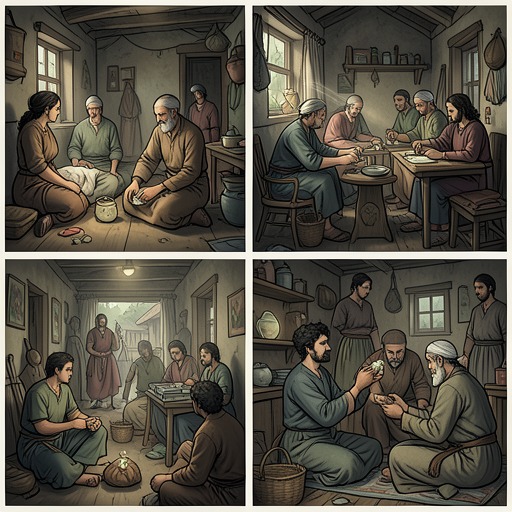
Wainamoinen responds by preparing a healing space. He heats the bath-rooms and the blocks of healing sandstone with magic wood from Northland. The cure is therefore not described as ordinary treatment set against supernatural illness; the materials and actions of healing also belong to a magical order. Heat, a prepared room, healing stone, and enchanted wood make the response concrete, while the broader conflict remains one power confronting another.
The episode concludes with Wainamoinen, the enchanter and wisdom-singer, expelling the nine diseases. This ending answers their earlier direction toward Kalevala with a counteraction: what had entered the community as a collective threat is driven out through the intervention of a named healer. The diseases are not merely endured or allowed to fade from view. Their removal confirms the poem’s account of them as agents susceptible to command and expulsion.
Narrative Significance
The supernaturalization of disease gives the epidemic a legible shape: ancestry explains where the threat comes from, naming distinguishes its members, and the healing episode supplies an effective response. The pattern turns sickness into a conflict that can be narrated and acted upon, while keeping the consequences communal. The golden-covered cradle and the heated healing stones mark opposite stages of that conflict: one attends the birth of the harmful powers, the other prepares the setting in which their influence is resisted.
The episode does not describe the sufferers’ individual experiences or distinguish the illnesses by symptoms. Its emphasis falls instead on the source and reach of the danger, and on Wainamoinen’s authority to end it. Disease is thus represented simultaneously as embodied affliction among the people and as an organized supernatural force with a parent, names, and a destination. Because the resolution is an explicit expulsion, the account settles firmly on a supernatural understanding of both illness and cure.